Clear Sky Science · en
Linked skyrmions in shifted magnetic bilayer
Magnetic Knots for Future Data Tech
Modern electronics increasingly relies on tiny magnetic patterns to store and process information. This research explores an advanced kind of magnetic pattern—called a “linked skyrmion”—that behaves like a knot in the fabric of magnetism. By cleverly stacking two ultra-thin magnetic layers with a slight sideways shift, the authors show how to create and control these intricate knots, opening a path to denser, more robust ways of handling data in future devices.
Twisted Whirls in Magnetic Films
In very thin magnetic films, the direction of tiny atomic magnets can twist into whirl-like shapes known as skyrmions. Each skyrmion carries a kind of “winding number,” a topological charge that counts how many times the spins wrap around. Most past work focused on simple skyrmions with charge one, treated as potential information bits because they are small, mobile, and stable against minor disturbances. This paper goes beyond those basic whirls to explore elaborate multi-skyrmion structures that can carry much larger topological charges, which in principle could encode more information in the same area.
Designing a Double-Layer Magnetic Playground
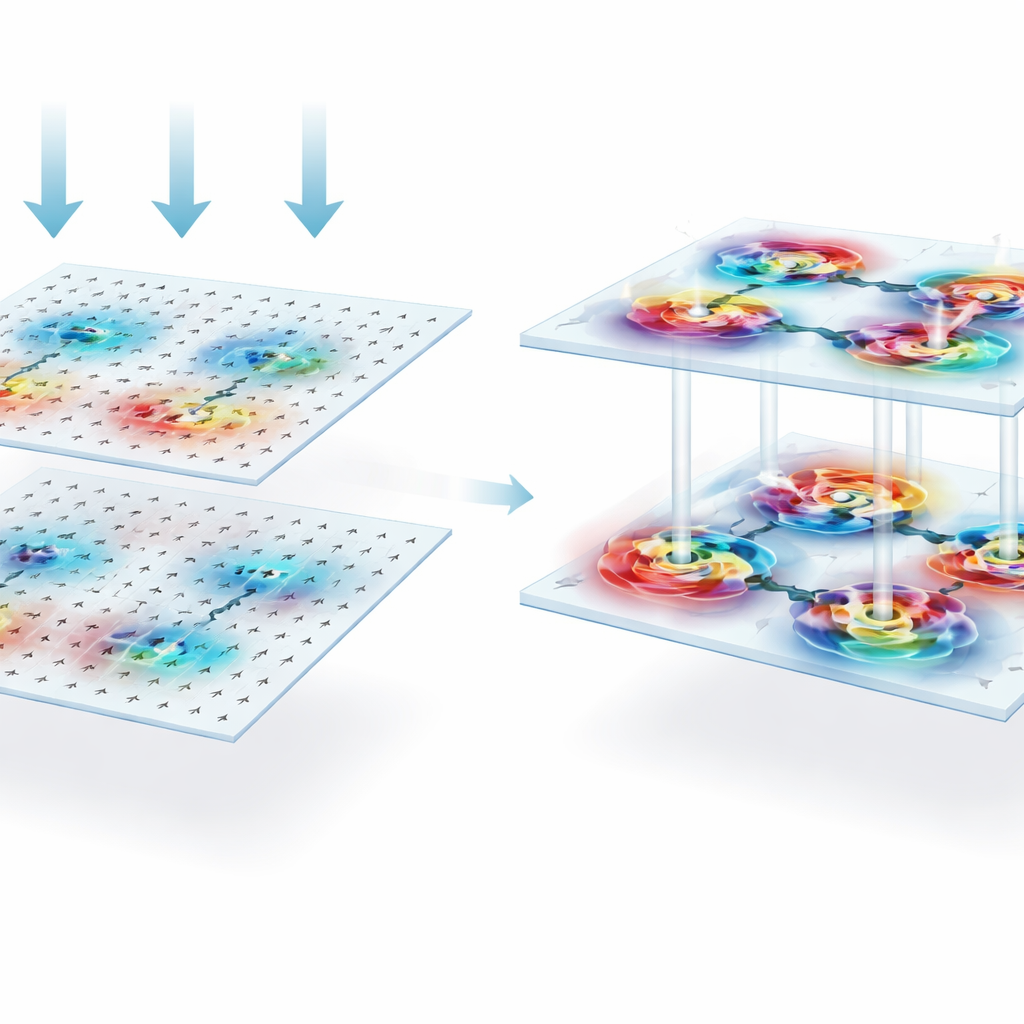
The authors propose a specific architecture: two magnetic layers arranged on square grids, one shifted half a lattice constant along both directions so the upper layer is offset from the lower like a zincblende crystal. Between them sits a non-magnetic spacer that provides strong spin–orbit coupling, which in turn generates a special twisting force on the spins known as the Dzyaloshinskii–Moriya interaction. Crucially, this twisting acts along one direction in the top layer and along a perpendicular direction in the bottom layer. By tuning how strongly the two layers are magnetically tied together, and by applying an external magnetic field perpendicular to the layers, the system can be driven through several distinct magnetic arrangements: checkerboard-like spirals, stripes, regular skyrmion lattices, and more complex knotted textures.
Linked Skyrmions and Hidden Point Defects
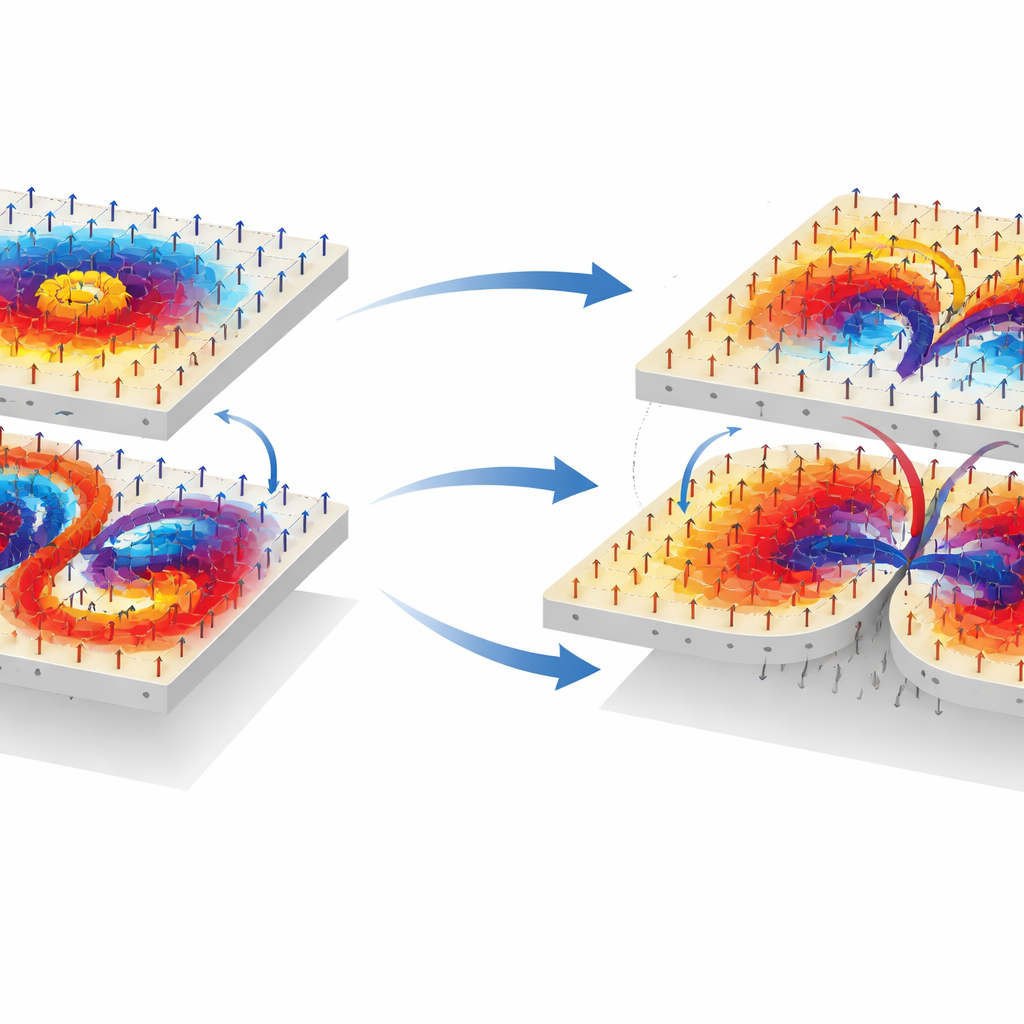
At weak coupling and low field, the two layers host spiral patterns whose overlap looks like a checkerboard when viewed from above. Within this pattern, there are special spots where the local magnetization in one layer is effectively opposite to what the interlayer coupling prefers. The authors call these anti-aligned points, and they show that such points behave as topological defects—singular locations around which the surrounding spins are arranged in a protected way. When the field and coupling are increased so that skyrmions appear, some of these anti-aligned points can survive, stitching together skyrmions in the two layers into “linked skyrmions.” In these objects, the total winding in the top and bottom layers need not match, and the difference between them defines the topological charge of the central point defect. Because one can combine many skyrmions around one or several such points, the system supports configurations with arbitrarily large total topological charge.
Other Composite Whirls and Real Materials
Alongside linked skyrmions, the same design also supports multi-skyrmion “bags” and ring-like patterns called kπ-skyrmions, where both layers carry the same winding and no point defects are present. These states can have positive, negative, or even zero net charge, forming a zoo of metastable magnetic creatures in roughly the same range of fields and couplings as the regular skyrmion lattice. To ground their model in reality, the authors perform detailed quantum-mechanical calculations for a thin-film structure made of nickel on an indium arsenide (InAs) substrate. They find that a Ni/InAs(001) bilayer naturally realises the required symmetry and twisting forces, and that realistic values of the interlayer coupling and magnetic field should stabilize linked skyrmions of technologically relevant size scales.
Why These Magnetic Knots Matter
The study shows that by shifting and coupling two magnetic layers with perpendicular twisting tendencies, one can reliably generate complex linked skyrmions with very high topological charge density. Because topological charge is closely tied to how these textures move in electric currents—affecting, for example, their sideways “Hall” motion and nonlinear response—linked skyrmions could offer stronger and more tunable signals than ordinary skyrmions. This makes them appealing building blocks for future magnetic computing schemes and ultradense memory, while the identified Ni/InAs system suggests that these exotic magnetic knots may be achievable in real materials rather than only in theory.
Citation: Ghosh, S., Katsumoto, H., Bihlmayer, G. et al. Linked skyrmions in shifted magnetic bilayer. Commun Phys 9, 104 (2026). https://doi.org/10.1038/s42005-026-02533-7
Keywords: magnetic skyrmions, topological solitons, spintronics, magnetic bilayers, skyrmion-based memory