Clear Sky Science · en
Superconductivity of bad fermions and the origin of two gaps in cuprates
Why strange electrons matter for future technologies
High-temperature superconductors made from copper oxides (cuprates) can carry electricity without resistance at temperatures far above those of conventional superconductors, yet their inner workings remain puzzling. Experiments show that these materials host not just one, but two distinct energy gaps in their electronic spectra, along with oddly behaving “bad” electrons that seem to defy the simple rules of metals. This paper uses advanced computer simulations of a simplified model to explain how these bad electrons, local magnetic tendencies, and superconductivity are all tied together, and why they might actually help, rather than hinder, the formation of a superconducting state.
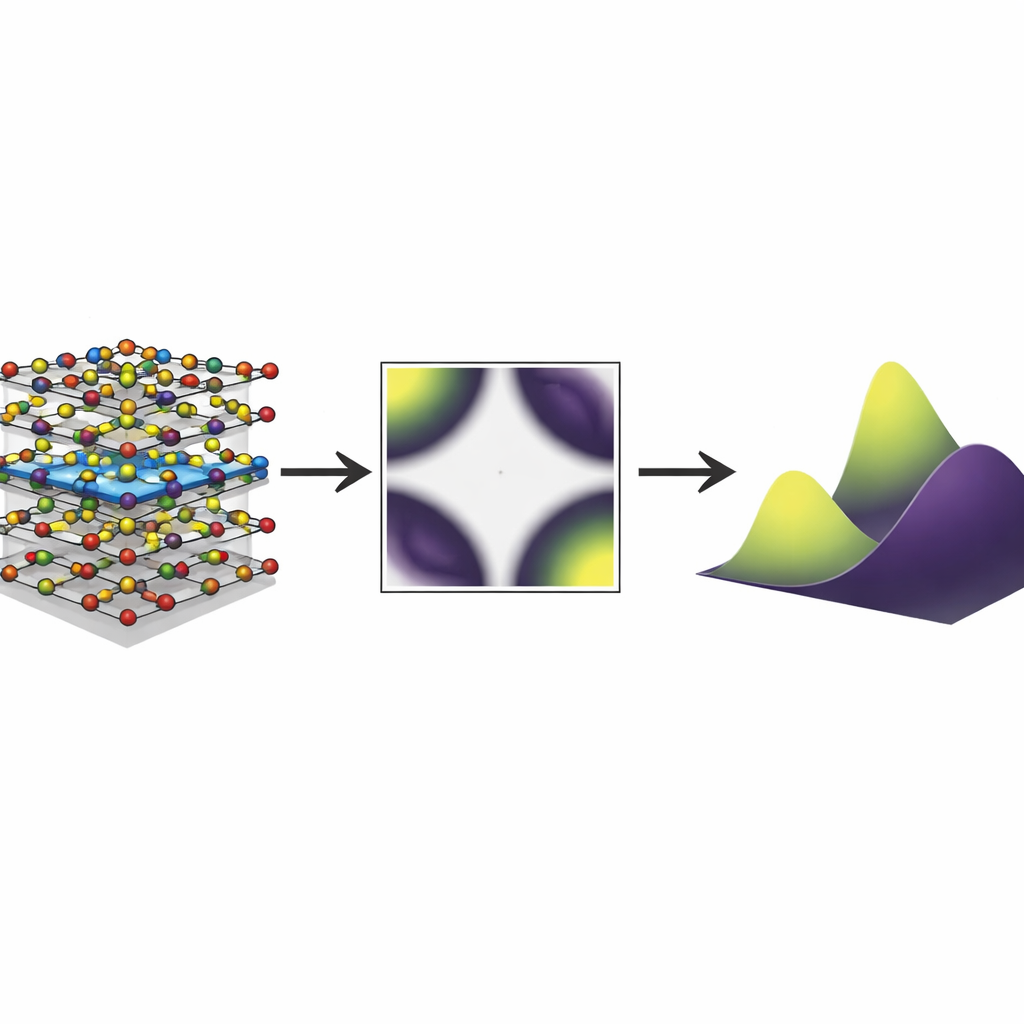
From simple model to complex cuprate behavior
The authors focus on a widely used theoretical description of cuprates called the t–t′ Hubbard model, which captures electrons moving and repelling each other on a square lattice mimicking a copper-oxide layer. A key ingredient is an extra “next-nearest-neighbor” hopping path, t′, whose magnitude and sign are known from realistic calculations to correlate with high transition temperatures in actual cuprate compounds. By tuning t′ to values characteristic of materials with transition temperatures around 100 K and choosing an interaction strength consistent with prior studies, they explore how the electronic spectrum evolves as electrons are removed (hole doping) from a strongly insulating parent state.
Bad electrons and the birth of a pseudogap
Using a strong-coupling Green’s function expansion built on top of a numerically exact quantum Monte Carlo solution of an antiferromagnetic Mott insulator, the authors track how the spectrum changes when the system is doped to about 15 percent holes. They find that the once broad, high-energy Hubbard bands give way to a much more intricate structure: a very flat electronic band appears near special “antinodal” points in momentum space, and a partial depletion of spectral weight—the pseudogap—opens there. Electrons in these regions become heavy and poorly defined, earning the nickname “bad fermions,” while electrons near the “nodal” directions remain light and coherent, behaving more like those in an ordinary metal. This nodal–antinodal dichotomy closely mirrors what angle-resolved photoemission experiments see in real cuprates.
Two gaps from one intertwined mechanism
To probe superconductivity, the team adds a small external d-wave pairing field and computes the Nambu Green’s functions, which describe both normal and paired electrons. The normal component shows the pseudogap concentrated at the antinodes, while the anomalous component—associated with superconducting pairing—develops a pronounced d-wave pattern that is strongest between nodal and antinodal regions and vanishes exactly at the nodes. Crucially, the superconducting response is reduced where the pseudogap is deepest, but not eliminated. This naturally produces two distinct gaps: a larger pseudogap tied to bad electrons at the antinodes, and a superconducting gap whose maximum is shifted away from those regions, in agreement with the “two-gap” phenomenology seen in spectroscopy and tunneling measurements.
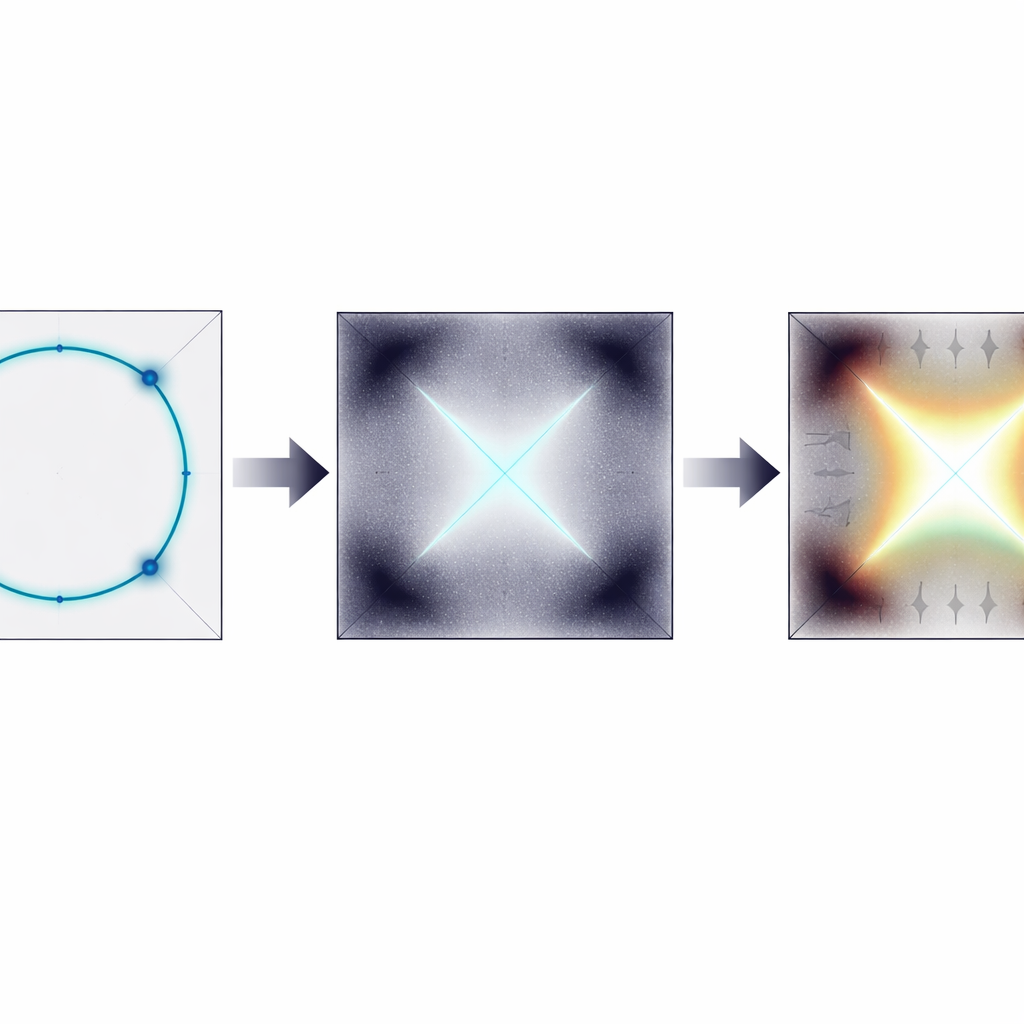
Local magnetic bonds as an invisible helper
To uncover what drives the pseudogap and how it feeds back on superconductivity, the authors perform a complementary analysis with another advanced method (D-TRILEX) that separates the roles of ordinary spin fluctuations and more localized magnetic moments. By introducing an effective static antiferromagnetic “Higgs” field into this framework, they mimic the formation of short-range singlet bonds between neighboring spins—similar to the resonating valence bond (RVB) picture proposed long ago by Philip Anderson. They find that when these local moments and their antiferromagnetic correlations are included, the pseudogap appears and the superconducting response is significantly boosted. When the pseudogap is allowed to influence only the normal electrons, it indeed suppresses pairing, but when it also contributes directly to the pairing channel, the net effect is to enhance superconductivity by more than half compared with spin fluctuations alone.
What this means for understanding cuprates
In everyday terms, the work supports the idea that the very electrons that misbehave in the normal state—refusing to act like simple quasiparticles and instead forming heavy, partially gapped “bad” states—are also the ones that help glue superconducting pairs together through their short-range magnetic bonds. The extra hopping path t′ in the copper-oxide plane not only shapes the electronic landscape near a van Hove singularity, but also strongly increases the tendency of holes to bind in pairs. Together, these effects provide a microscopic route to the two-gap structure of cuprates and clarify how pseudogap physics, bad fermions, and high-temperature superconductivity can arise from the same underlying strong-coupling mechanism.
Citation: Stepanov, E.A., Iskakov, S., Katsnelson, M.I. et al. Superconductivity of bad fermions and the origin of two gaps in cuprates. Commun Phys 9, 91 (2026). https://doi.org/10.1038/s42005-026-02532-8
Keywords: high-temperature superconductivity, cuprates, pseudogap, Hubbard model, d-wave pairing