Clear Sky Science · en
Experimental evidence for granular shear-flow instability in the Epstein regime
Dust, gas, and the birth of planets
How do clouds of tiny dust grains swirling around young stars eventually build planets? Astronomers think that the way dust and gas move together in these disks can trigger waves and whirlpools that clump material, but this happens in conditions that are hard to recreate on Earth. This study reports a rare laboratory experiment carried out in microgravity that mimics a small piece of a planet-forming disk, revealing that a simple stream of gas loaded with fine dust can spontaneously develop a shear-flow instability—an internal, wave-like motion that could help shape newborn planetary systems.
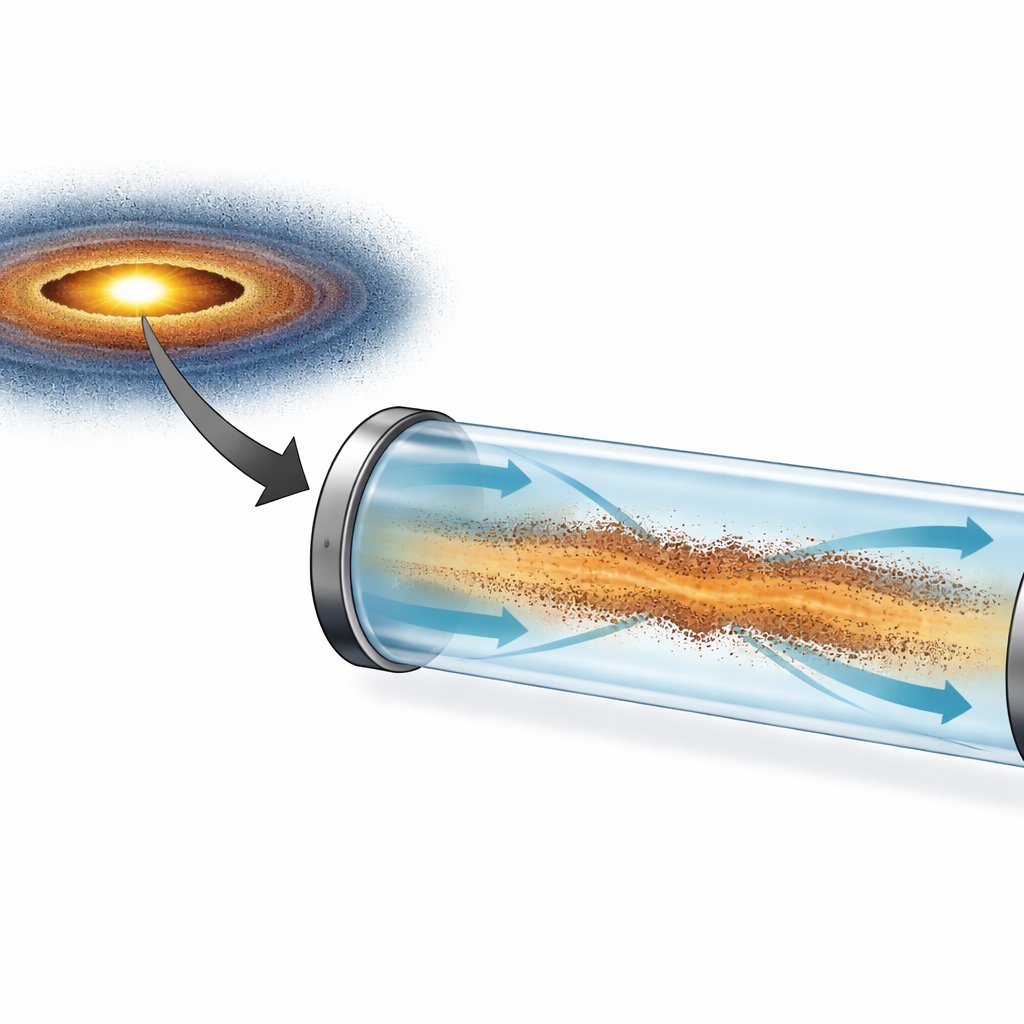
Recreating a slice of a planet-forming disk
In space, dust grains float in gas that is so thin that individual molecules travel long distances before colliding. In this so‑called Epstein regime, drag on dust works differently than in everyday air or water, and gravity in disks gently pulls dust into dense midplane layers. Because telescopes cannot directly see how dust and gas swirl together on small scales, the authors built a dedicated experiment to reproduce the essential ingredients under controlled conditions. Their TEMPus VoLA apparatus is a one‑meter‑long, eight‑centimeter‑wide cylinder in which air flows gently at very low pressure while a stream of 10‑micrometer silica grains is injected along the tube’s center line during brief periods of weightlessness on parabolic flights.
Turning dust into a temporary “fluid”
At first, individual grains start at rest and are dragged along by the moving gas. If the grains simply behaved as isolated passengers, they would quickly match the gas speed and continue downstream in a smooth, laminar flow. Instead, when many grains are present, their collective inertia pushes back on the gas: the dust‑rich central layer slows down while the dust‑poor gas near the walls keeps its original speed. In effect, the mixture acts like two superposed fluid layers of different density and velocity. Theory predicts that such shear layers are prone to Kelvin–Helmholtz–type instabilities, familiar from the rolling waves seen where air masses slide past each other in Earth’s atmosphere. Detecting this behavior in the experiment would confirm that the dust ensemble behaves like a fluid and that mutual drag alone can generate unstable flow.
Watching patterns emerge in microgravity
To track the motion of the grains, the team illuminated a thin slice of the tube with a laser sheet and used high‑speed cameras to record successive images at 1,000 frames per second. Using particle image velocimetry, they reconstructed two‑dimensional velocity fields of the particle phase. Instead of a uniform stream, they observed alternating regions of upward and downward motion above and below the midline, along with localized spinning structures. Measurements of the divergence showed that, on average, the flow was nearly incompressible, yet clearly departed from simple laminar motion. By examining the vertical velocity along the midline, the researchers found sinusoidal, wave‑like patterns whose wavelength clustered around about 3 centimeters—the smallest scale at which coherent features persisted and grew.
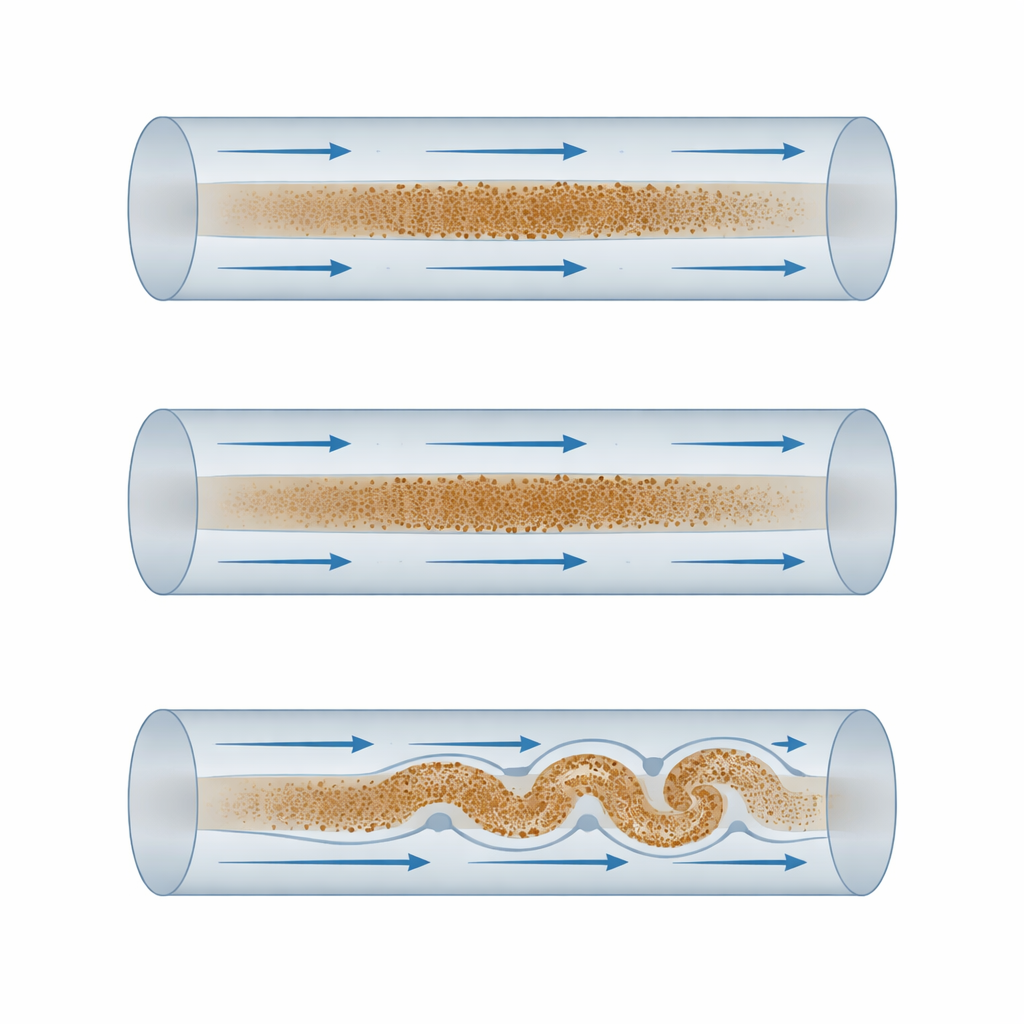
Decoding the waves and testing theory
The authors then analyzed how these waves evolved over time using a Morlet wavelet transform, which reveals how different oscillation frequencies appear and fade. Early in the run, the velocity field contained strong, high‑frequency oscillations in the few‑hundred‑hertz range; as time progressed, power shifted towards lower frequencies and larger structures, suggesting the system was moving from simple ripples to more complex patterns without yet reaching fully developed turbulence. Using a standard dispersion relation for Kelvin–Helmholtz waves, and numerical solutions of the coupled dust–gas momentum equations, they showed that the observed wavelengths and frequencies are consistent with a shear instability in a dust‑laden layer whose mass density is comparable to that of the surrounding gas. The inferred dust‑to‑gas ratio and particle stopping times agree with independent estimates from the experiment’s design and diagnostics.
Why these waves matter for planet formation
By demonstrating that a dust‑rich stream in rarefied gas can, by drag alone, excite a Kelvin–Helmholtz‑like instability in the Epstein regime, this work provides direct experimental support for the “two‑fluid” models widely used to describe dust dynamics in planet‑forming disks. It shows that dust is not merely a passive passenger in a gaseous disk: once present in sufficient concentration, it can slow the local gas, create sharp velocity contrasts, and seed turbulence and vortices that redistribute material. Such dust‑driven shear instabilities may help stir the midplanes of disks, influence where solids concentrate, and contribute to the mysterious turbulence that allows gas to spiral inward and planets to grow. The experiment therefore offers a concrete laboratory benchmark for theories of planetesimal formation and opens the door to future microgravity studies that follow the instability all the way from first ripples to fully turbulent mixing.
Citation: Capelo, H.L., Bodénan, JD., Jutzi, M. et al. Experimental evidence for granular shear-flow instability in the Epstein regime. Commun Phys 9, 88 (2026). https://doi.org/10.1038/s42005-026-02531-9
Keywords: planet formation, dust gas interactions, shear instability, protoplanetary disks, microgravity experiments