Clear Sky Science · en
Learning hadron emitting sources with deep neural networks
Peering Inside Tiny Cosmic Fireworks
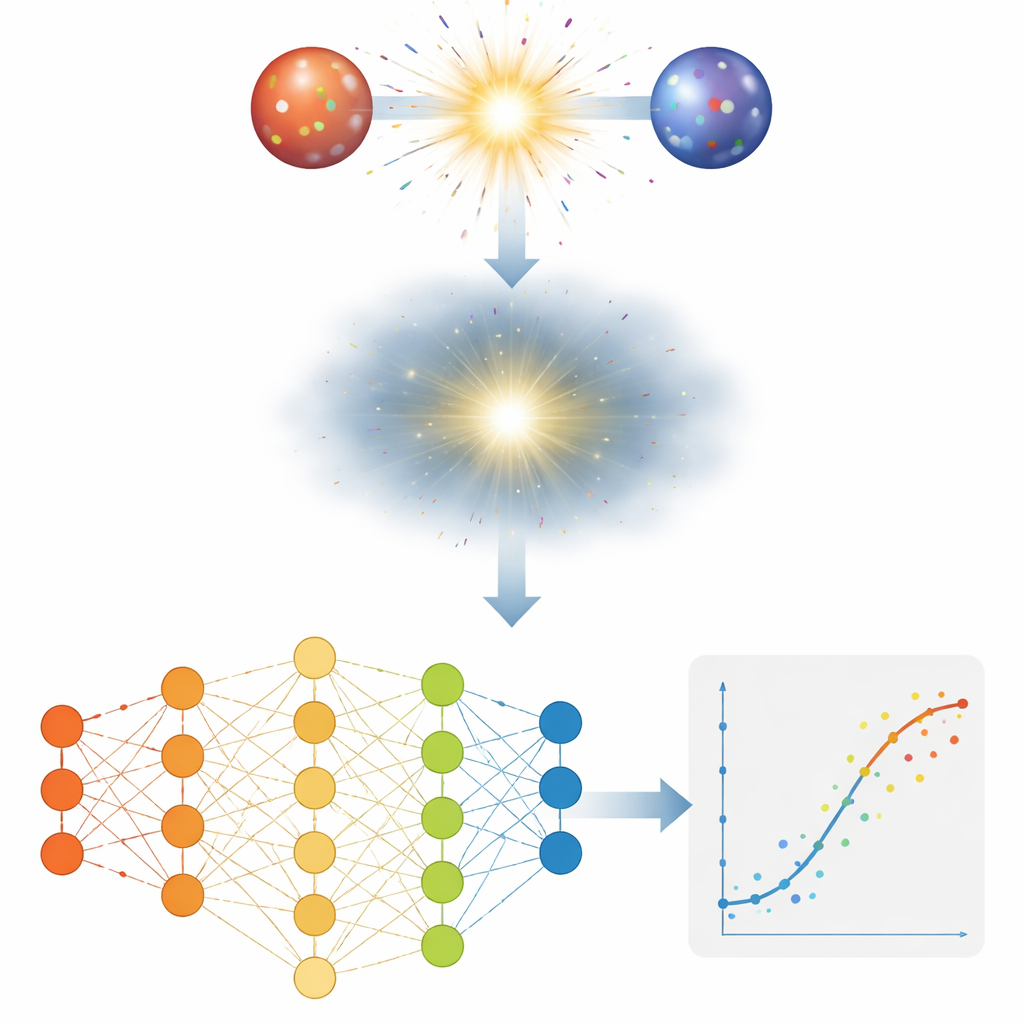
When protons slam into each other at nearly the speed of light, they create a tiny, short‑lived fireball of new particles. Hidden inside this subatomic burst is information about one of nature’s most fundamental forces: the strong force that glues matter together. This paper shows how modern deep‑learning techniques can read subtle patterns in the data from these collisions to reveal where, and how, particles are born—offering new clues about the behavior of matter in extreme environments such as neutron stars.
Why Tiny Distances Matter
The strong nuclear force binds protons and neutrons in atomic nuclei and shapes everything from ordinary atoms to the dense cores of dead stars. Physicists have mapped the force between two protons fairly well, using decades of scattering experiments and theoretical models. But interactions involving more exotic particles, such as hyperons (which contain strange quarks), remain much more uncertain. These rare particles are hard to study directly, yet they have an outsized impact on how matter behaves at extreme densities. To learn about them, researchers turn to high‑energy collisions in accelerators, where fleeting pairs of particles are produced in abundance.
Using Quantum Ripples as a Microscope
In these experiments, scientists do not see the birthplaces of particles directly. Instead, they measure how often pairs of particles emerge with different relative momenta—essentially how strongly their paths are correlated. A technique called femtoscopy, inspired by an idea from radio astronomy, connects these correlations to both the forces between the particles and the shape of the region from which they are emitted. Traditionally, analyses assumed that this emission region looked like a smooth, bell‑shaped cloud. However, earlier studies hinted that reality is messier: decays of short‑lived intermediate particles can create long “tails” far from the center, meaning the true source may be far from bell‑shaped.
Letting the Data Draw Its Own Picture
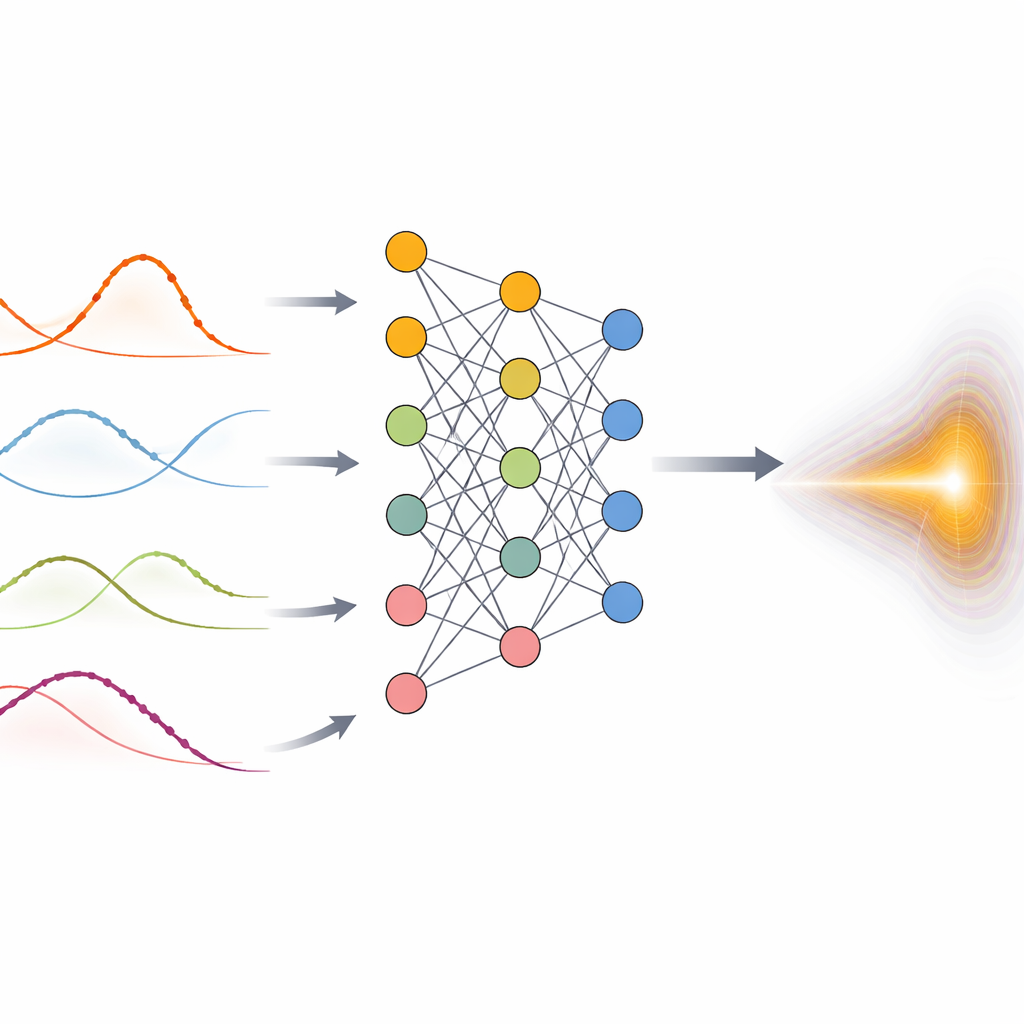
The authors build a new, data‑driven way to infer the emission region without presupposing its shape. They start from well‑tested models of the proton–proton force and use them to compute how a hypothetical source would affect the observed correlations. Instead of choosing a simple formula for the source, they represent it with a deep neural network that takes distance as input and outputs the probability that a proton pair originates at that separation. By automatically differentiating through the full calculation, they adjust the network’s internal parameters so that the predicted correlation curve matches the experimental measurements as closely as possible, while enforcing basic physical requirements such as smoothness and non‑negativity.
Finding a Long‑Tailed Birthplace
When this neural‑network‑based source is compared with the conventional bell‑shaped model, it gives a dramatically better description of the proton–proton correlation data from the Large Hadron Collider. The recovered source has a pronounced long‑range tail: most protons are still born in a compact central region, but a significant fraction appear to come from much larger distances. This pattern fits naturally with the idea that many protons are created indirectly, via short‑lived resonances that travel some distance before decaying. Crucially, the network uncovers this structure directly from the data, without the researchers having to guess which resonances are involved or how many there are.
Probing Strange Matter with a New Lens
Because hyperons and protons are similar in mass and quark content, the team can reuse the learned proton emission profile to analyze proton–hyperon pairs. By combining the data‑driven source with a model for the proton–Lambda force, they find that the experimental correlations favor a relatively shallow attractive potential—consistent with early results from first‑principles lattice simulations of quantum chromodynamics. This approach thus offers a new, largely assumption‑free way to constrain poorly known interactions in the strong sector. In plain terms, the study shows that deep learning can turn subtle quantum ripples into a clear image of where particles are born, sharpening our view of the strong force and paving the way for future three‑dimensional maps of the particle‑emitting region in heavy‑ion collisions.
Citation: Wang, L., Zhao, J. Learning hadron emitting sources with deep neural networks. Commun Phys 9, 90 (2026). https://doi.org/10.1038/s42005-026-02530-w
Keywords: strong nuclear force, deep learning, high-energy collisions, femtoscopy, hyperon-nucleon interaction