Clear Sky Science · en
Phase retrieval via gain-based photonic XY-Hamiltonian optimization
Turning Blurry Light into Clear Pictures
Many of the sharpest images in modern science are created in a roundabout way: detectors measure only the brightness of light scattered from a sample, but not its phase, which encodes crucial shape and structure. Reconstructing full images from this incomplete information, a task called phase retrieval, is notoriously difficult for conventional computers. This paper shows how to reframe that challenge as a problem a special class of light-based devices is naturally good at solving, opening a route to faster and more energy‑efficient imaging in fields ranging from X‑ray crystallography to astronomy.
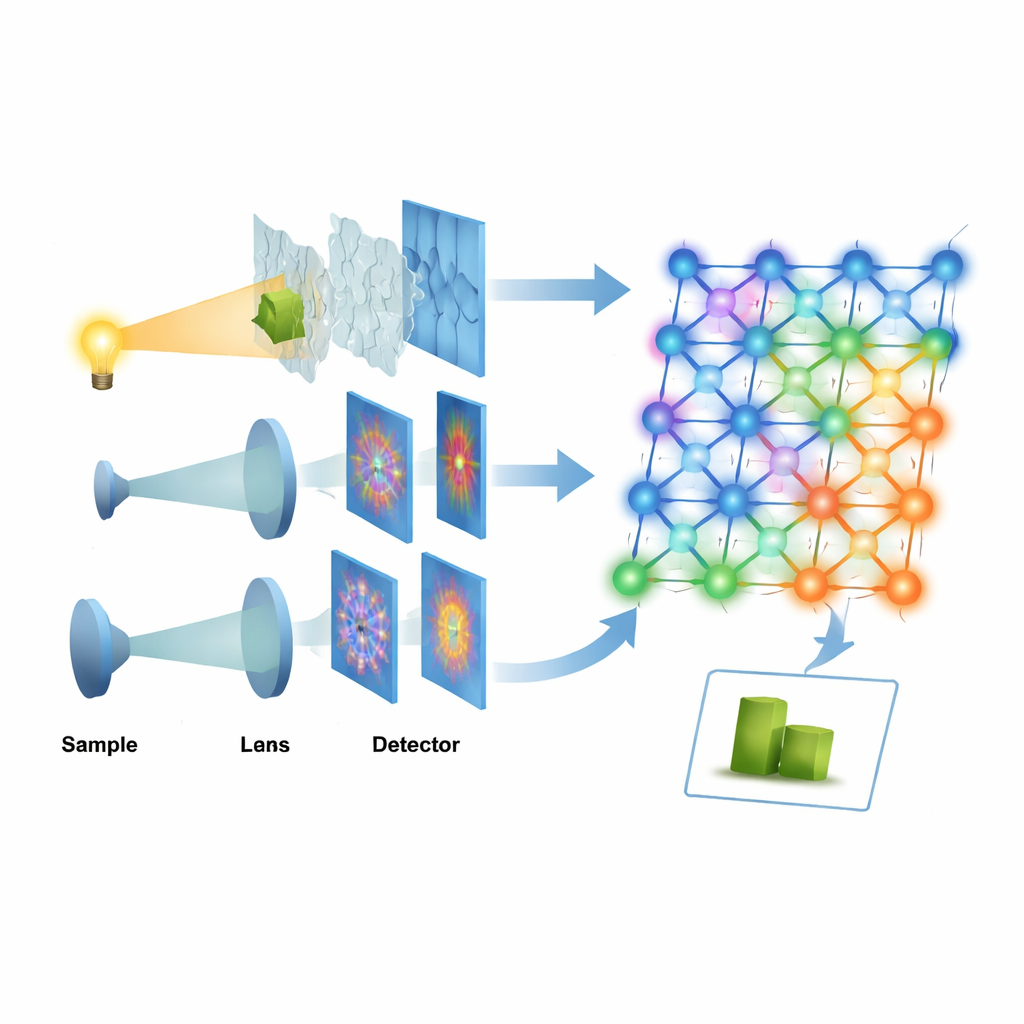
Why Losing Half the Information Is a Big Deal
When X‑rays, electrons, or laser beams bounce off a sample, they form a complex wave described by both amplitude (how bright) and phase (where the wave’s peaks and valleys are). Standard detectors record only the amplitude, producing a diffraction pattern of intensities. Many different underlying objects can lead to the same pattern, so reconstructing the original object is like solving a puzzle with many possible answers. Mathematicians have shown that, in general, this is a very hard problem. Extra tricks are therefore needed to make the puzzle well posed and to avoid getting stuck in wrong solutions.
Making the Puzzle More Solvable with Random Screens
One powerful trick, known as coded diffraction patterns (CDP), is to send identical copies of the same wavefront through several different random phase screens before recording the intensities. Each screen scrambles the phase in a distinct way, effectively giving multiple views of the same hidden object. When enough such screens are used, theory guarantees that there is essentially one correct solution consistent with all the measurements. Earlier work showed that, in this setting, sophisticated digital algorithms can recover the object, but they remain computationally heavy and can still falter when measurements are noisy.
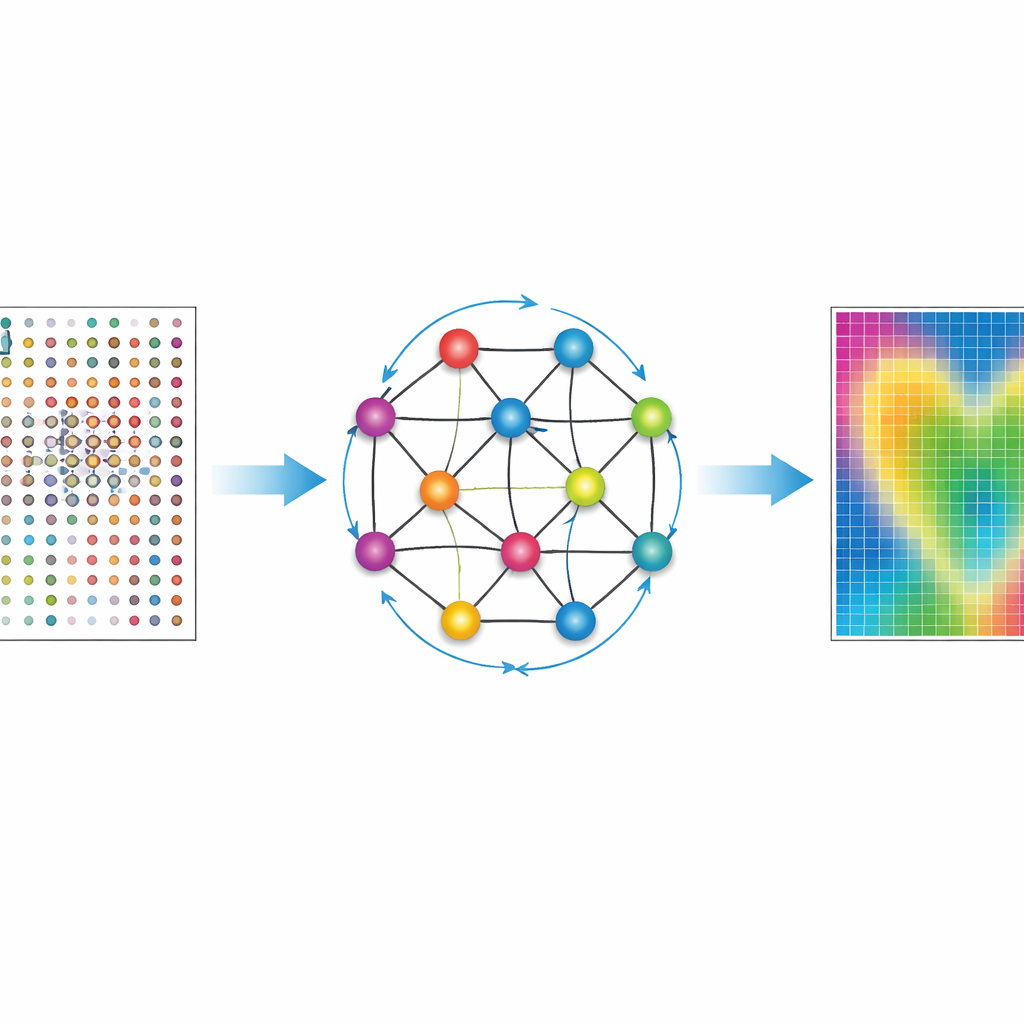
Letting Networks of Light Do the Hard Work
The authors show that the CDP phase‑retrieval task can be written exactly as minimizing the energy of a system in which many tiny arrows, or “spins,” can smoothly rotate in a plane. This is known as an XY Hamiltonian. Importantly, networks of coupled light oscillators—such as exciton‑polariton condensates, arrays of lasers, and spatial photonic Ising machines—naturally try to relax toward low‑energy states of exactly this type when their gain and loss are properly tuned. By mapping the experimental data onto the strengths of the couplings between these oscillators, the physical system itself becomes an analog computer that searches, in parallel, for the configuration of phases that best matches the measurements.
How Well the Light‑Based Solver Performs
Using detailed numerical simulations, the researchers compare this gain‑based photonic solver with one of the best current digital methods, the Relaxed‑Reflect‑Reflect (RRR) algorithm. They test both on simple real‑valued images and on fully complex wavefields, including two‑dimensional vortices, three‑dimensional vortex rings, and entirely random complex data. Across a wide range of problem sizes, and for several realistic types of noise—Gaussian, Poisson, and systematic offsets—the light‑inspired method consistently matches or beats RRR. Its advantage is clearest in the medium‑noise regime typical of many experiments: where the digital method starts to blur fine features, the gain‑based solver still recovers crisp structure and more accurate phases, and it maintains this edge even as the dimensionality of the problem grows.
From Theory to Fast, Practical Imaging
Because the optimization is performed by the continuous dynamics of the physical device, solving a phase‑retrieval problem boils down to waiting for the optical network to settle into a steady state. Existing and near‑future photonic platforms suggest that such relaxation could take microseconds to milliseconds, even for problems involving tens or hundreds of thousands of variables, all while consuming far less energy than a comparable digital computation. In plain terms, the work demonstrates that carefully engineered networks of light can act as powerful, specialized calculators for turning raw diffraction patterns into meaningful images, promising faster and more efficient reconstruction in applications from biological structure determination to real‑time monitoring of quantum fluids.
Citation: Wang, R.Z., Li, G., Gentilini, S. et al. Phase retrieval via gain-based photonic XY-Hamiltonian optimization. Commun Phys 9, 85 (2026). https://doi.org/10.1038/s42005-026-02525-7
Keywords: phase retrieval, photonic computing, coded diffraction patterns, analog optimization, imaging algorithms