Clear Sky Science · en
Complex frequency detection in a subsystem
Why hidden frequencies matter
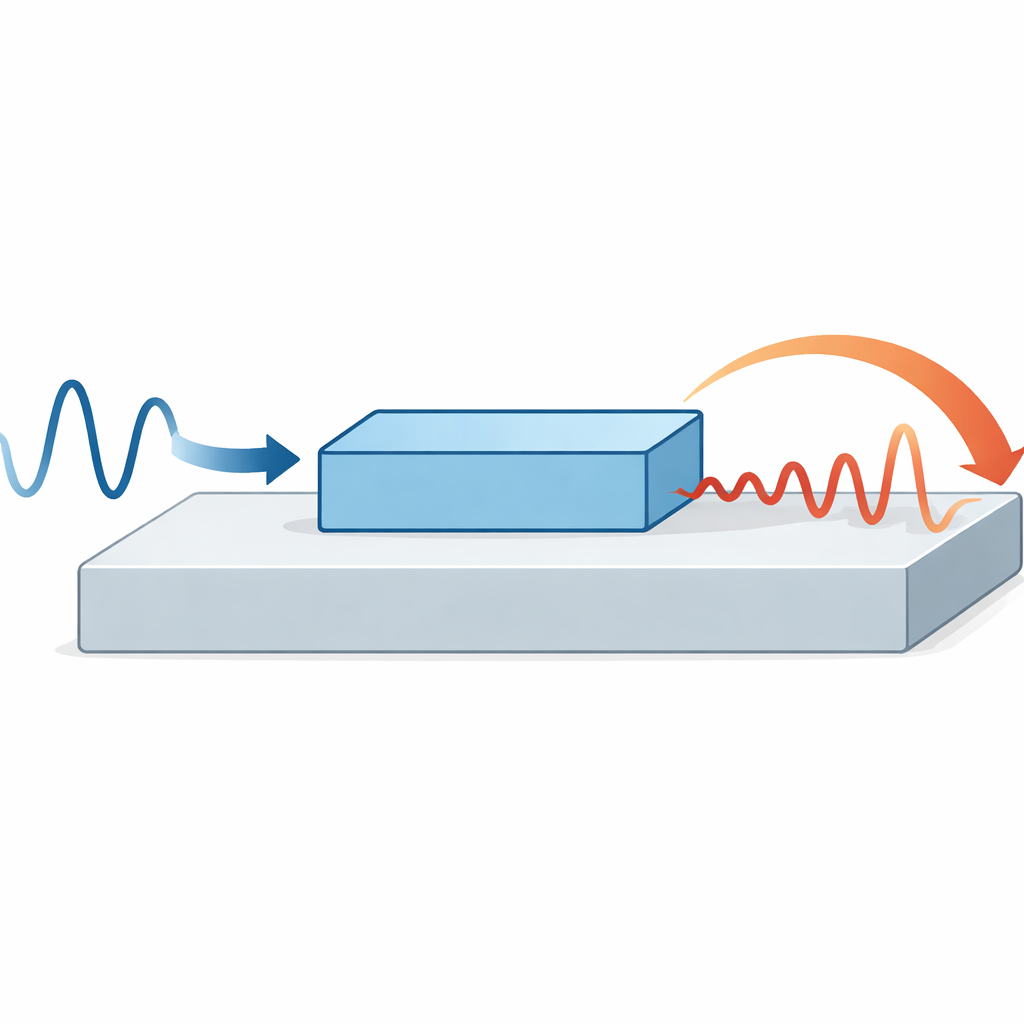
Modern physics increasingly relies on systems that lose energy, amplify signals, or send waves in one direction more easily than the other. These so‑called non-Hermitian effects underlie exotic behaviors such as waves piling up at the edges of a material instead of spreading evenly. Until now, most demonstrations have used classical setups—like light, sound, or electrical circuits—that are built to be leaky from the start. This paper tackles a tougher question: can such non-Hermitian behavior be uncovered inside a fundamentally conservative quantum system, and if so, how can we reliably detect it?
A small part in a larger world
The authors focus on a “subsystem” approach: instead of studying a full, complicated quantum material, they zoom in on a small region of interest and treat everything else as its environment. Mathematically, the environment leaves its mark through a quantity called the self‑energy, which depends on frequency—the rate at which the system is driven or oscillates. When this self‑energy is simplified to a constant, the subsystem can be described by an effective non-Hermitian Hamiltonian, a compact rulebook that allows unusual effects like the non-Hermitian skin effect, where many states crowd near one boundary. This constant‑self‑energy trick is widely used because it reproduces standard, real‑frequency measurements such as spectra and densities of states with impressive accuracy.
Where the common shortcut breaks down
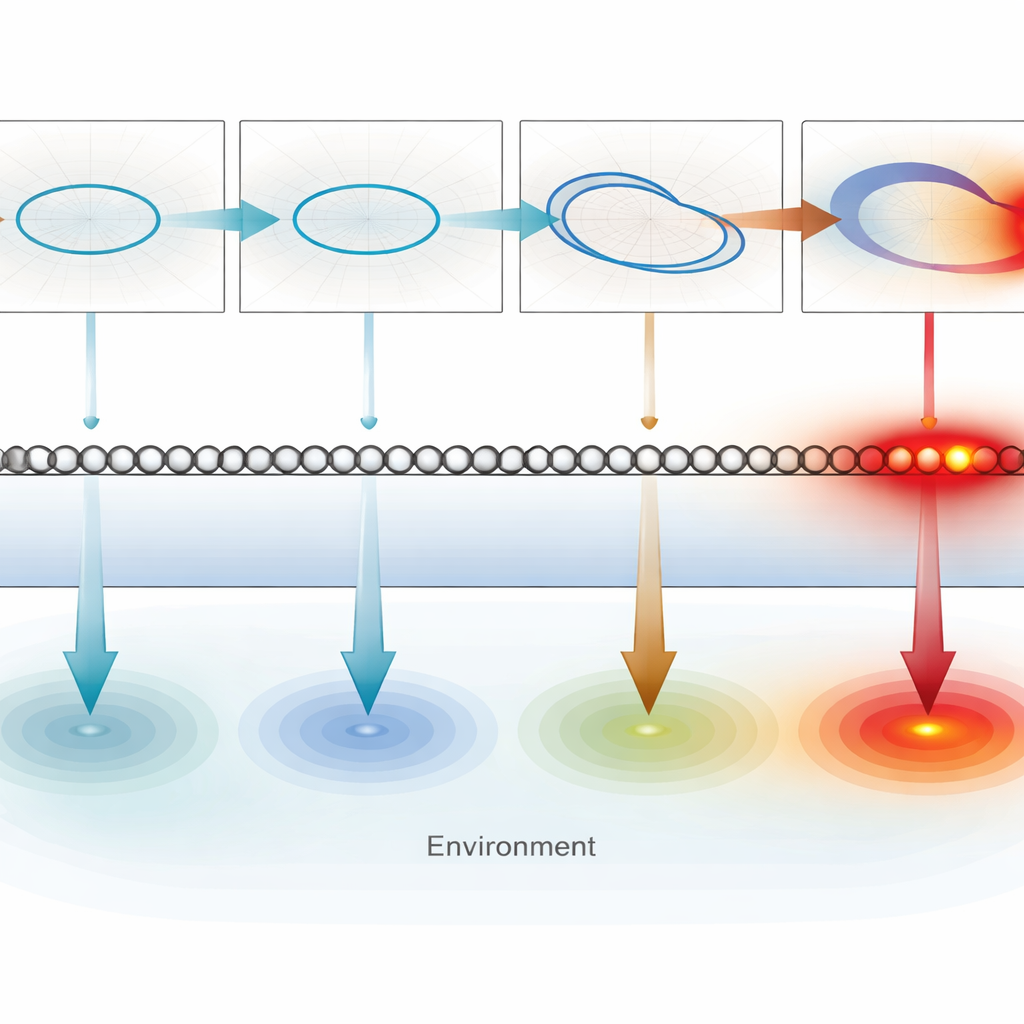
The work shows that this familiar shortcut, while excellent on the real‑frequency line, can be deeply misleading once one ventures into the full complex-frequency plane. To probe this, the authors introduce a concrete model: a one‑dimensional chain (the subsystem) coupled to a two‑dimensional environment with many degrees of freedom and a broad energy range. In this setting, they compare two descriptions: one using the exact, frequency‑dependent self‑energy and another using the usual constant approximation. On the real axis—where most experiments operate—the two views match almost perfectly. But away from that axis, the poles and singular features that shape the system’s response rearrange themselves: the approximate theory predicts closed loops associated with spectral winding and edge‑piled “skin” modes, while the exact theory instead develops a straight branch cut and no such winding.
Three ways to listen to complex tones
To connect these abstract differences to measurable signals, the authors analyze three experimental strategies that exploit complex frequencies. Complex frequency excitation drives the system with a waveform whose amplitude decays or grows in time, corresponding to a point in the complex plane. Complex frequency synthesis achieves the same effect by combining many ordinary drives at real frequencies, carefully weighted so that their superposition mimics a complex drive. In the long‑time limit, both protocols faithfully reproduce the exact complex‑frequency Green’s function of the subsystem—meaning they inherit its lack of edge‑biased, non‑Bloch behavior. In other words, these two methods cannot reveal the skin effect in a truly Hermitian system because, once treated exactly, the underlying spectral winding that would support it simply vanishes.
A new fingerprint for subtle edge effects
The third strategy, called complex frequency fingerprint, takes a different route. Instead of directly driving the system at complex frequencies, it uses only real‑frequency drives but processes the resulting data in a richer way. By exciting each site of the subsystem in turn with a steady harmonic tone, recording the full pattern of responses, and then assembling these into a response matrix, one can mathematically construct a “double‑frequency” Green’s function. This object depends on both the real driving frequency and an auxiliary complex frequency. Remarkably, for each chosen real drive, the double‑frequency description behaves as though the subsystem were governed by a non-Hermitian Hamiltonian frozen at that drive frequency. In that effective description, spectral loops and skin‑like, boundary‑localized responses reappear, and the complex frequency fingerprint can cleanly detect them, even though the full combined system remains fundamentally Hermitian.
What this means for future experiments
The study draws a clear map for researchers exploring non-Hermitian phenomena in quantum materials. Standard complex‑frequency excitation and synthesis faithfully report the true dynamics of a subsystem embedded in a larger, lossless world, and therefore may show no trace of edge‑piling skin modes even when a simple non-Hermitian model would suggest otherwise. In contrast, the complex frequency fingerprint method is specifically tuned to recover the effective non-Hermitian description that captures how the subsystem behaves within its environment. For experimentalists, this provides a principled way to design measurements that either avoid or purposely expose hidden non-Hermitian behavior. More broadly, the work demonstrates that non-Hermitian Hamiltonians can arise naturally and be probed rigorously inside quantum systems, but only if one chooses the right kind of “listening” to the system’s complex frequencies.
Citation: Huang, J., Hu, J. & Yang, Z. Complex frequency detection in a subsystem. Commun Phys 9, 84 (2026). https://doi.org/10.1038/s42005-026-02524-8
Keywords: non-Hermitian skin effect, complex frequency detection, quantum many-body systems, Green’s function, open quantum systems