Clear Sky Science · en
Electron-phonon-dominated charge-density-wave fluctuations in TiSe2 accessed by ultrafast nonequilibrium dynamics
Why Shimmering Waves of Electrons Matter
Many of today’s most intriguing materials, including high-temperature superconductors, behave in strange ways because their electrons and atomic lattice move in lockstep. One striking example is a “charge density wave,” a standing pattern of electrons that ripples through a crystal like frozen surf. This paper explores how such waves survive and fluctuate in the material 1T-TiSe2 at everyday room temperature, and what actually drives them. Understanding this hidden choreography of electrons and atomic vibrations could help scientists design new quantum materials with tunable conductivity, optical properties, or even superconductivity.
A Crystal with Hidden Patterns
In the compound 1T-TiSe2, cooling below about –73 °C (200 K) causes electrons to self-organize into a regular charge density wave (CDW). This ordered state rearranges both the electrons and the atomic lattice into a new, larger pattern. Even above this transition temperature, however, earlier experiments hinted that faint fragments of the CDW survive as short-lived, nanoscale “domains” that flicker in and out—so‑called CDW fluctuations. For nearly half a century, researchers have debated whether these fluctuations are mainly driven by electron–electron attraction (excitons, bound pairs of electrons and holes) or by the coupling between electrons and lattice vibrations (phonons). The answer matters because it shapes how the material responds to temperature, light, and doping, and how it might be steered into exotic phases, including unconventional superconductivity.
Freezing Motion with Ultrafast Snapshots
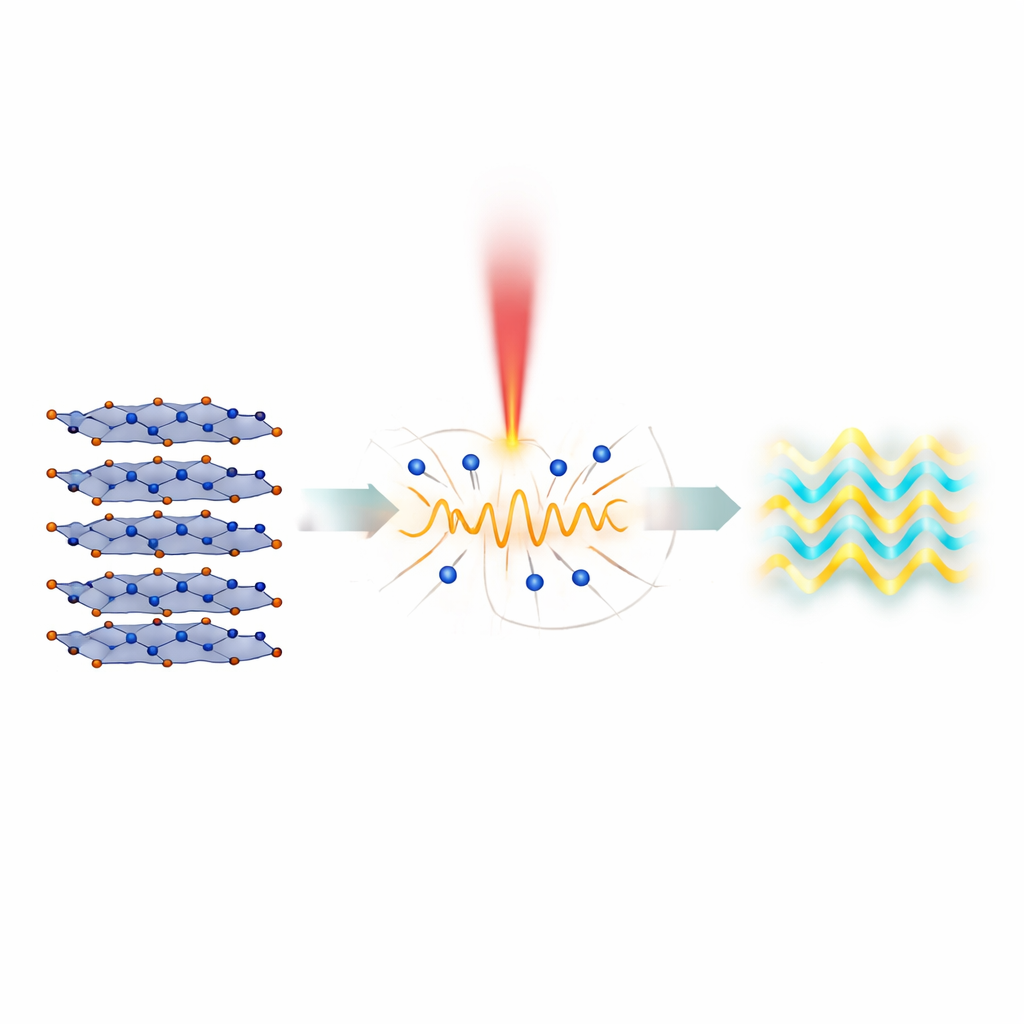
To watch these elusive fluctuations in real time, the authors used an advanced technique called time-resolved extreme-ultraviolet momentum microscopy. Very short infrared laser pulses first disturb the electrons in the crystal, while delayed extreme-ultraviolet pulses eject electrons whose energies and momenta are recorded over the entire surface Brillouin zone. By stitching together these snapshots at different delays, the team reconstructs a four-dimensional movie of how the electronic bands evolve after excitation. Even at room temperature, they clearly see a faint “backfolded” band—a key fingerprint of CDW order—showing that CDW-like correlations persist far above the nominal transition temperature.
Watching the Wave Melt and Rebuild
When the crystal is hit with a relatively intense laser pulse, the spectral weight of this backfolded band rapidly diminishes, revealing a partial melting of the CDW fluctuations on a timescale below 200 femtoseconds. Yet the feature does not disappear completely, even under strong excitation, and it recovers within about 700 femtoseconds. Crucially, the moment of strongest suppression does not coincide with the peak electronic temperature extracted from the data. Instead, it tracks the population dynamics of electrons in specific titanium 3d states and exhibits a characteristic delay of roughly 140 femtoseconds—about half a cycle of a particular lattice vibration. Superimposed on the recovery, the team detects long-lived oscillations at about 3.5 terahertz, corresponding to the so‑called amplitude mode of the CDW, in which atoms move in and out of the CDW pattern. Remarkably, this coherent lattice mode survives far above the transition temperature, acting like a ghost of the low-temperature ordered phase.
Vibrations Take the Lead
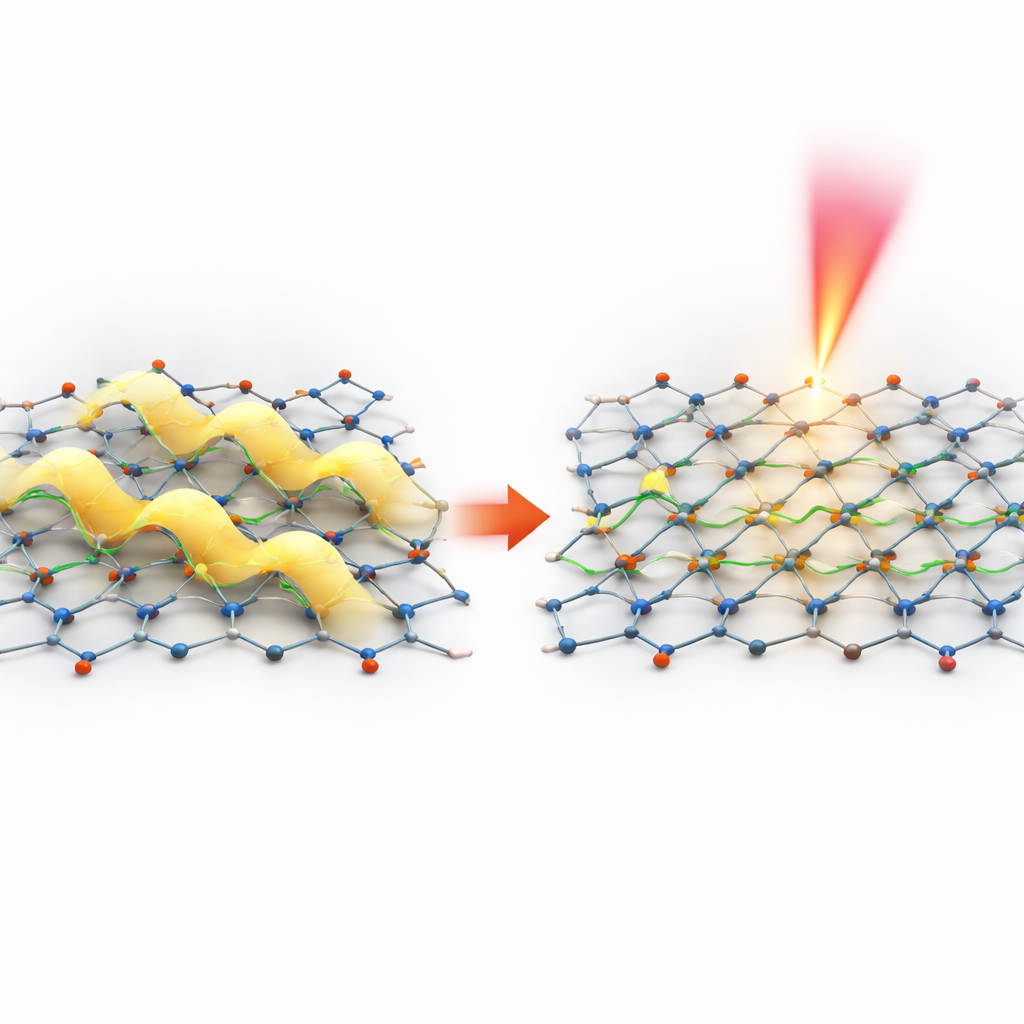
To disentangle the roles of electrons and lattice vibrations, the researchers performed detailed first-principles calculations including dynamical electron–phonon scattering, but deliberately excluding explicit electron–electron (excitonic) terms. Even without excitons, the computed electronic spectra reproduce the main experimental signatures: replica-like bands below the conduction band, loss of spectral weight in specific momentum regions, and their gradual disappearance at higher temperatures. The calculations show that these effects arise from a “soft” acoustic phonon mode at the M point of the Brillouin zone, which strongly couples selenium 4p and titanium 3d states just above the CDW instability. As temperature or photoexcitation increase, this soft mode hardens, weakening the electron–phonon scattering and thus quenching the CDW fluctuations—a behavior consistent with ultrafast diffraction measurements that track the same phonon in real space.
What This Means for Future Quantum Materials
Taken together, the ultrafast measurements and theory strongly indicate that at room temperature the fluctuating CDW in 1T-TiSe2 is dominated by electron–phonon coupling, with excitonic effects playing at most a supporting role. In simple terms, the lattice vibrations provide the scaffolding on which the fleeting charge pattern is built. This insight reframes the long-standing debate over the origin of the CDW in this material and clarifies why CDW-like fluctuations persist well above the transition temperature. More broadly, it suggests that similar phonon-driven fluctuations—and their associated “pseudogap” behavior—may be central to other quantum materials where charge order and superconductivity compete or coexist. By learning how to excite and manipulate these lattice modes with light, researchers may ultimately gain a powerful lever for steering materials into desirable electronic and optical states on ultrafast timescales.
Citation: Fragkos, S., Orio, H., Girotto Erhardt, N. et al. Electron-phonon-dominated charge-density-wave fluctuations in TiSe2 accessed by ultrafast nonequilibrium dynamics. Commun Phys 9, 86 (2026). https://doi.org/10.1038/s42005-026-02521-x
Keywords: charge density wave, electron phonon coupling, ultrafast spectroscopy, quantum materials, TiSe2