Clear Sky Science · en
Broadband nonlinear microresonator arrays enable topological second harmonic generation
Light That Refuses to Get Lost
Modern technologies from the internet backbone to quantum computers rely on guiding light through tiny circuits on a chip. But light is notoriously sensitive: a small defect or bump in a waveguide can scatter it away. This paper explores a new kind of optical chip where light can travel along the edges of a carefully engineered ring‑shaped lattice, barely noticing imperfections, while at the same time changing its color in a highly efficient way. Such devices could become key ingredients for future ultra‑fast, low‑power communication and quantum information systems.
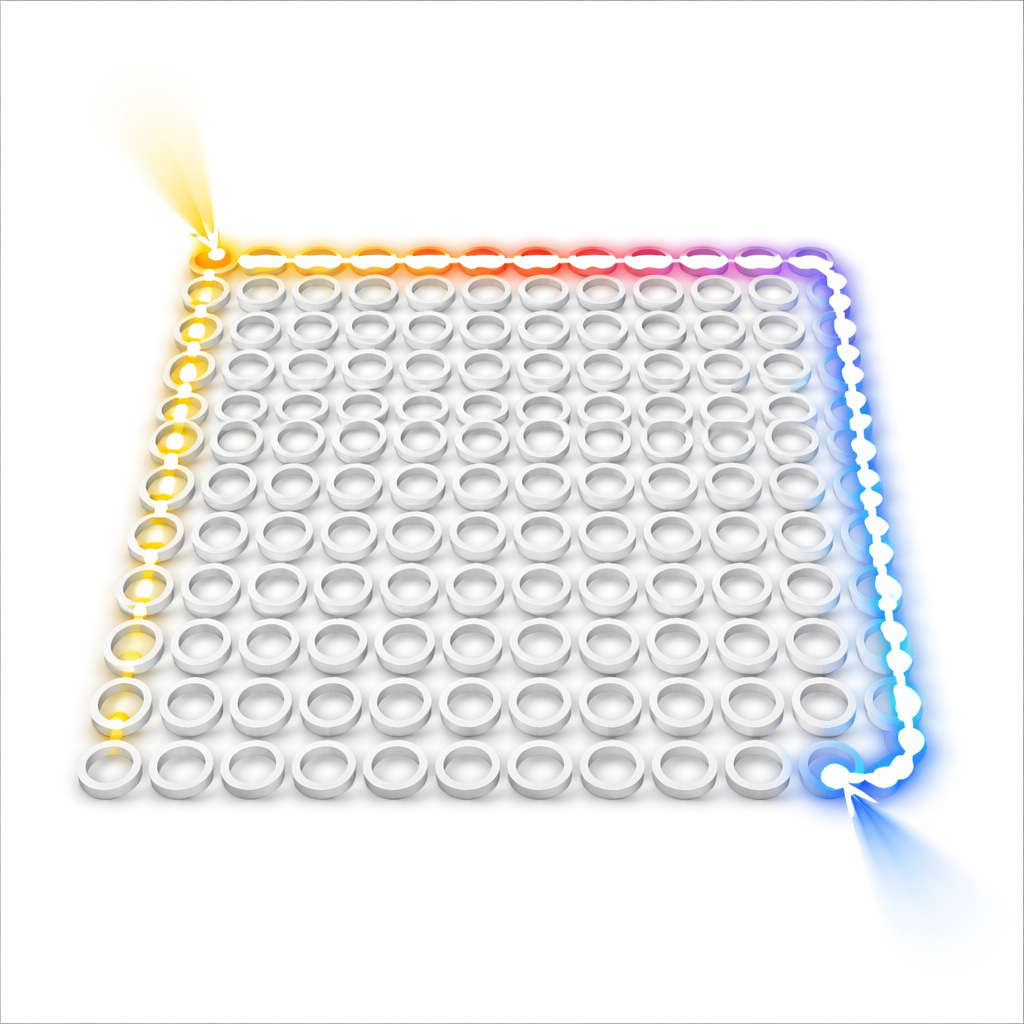
Rings on a Chip as Protected Pathways
The authors study a flat grid of microscopic ring resonators—tiny racetracks for light—arranged in an 8×8 square. Light normally sloshes around these rings in loops, but here the rings are coupled so that light collectively flows along the outer boundary of the entire grid. This edge pathway is “topological,” meaning its direction and robustness are set by deeper geometric properties of the system rather than by the exact details of each ring. As a result, light hugs the edges and keeps moving in one direction even if some rings are slightly off‑size or a few couplers are imperfect.
Turning Red Light into Blue Without Losing the Edge
A central goal is to take incoming light of one color (the “fundamental” frequency) and convert it into light at twice the frequency (the “second harmonic”) while both colors remain locked to these protected edge paths. Achieving this is tricky because the conditions that make the edge states topological generally differ at different colors. The team solves this by engineering a “dual‑frequency” design: the link rings between sites are made slightly longer, which builds in controlled phase delays for both colors. This careful tuning acts like a synthetic magnetic field for light, opening bandgaps and creating edge channels at both the original and doubled frequencies that line up in energy, a requirement for efficient color conversion.
Steering the Direction of the New Color
In this lattice, the material itself supports a special kind of optical nonlinearity that enables two photons of the original color to combine into one photon at double the frequency. The authors show that, once created, these higher‑frequency photons also inherit the edge‑hugging behavior. More intriguingly, by changing a parameter that controls the synthetic magnetic flux, they can flip a topological quantity known as the Chern number for the doubled‑frequency band. To a lay observer, this means the new color can be made to run clockwise or counterclockwise around the chip edge, independently of the pump’s direction, all while staying protected from scattering and defects.
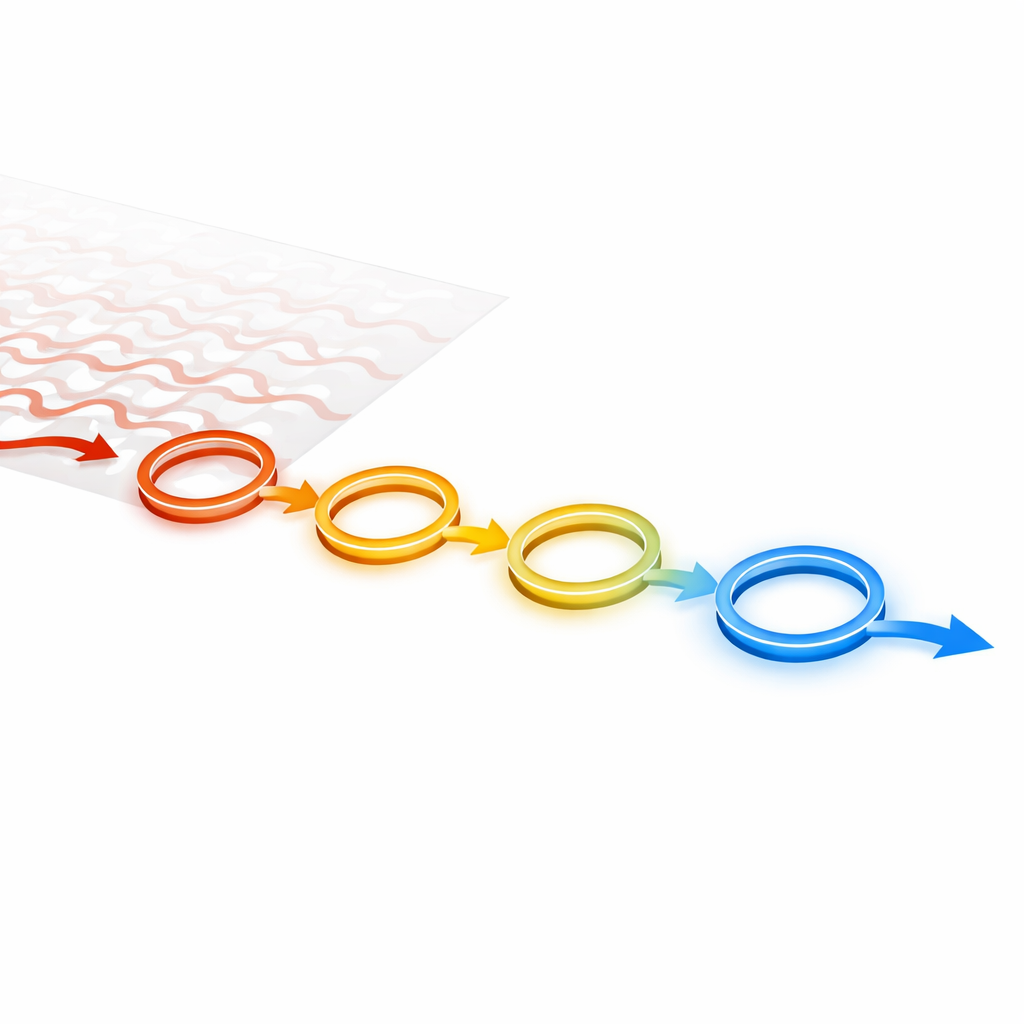
Making Frequency Conversion Stronger, Not Fragile
The team uses detailed simulations to compare this 2D edge‑guided design with a single isolated ring. In a conventional single ring, second‑harmonic generation works best only at very low pump powers; as the power climbs, the conversion saturates and can even become less efficient. In contrast, in the topological array the pump light spreads coherently over many rings along the edge. This collective behavior lets the system handle much higher powers before saturation, and the second‑harmonic output grows dramatically. Their calculations show more than a hundred‑fold boost in conversion efficiency compared with a single ring under comparable conditions, with the potential for even greater gains at higher powers.
Why This Matters for Future Photonic Chips
In plain terms, the paper introduces a blueprint for chips that can both protect light from getting scrambled and reshape its color very efficiently, with a built‑in “steering wheel” for the direction of the converted light. Because the design is compatible with emerging platforms such as thin‑film lithium niobate—already popular for fast modulators and quantum devices—it provides a practical route to optical diodes, logic elements, and sources of entangled photons that are resilient to fabrication flaws. By showing that this type of nonlinearity can live comfortably inside a topological setting across a broad range of colors, the work opens a path toward robust, reconfigurable photonic circuits for classical and quantum technologies.
Citation: Wang, R., Pan, Y. & Shen, X. Broadband nonlinear microresonator arrays enable topological second harmonic generation. Commun Phys 9, 79 (2026). https://doi.org/10.1038/s42005-026-02520-y
Keywords: topological photonics, microresonator arrays, second-harmonic generation, integrated photonics, quantum photonics