Clear Sky Science · en
Granular Ta-Te nanowire superconductivity exceeding the Pauli limit
Wires That Carry Current Without Resistance
Modern technologies from MRI scanners to quantum computers rely on superconductors—materials that can carry electric current without losing energy. But strong magnetic fields usually break superconductivity, limiting where these materials can be used. This study explores hair-thin wires made of tantalum and tellurium (Ta-Te) that become superconducting under pressure and keep working in magnetic fields that defeat most other superconductors, opening possibilities for more powerful magnets and compact devices.
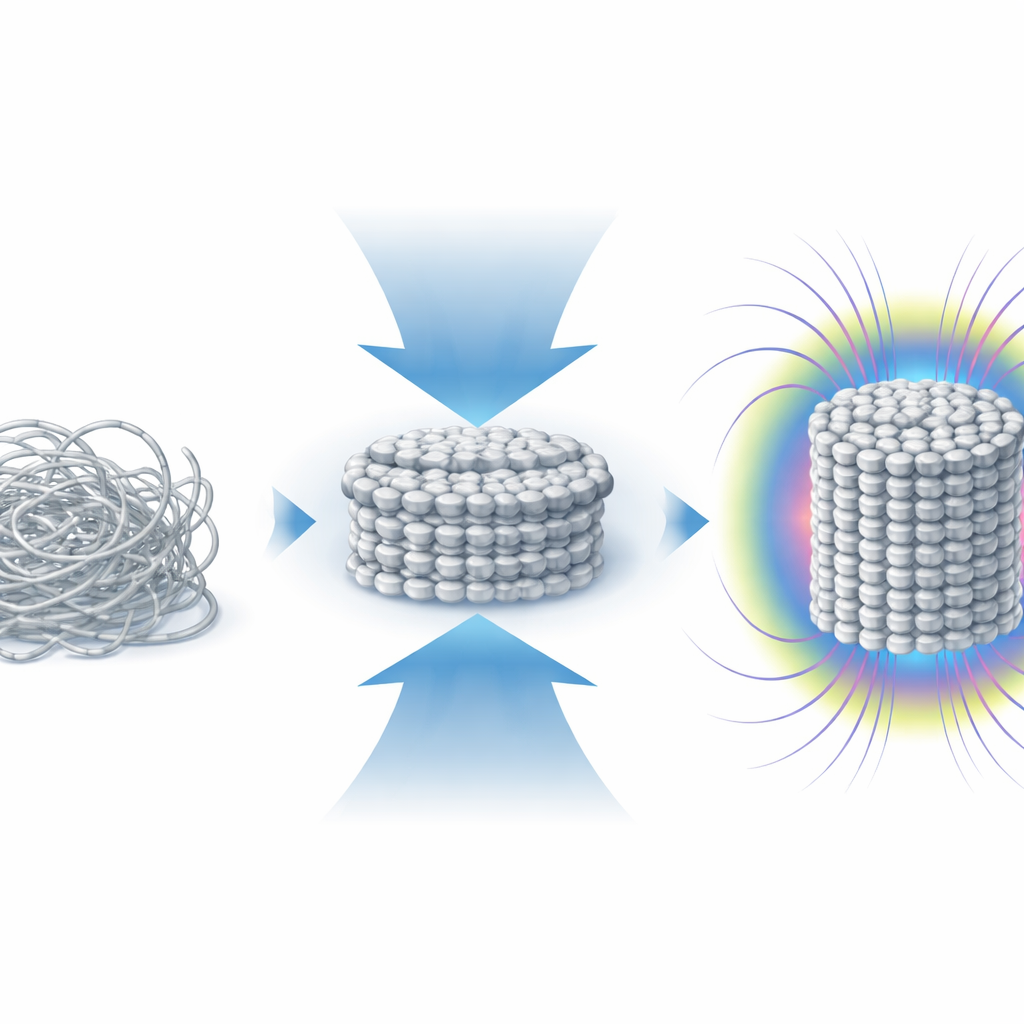
From Tangles of Fibers to a New Kind of Wire
The researchers grew Ta-Te nanowires using a vapor-based method, ending up with black, fiber-like bundles only tens of nanometers thick—thousands of times thinner than a human hair. Microscopy showed that each wire is not a smooth crystal but a chain of many tiny crystalline grains, about 10 nanometers across, joined together like segments of bamboo. Chemical mapping confirmed that tantalum and tellurium are spread evenly through the wires, and X-ray diffraction revealed that the grains share a crystal structure known from related materials, even though their orientations are randomly arranged.
Acting Like a Near-Insulator at Normal Conditions
When the team measured how easily electricity flowed through a single Ta-Te nanowire at normal pressure, they found an unusual behavior. As the temperature dropped, the resistance first decreased slightly, then rose sharply below about 200 kelvin, making the wire behave more like an insulator than a metal. Infrared measurements indicated only a tiny energy gap for electrons, and the way resistance increased at low temperature matched a model where electrons hop between localized regions in a one-dimensional, disordered system. This suggests that electrons are trapped by the granular, chain-like structure of the wire, inhibiting smooth current flow.
Squeezing Wires Until They Become Superconductors
To see how pressure changes things, the scientists compressed bundles of Ta-Te nanowires to over 50 gigapascals—hundreds of thousands of times atmospheric pressure—while tracking their electrical resistance from room temperature down to a few kelvin. With increasing pressure, the material gradually shifted from insulating to a poor metal. At around 10.6 gigapascals, the resistance suddenly dropped to zero at low temperature, signaling the onset of superconductivity. As the pressure rose further, the critical temperature where superconductivity appears formed a broad “dome,” peaking at about 4 to 5 kelvin before gradually decreasing again at the highest pressures tested.
Beating a Supposed Limit in Strong Magnetic Fields
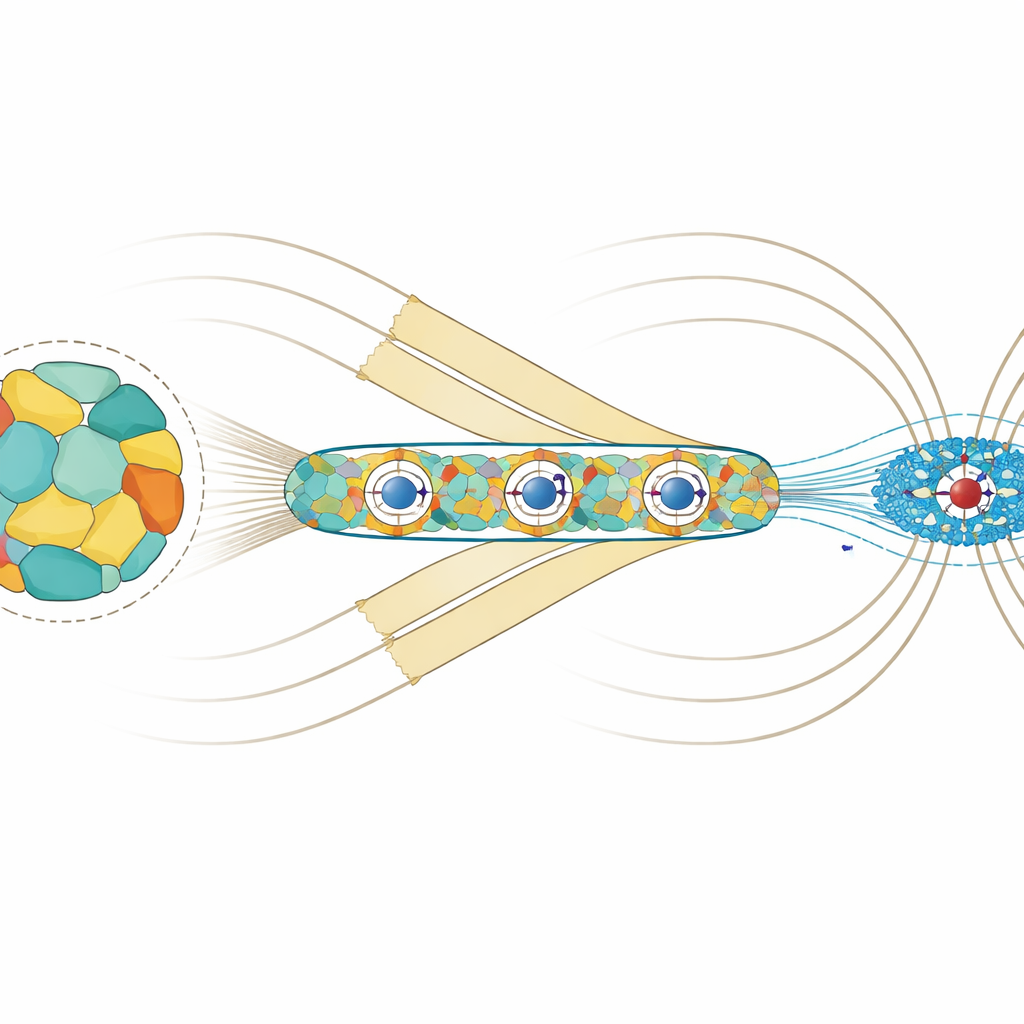
The standout feature of these Ta-Te nanowires is how well they withstand magnetic fields. At pressures near 20 to 30 gigapascals, the upper critical field—the field strength beyond which superconductivity is destroyed—reached about 16 tesla. For comparison, many superconductors are limited by the so-called Pauli limit, which ties the maximum field to the transition temperature. For the modest critical temperatures of these wires, the Pauli limit would predict about 7 to 8 tesla, so the wires endure roughly twice that value. Careful measurements at very low temperatures confirmed that this is not an artifact of the experiment but an intrinsic property of the material.
How Structure and Spin Help Break the Rules
The authors examined why these wires can so dramatically exceed the expected limit. Magnetic fields disrupt superconductivity in two main ways: by tugging on electron spins and by forcing their orbits into patterns that spoil the paired state. In a standard superconductor, spin effects usually set the ceiling. In Ta-Te nanowires, however, the lack of symmetry in the crystal structure generates strong spin–orbit coupling, which locks an electron’s spin to its motion and leaves some spin sensitivity even in the superconducting state. This raises the threshold where spin effects would normally break electron pairs. At the same time, the coherence length—the distance over which the superconducting state remains uniform—is unusually short, favoring very high orbital limits. Together, the granular one-dimensional structure and strong spin–orbit effects allow the orbital mechanism to dominate and push the upper critical field well beyond the Pauli limit.
What This Means for Future Devices
In the end, the study shows that carefully designed nanowires can act as robust superconductors in extremely strong magnetic fields, even when their operating temperatures are modest. Granular Ta-Te nanowires combine easy synthesis, mechanical flexibility, and exceptional magnetic resilience, making them promising candidates for next-generation high-field applications, from compact magnets to specialized quantum devices. At the same time, they offer physicists a clean platform to explore how dimensionality, disorder, and spin–orbit effects work together to reshape the fundamental limits of superconductivity.
Citation: Zhao, L., Zhao, Y., Qi, ZB. et al. Granular Ta-Te nanowire superconductivity exceeding the Pauli limit. Commun Phys 9, 82 (2026). https://doi.org/10.1038/s42005-026-02519-5
Keywords: superconducting nanowires, high magnetic fields, spin–orbit coupling, pressure-induced superconductivity, tantalum telluride