Clear Sky Science · en
Probing Earth’s missing potassium using the antimatter signature of geoneutrinos
Why Earth’s Hidden Heat Matters
Earth’s interior is hot enough to power volcanoes, drive plate tectonics, and sustain the planet’s magnetic field, yet scientists still do not know exactly where all that heat comes from. A big part of the puzzle lies in tiny, ghostlike particles called geoneutrinos, which are released when radioactive elements inside Earth decay. We have already seen geoneutrinos from uranium and thorium, but not from potassium-40, a rare form of potassium that should be a major heat source. This paper lays out how we might finally detect potassium’s elusive signal, and in doing so, solve long-standing mysteries about Earth’s composition and thermal history.
The Case of the Missing Potassium
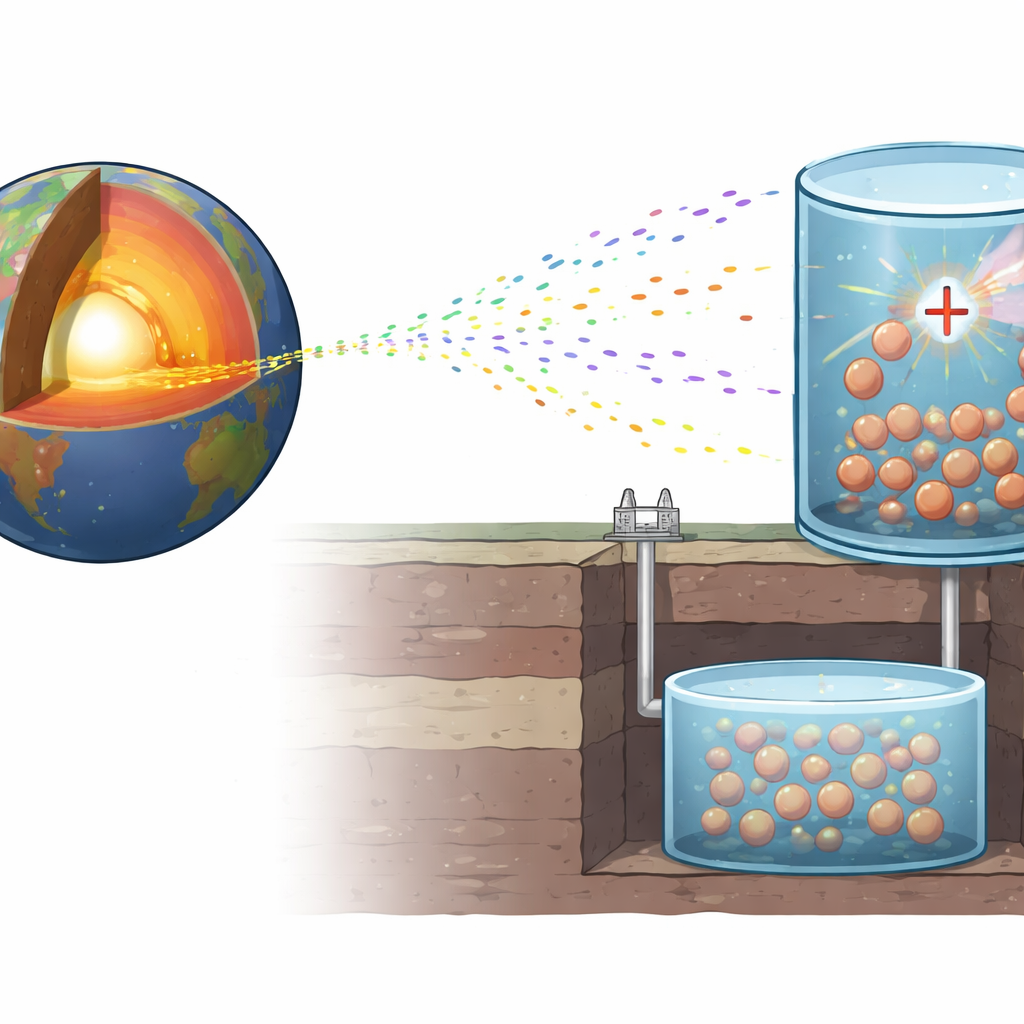
Models of Earth’s formation suggest that our planet should contain much more potassium than we actually see in surface rocks. Compared with primitive meteorites, Earth appears to be missing between two-thirds and seven-eighths of its expected potassium. One idea is that potassium was lost to space during the planet’s violent youth; another is that a large fraction sank into the core. At the same time, almost all of the argon-40 in the atmosphere comes from potassium-40 decays, and current measurements show a “missing argon” problem too. Because potassium-40 decays produce both heat and antineutrinos in a fixed ratio, directly measuring its geoneutrinos would tell us how much potassium is hidden deep inside Earth, clarifying how much radiogenic heat it provides now and in the past, and tightening our picture of Earth’s volatile elements, including water.
Seeing Antimatter Footprints
Neutrino experiments in Japan and Italy have already caught antineutrinos from uranium and thorium using a process called inverse beta decay on hydrogen, which only works for relatively high-energy particles. Potassium-40 geoneutrinos are too low in energy to trigger that reaction. The authors instead focus on a different property: these geoneutrinos are antimatter, and when they interact they produce positrons, the antimatter twins of electrons. A positron leaves a distinctive pattern: it slows down, annihilates with an electron, and creates two characteristic gamma-ray flashes. The LiquidO detector concept captures these topological details by using an “opaque” liquid scintillator threaded with many light-collecting fibers. In such a medium, light stays close to where it is produced, so the detector reconstructs the fine-grained shape and timing of each event, making it possible to tag positrons and reject most ordinary radioactive backgrounds.
Choosing the Right Atomic Target
To catch potassium-40 geoneutrinos, the team surveys many candidate nuclei that can undergo a hydrogen-like inverse beta decay at low energy. They require a low reaction threshold, a reasonably large interaction probability, and a high natural abundance so the detector does not need exotic enrichment. Chlorine and copper emerge as the most promising options. Chlorine has good nuclear properties and can be dissolved in organic liquids, but it harbors a fatal flaw: natural chlorine contains trace amounts of a long-lived isotope, chlorine-36, which produces positrons at a rate that would completely swamp the feeble potassium signal. In contrast, copper has no such long-lived positron-emitting isotopes, and its main activation product, copper-64, is short-lived and can be strongly suppressed by shielding, underground operation, and careful handling.
How Copper and LiquidO Work Together
In the proposed design, an enormous LiquidO detector is loaded with a large fraction of copper. When a potassium-40 antineutrino hits a copper-63 nucleus, it can transform it into nickel-63 while emitting a positron. In many cases the nickel-63 is produced in a slightly excited state and, after about a microsecond, emits a low-energy gamma ray as it relaxes. LiquidO can capture the full story: first a localized positron track capped by two annihilation gamma flashes, then a delayed, single-point gamma deposit nearby. This double signature is extremely hard for background processes to mimic. At the same time, the hydrogen in the scintillator continues to detect the more abundant uranium and thorium geoneutrinos, plus reactor antineutrinos, using standard inverse beta decay with a neutron signal. Those high-statistics measurements let researchers precisely predict how many non-potassium antineutrino events should spill into the low-energy copper channel, so any excess can be attributed to potassium-40.

The Scale of the Challenge
Even with this clever strategy, potassium-40 geoneutrinos interact incredibly rarely. The authors estimate that to reach a statistically solid discovery, a detector would need a mass comparable to the largest planned neutrino experiments—on the order of one to a few hundred thousand tons of scintillating liquid, with copper making up as much as half the total weight. Over ten years of operation, such an instrument could gather only a handful of potassium events per year, but enough to reach 3–5 sigma significance while also measuring uranium and thorium geoneutrinos with exquisite precision. Building and operating a detector of this scale, with high copper loading and dense fiber readout, will demand major advances in scintillator chemistry, mechanical engineering, and cost optimization, so the authors envision a staged program starting with smaller prototypes near nuclear reactors to test the core ideas and calibrate the copper interaction rate.
What We Learn About Our Planet
If potassium-40 geoneutrinos can be observed in this way, they would provide a direct measure of Earth’s hidden potassium content and its contribution to the planet’s internal heat. That, in turn, would sharpen estimates of how quickly Earth has cooled over time, how much of today’s surface heat flow is radiogenic versus primordial, and how closely Earth’s bulk composition matches different meteorite-based models. Combined with precise uranium and thorium geoneutrino data, potassium measurements would tighten constraints on the ratios of key elements, helping to resolve the “missing potassium” and “missing argon” problems and improving our understanding of volatile elements during planet formation. In short, catching these faint antimatter whispers from beneath our feet could rewrite the story of how Earth formed, evolved, and stays geologically alive.
Citation: LiquidO Collaboration. Probing Earth’s missing potassium using the antimatter signature of geoneutrinos. Commun Phys 9, 95 (2026). https://doi.org/10.1038/s42005-026-02518-6
Keywords: geoneutrinos, Earth’s internal heat, radioactive potassium, neutrino detectors, planetary formation