Clear Sky Science · en
Observation and extended Weiss modeling of multi-step type-II spin switching in Mn doped YbFeO3
Building Better Magnetic Brains
Modern technologies—from data centers to smartphones—rely on magnets to store and move information. But most of today’s magnetic bits are power-hungry and relatively slow. This study explores a special class of magnets that could act like tiny, power‑efficient "magnetic brains," able to switch among several stable states instead of just the usual zero and one. Understanding and controlling these states is a key step toward faster, cooler-running memory and logic devices.
A Quiet Kind of Magnetism
The material at the heart of this work is an antiferromagnet, a crystal where tiny atomic magnets line up in opposite directions so that their overall magnetization nearly cancels out. Unlike ordinary bar magnets, antiferromagnets produce almost no stray magnetic field, can respond on ultrafast time scales, and are immune to many types of interference. The researchers focus on a family of compounds called rare‑earth orthoferrites and, in particular, a crystal known as YbFeO3, where ytterbium (Yb) and iron (Fe) form two interacting magnetic sublattices. They slightly modify this crystal by replacing 5% of the iron atoms with manganese (Mn), producing YbFe0.95Mn0.05O3. This gentle adjustment turns out to be enough to reshape the internal magnetic forces while keeping the overall crystal structure intact.
Designing the Crystal for Tunable Spins
First, the team shows that their Mn‑doped crystal is structurally clean and well ordered. Using X‑ray diffraction, they confirm that the material retains the expected orthorhombic perovskite framework, where Fe/Mn and oxygen atoms form corner‑sharing octahedra and ytterbium atoms sit in between. The Mn substitution slightly bends the Fe–O–Fe bonds, which weakens the usual magnetic superexchange interaction and enhances a subtle canting effect that produces a small net magnetization. X‑ray photoelectron spectroscopy verifies that the elements have mostly the desired valence states and that Mn is evenly distributed throughout the material. Together, these measurements show that the researchers have created a precisely tuned platform where the internal magnetic fields can be nudged without introducing disorder that would wash out the effects they want to study.
Many Ways for Spins to Flip
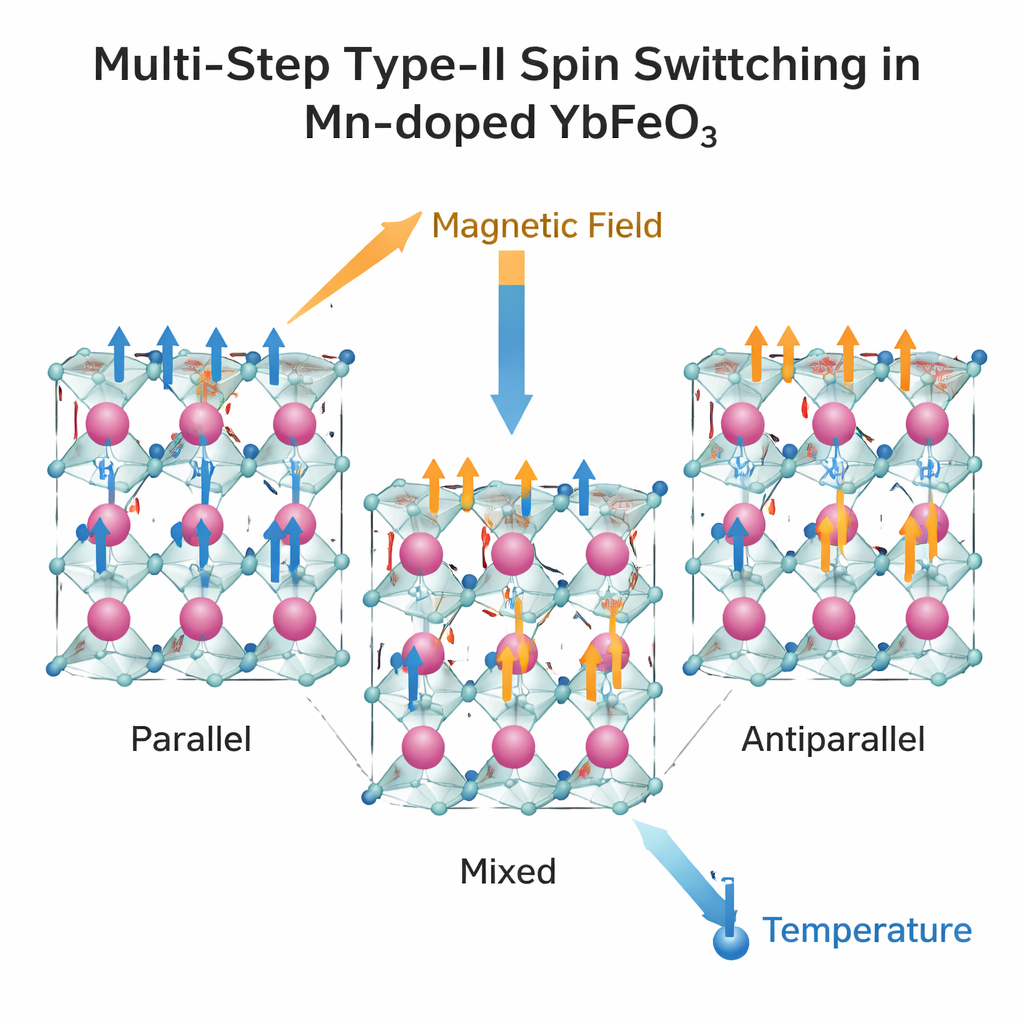
The authors then probe how the crystal’s magnetization changes when they cool it under small magnetic fields. They observe a phenomenon called type‑II spin switching: the magnetic moments associated with ytterbium reverse while the iron moments keep their overall direction. Remarkably, this switching does not always happen in a single clean jump. Under certain low external fields, the Yb spins flip in stages, producing a series of small steps in the magnetization curve as temperature changes. By tuning the applied field between about 20 and 120 oersted—values far smaller than those typically needed for magnetic memory—they can move between conventional single‑step switching and multi‑step behavior. At even higher fields, the switching is suppressed altogether, showing that the delicate balance between internal and external fields determines whether the spins can be thermally driven across the energy barrier.
Hidden Steps and Rotating Spins
Another twist appears at very low temperatures, where the iron sublattice gradually rotates its preferred direction within the crystal—a process known as a spin reorientation transition. Detailed analysis of how magnetization and its temperature derivative behave reveals that, in a certain field range, some of the multi‑step switching events overlap with this slow rotation and become partly hidden in the raw data. The researchers construct a field–temperature phase diagram that maps out all the regimes: parallel alignment of Fe and Yb moments, fully flipped antiparallel alignment, and mixed states where only part of the Yb sublattice has switched. This map highlights how a modest Mn‑induced weakening of the internal field, combined with small applied fields, can generate a rich set of spin configurations and transitions.
A New Framework for Multi‑Level Magnetic Control
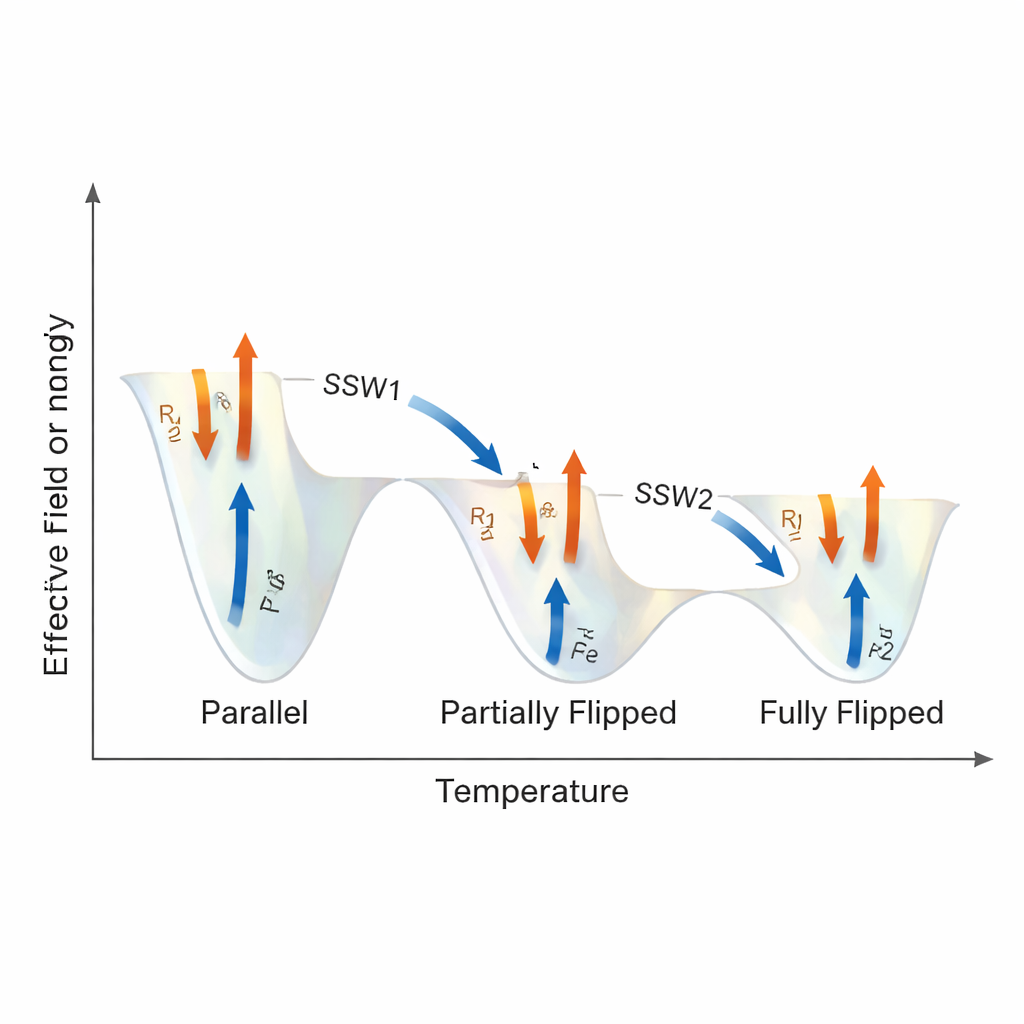
To make sense of these complex behaviors, the team extends a classic theory of magnetism known as the Weiss molecular field model. In their generalized version, the rare‑earth sublattice is treated as consisting of several magnetically distinct components, each feeling a slightly different effective internal field from the iron network and from its neighbors. As temperature changes, these local fields can cross zero at different points, causing the components to flip one by one. This simple but powerful idea explains both the single‑step and multi‑step switching, as well as how the transitions merge or separate under different applied fields. For a lay reader, the key takeaway is that by carefully engineering the internal fields in a clean crystal—here, via a small amount of Mn doping—the researchers show how to reliably select among multiple magnetic states using tiny external fields. Such controllable, multi‑level spin switching could underpin future low‑energy, multi‑state memory elements and programmable antiferromagnetic devices that go beyond the binary logic of today’s computers.
Citation: Yang, W., Peng, H., Guo, Y. et al. Observation and extended Weiss modeling of multi-step type-II spin switching in Mn doped YbFeO3. Commun Phys 9, 74 (2026). https://doi.org/10.1038/s42005-026-02517-7
Keywords: antiferromagnetic spintronics, spin switching, rare-earth orthoferrites, magnetic memory, Weiss model