Clear Sky Science · en
Attenuation-resilient underwater optical ranging using a spatially petal-like structured beam with tailorable longitudinal intensity
Sharper underwater vision
Clear underwater images and precise distance measurements are vital for tasks like exploring shipwrecks, inspecting offshore infrastructure, or guiding underwater robots. But murky water filled with particles scatters light, quickly dimming laser signals and blinding detectors at close range. This study introduces a new kind of carefully shaped light beam that keeps its useful signal strong over distance, making it easier to “see” and measure objects underwater, even when the water is cloudy.
Why ordinary light struggles in murky water
Conventional underwater laser ranging systems work by timing how long light takes to travel to an object and back, or by analyzing how its frequency is modulated. In clear water this can be very accurate, but in turbid water scattered light spreads out in time and space, blurring the signal and reducing contrast. Increasing laser power to see farther is not a simple fix: nearby targets can then overwhelm the detector, while distant objects still appear too faint. On top of this, detectors have a limited “dynamic range” — they cannot reliably measure signals that vary too much in brightness between near and far objects.
Using rotating light patterns to measure distance
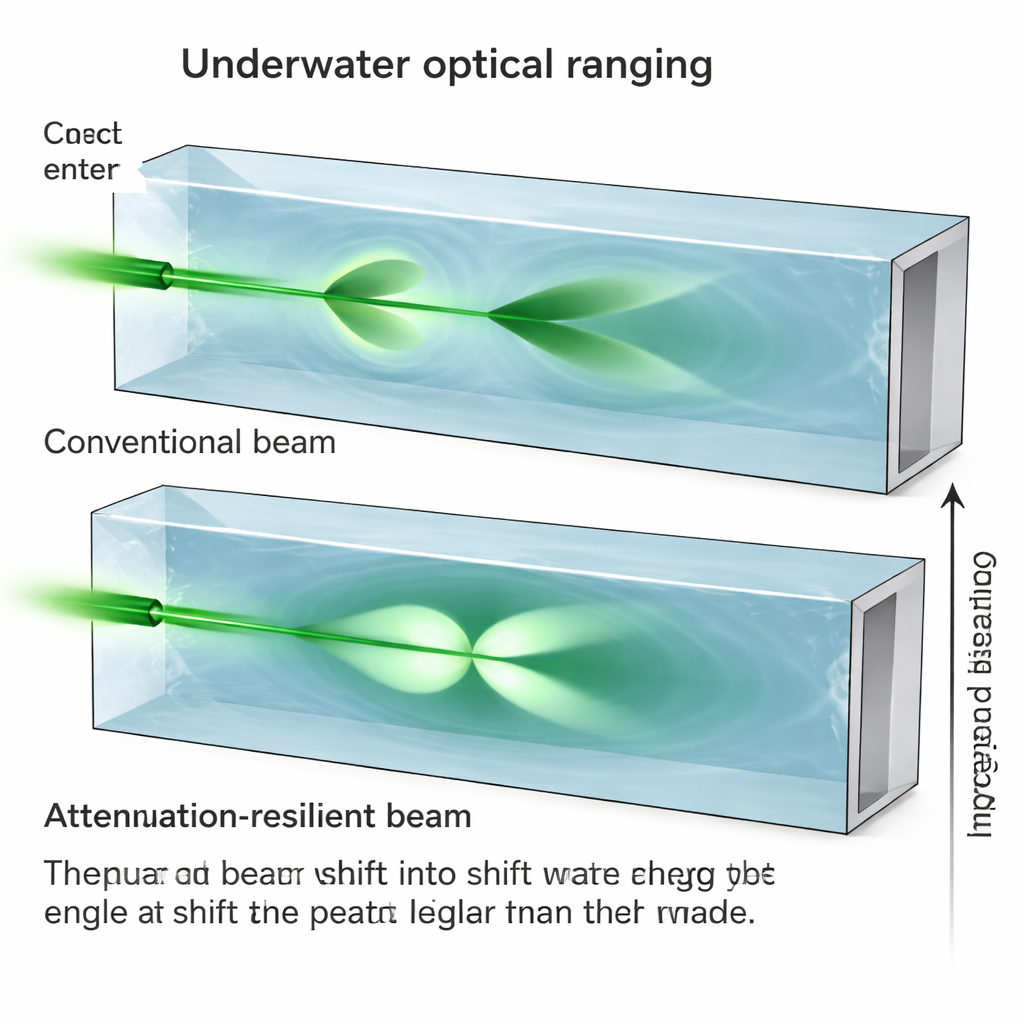
The researchers build on a different idea: encode distance into the shape of the light beam rather than into timing alone. They use a beam whose cross-section looks like two bright petals of light. As this structured beam propagates, the petal pattern slowly rotates. By measuring the rotation angle after the beam travels to a target and back, one can deduce the distance, much like reading off the position of a dial. Earlier versions of this technique combined just two special beam components, which created the rotating petal pattern but left much of the beam’s energy sitting in faint outer rings that did not contribute to the useful central signal.
Recycling wasted light into the useful center
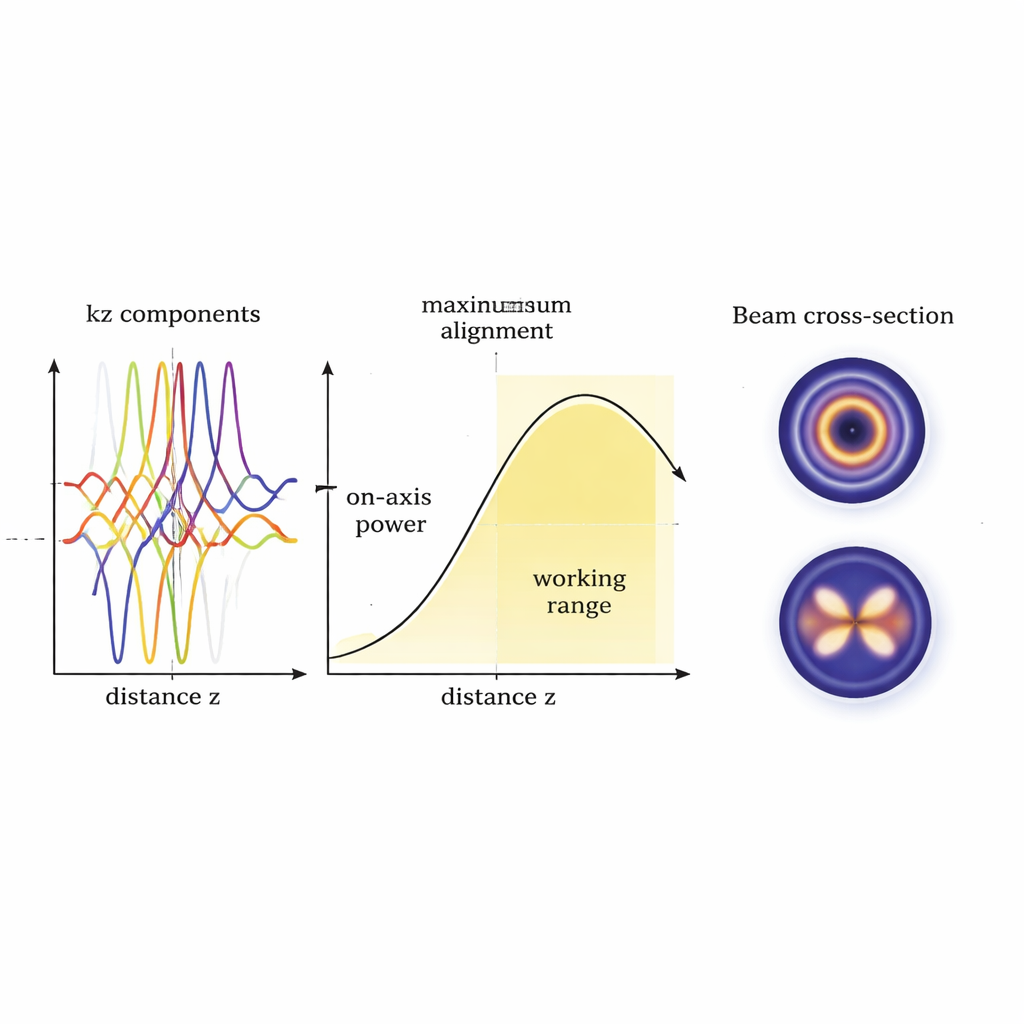
The central advance of this work is to design a new “attenuation-resilient” petal-like beam that deliberately shifts energy from the outer rings into the central petal region as it travels. Instead of using only two building blocks, the team combines many related beam components, each with a slightly different longitudinal property. By carefully choosing their relative strengths and phases — similar to designing a sound waveform by mixing many tones — they cause these components to interfere constructively at the beam center over a chosen distance range. In effect, as the beam propagates, the bright petals in the middle grow stronger at the expense of the sidelobes, partially offsetting the natural loss caused by scattering in the water.
Tuning the beam to match the water
The authors introduce a design parameter that sets how quickly the central petal intensity increases with distance. This parameter can be adjusted based on how strongly the water scatters light. In experiments, they generated such beams in a 0.5-meter tank filled with water whose turbidity they controlled using microscopic particles. They then measured how much power remained in the central petal region and how accurately they could recover distance. Compared with the earlier two-component beam, the new multi-component design boosted the central petal power by up to about 13 decibels — more than a tenfold increase — at a 0.4-meter distance in turbid water. Under the same conditions, the new beam kept average distance errors below 5 millimeters across 0.4 meters, while the conventional beam failed beyond 0.25 meters and showed errors exceeding 80 millimeters.
Handling real-world limits of cameras and detectors
Because the new beam reshapes itself along the path instead of just becoming dimmer everywhere, it helps work within the limited dynamic range of real detectors. With equal starting power, the central petal of the multi-component beam gently brightens with distance, so nearby objects do not saturate the camera while far objects still return a detectable signal. Tests comparing three approaches — the new beam, a traditional two-component beam, and another advanced design that modifies the angular structure — showed that only the new method managed to keep the petal pattern visible and measurable across all tested distances in strongly scattering water without causing near-field saturation or far-field disappearance.
What this means for future underwater sensing
To a non-specialist, the key message is that the authors have found a way to “recycle” light that would normally be wasted in the outskirts of a beam and move it into the part that actually carries useful distance information. Instead of simply turning up the laser power, they reshape how light is distributed along the path so that the central signal remains strong over a wider range of distances, even in cloudy water. This concept could eventually help underwater vehicles, inspection tools, and scientific instruments measure distances more reliably, and it may be adapted to other hazy environments like fog or dust in air, all without requiring more powerful or more fragile hardware.
Citation: Wang, Y., Duan, Y., Zeng, R. et al. Attenuation-resilient underwater optical ranging using a spatially petal-like structured beam with tailorable longitudinal intensity. Commun Phys 9, 78 (2026). https://doi.org/10.1038/s42005-026-02515-9
Keywords: underwater lidar, structured light, optical ranging, turbid water, Bessel beam