Clear Sky Science · en
One-milligram torsional pendulum toward experiments at the quantum-gravity interface
A Tiny Pendulum with Big Questions
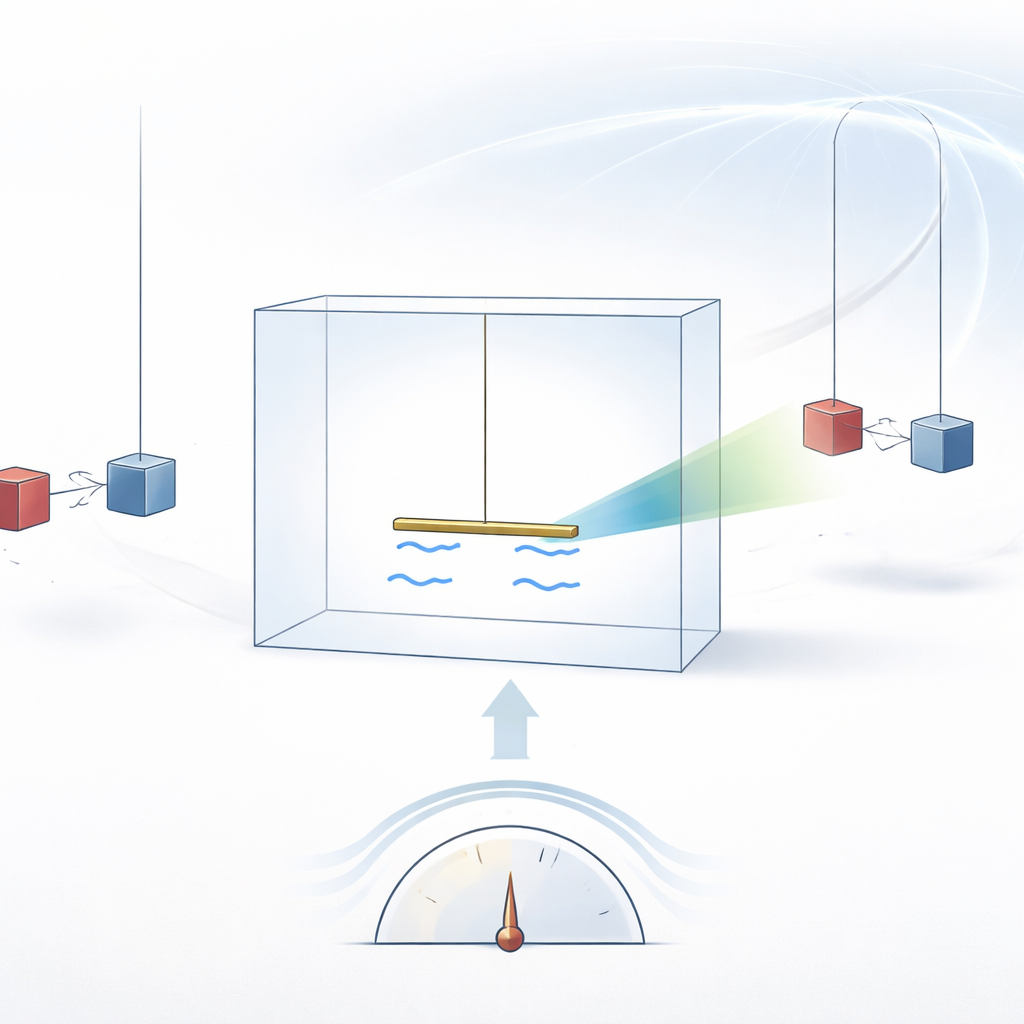
Can gravity itself behave according to the strange rules of quantum mechanics? This article describes an experiment that takes a concrete step toward answering that question. The authors have built and tamed an extraordinarily delicate one-milligram pendulum, using light to cool its motion almost to complete stillness. Though this device is far from testing “quantum gravity” directly, it reaches record levels of control for an object of its size and shows a path toward future experiments where gravity might generate quantum entanglement between small but still visible objects.
Why Gravity and Quantum Physics Need to Meet
Modern physics rests on two towering frameworks: quantum mechanics, which governs atoms and smaller particles, and general relativity, which describes gravity and the structure of spacetime. All known forces except gravity have been seen to obey quantum rules. Gravity remains the odd one out, and some proposed theories even imagine it as fundamentally classical. One promising way to probe gravity’s true nature is to see whether it can create quantum entanglement between two nearby masses. If two objects, each behaving quantum mechanically, become entangled only through their mutual attraction, it would be powerful evidence that the gravitational field itself must also be quantum.
Finding the Sweet Spot in Size
Designing such an experiment is tricky because the objects need to be heavy enough for their gravity to matter, yet light enough to be controlled in the fragile quantum regime. Previous work with tiny oscillators from femtograms to micrograms has showcased quantum behavior in surprisingly large systems, while much heavier setups, from grams to tons, have been used to detect gravitational waves. The authors argue that the microgram-to-milligram range is the sweet spot where both demands can be balanced. In this mass window, one can hope to make the positions of two objects uncertain in a quantum way, while still letting gravity between them be strong enough to play a measurable role.
Building a Featherweight but Sensitive Balance
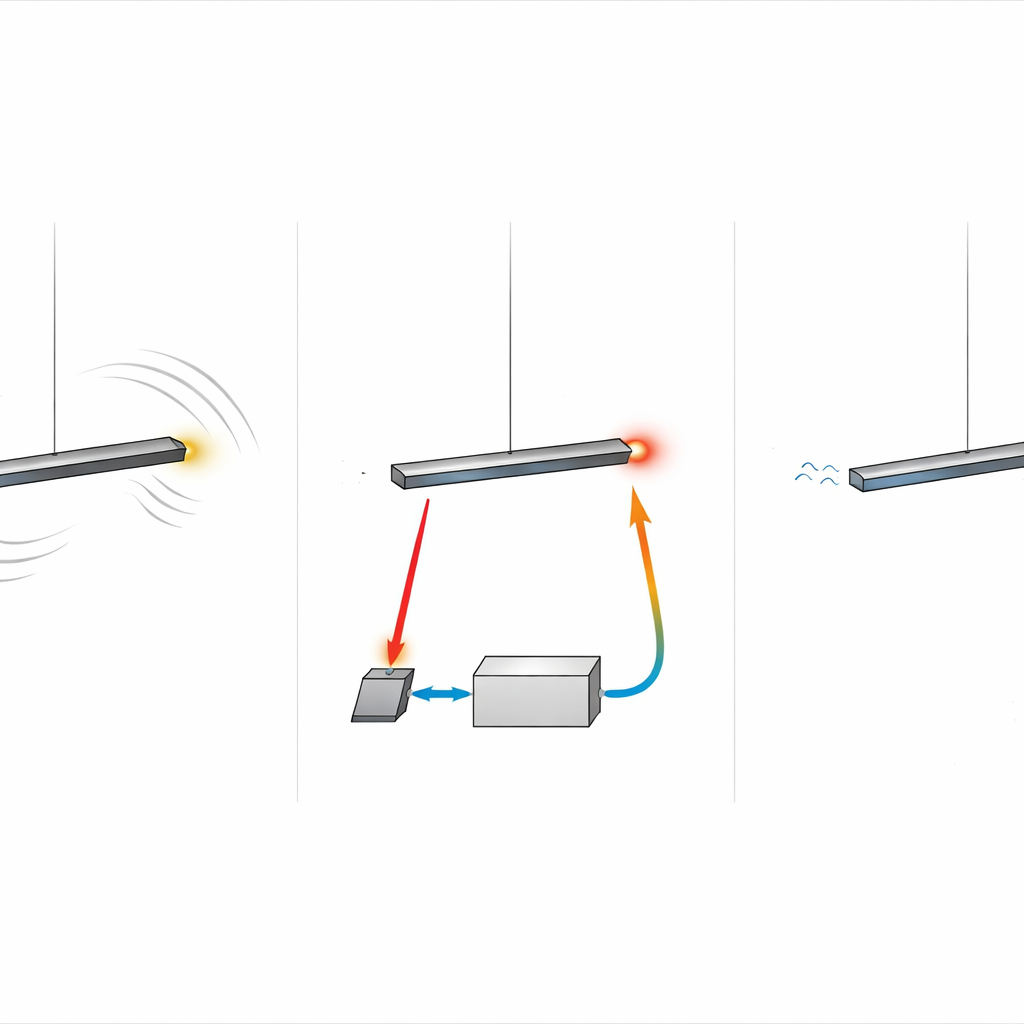
To explore this regime, the team constructed a torsional pendulum—a tiny suspended bar that twists back and forth—made from a millimeter-scale mirror attached to an ultra-thin glass fiber inside a high vacuum. This little balance weighs only about a milligram and naturally twists at around seven cycles per second. The design minimizes friction in the fiber so well that the bar can ring for more than an hour before its motion noticeably fades. Using a finely shaped laser beam reflected from the bar, the researchers monitor angular displacements small enough that, in principle, they could resolve even the bar’s quantum zero-point jitters, the residual motion that remains even at absolute zero.
Cooling Motion with the Pressure of Light
The core achievement is the use of light to both stiffen and cool the pendulum’s motion. By pushing with a separate “control” laser, the team effectively creates an optical torsion spring that raises the twisting frequency from 6.72 to 18 hertz while simultaneously increasing the quality of the oscillation. Then they apply a feedback loop: the measured tilt of the bar is converted into a carefully timed change in the laser’s push, acting like a smart shock absorber. This feedback damping dramatically reduces the random thermal jiggling of the bar, bringing its effective temperature down from room temperature to about 240 microkelvins—more than 20 times colder than the best previous results for similar or even much larger mechanical systems. The setup also reaches an extraordinarily low torque noise, making it one of the most sensitive twist sensors at the milligram scale.
Grading a Device for Future Quantum-Gravity Tests
To judge how useful such a device might be for future gravity experiments, the authors rely on two key measures. One is a figure that combines how far a mass can remain quantum coherent with how strongly gravity can act between a pair of such masses; the other is the “purity,” which indicates how close the motion is to a fully controlled quantum state. Their current pendulum still falls far short of the conditions needed for gravity to entangle two objects, but it already compares favorably with a broad range of existing mechanical systems, including much heavier gravitational-wave detectors and much smaller levitated particles. Just as important, the design offers clear routes to significant improvement.
Where This Work Could Lead Next
Looking ahead, the authors outline realistic upgrades: using an even thinner suspension fiber to further reduce internal losses, placing the pendulum inside a high-finesse optical cavity to enhance readout and cooling, and operating at cryogenic temperatures in a dilution refrigerator. Together, these steps could boost their quantum-gravity figure of merit by many orders of magnitude, potentially reaching the level where gravity-induced correlations between two such pendulums could be observed. While direct tests of quantum gravity remain a formidable challenge, this one-milligram torsional pendulum shows that macroscopic objects can be controlled with a precision once reserved for atoms, opening a promising route for future experiments at the boundary between gravity and quantum mechanics.
Citation: Agafonova, S., Rosselló, P., Mekonnen, M. et al. One-milligram torsional pendulum toward experiments at the quantum-gravity interface. Commun Phys 9, 80 (2026). https://doi.org/10.1038/s42005-026-02514-w
Keywords: quantum gravity, torsional pendulum, optomechanics, laser cooling, macroscopic quantum systems