Clear Sky Science · en
Ultrastrong coupling between magnetoplasmons and cyclotron harmonics in terahertz resonator-quantum point contact integrated systems
Turning Light Into a Powerful Control Knob
Imagine being able to change the behavior of electrons in a solid just by reshaping how light surrounds them. This study shows how researchers can precisely adjust the strength of the interaction between terahertz radiation and electrons confined in a tiny semiconductor structure. By doing so, they reach a regime where light and matter are so strongly intertwined that they form new hybrid states, opening routes toward future quantum technologies and exotic phases of matter that do not exist in everyday materials.
Why Strong Light–Matter Ties Matter
When light and electrons interact only weakly, light mostly passes through or is absorbed in a simple way. But if the interaction becomes extremely strong, the system enters a regime where neither light nor matter can be described on its own; instead, they behave as a single combined entity. In this so‑called ultrastrong regime, even the quantum “vacuum” state is altered, and theory predicts that entirely new phases, such as light‑driven superconductivity or ferroelectricity, could emerge. A crucial challenge, however, has been not just to reach this regime but to tune how strongly light and matter are coupled, so that researchers can explore different quantum phases and control them on demand.
A Tiny Circuit for Trapping Waves
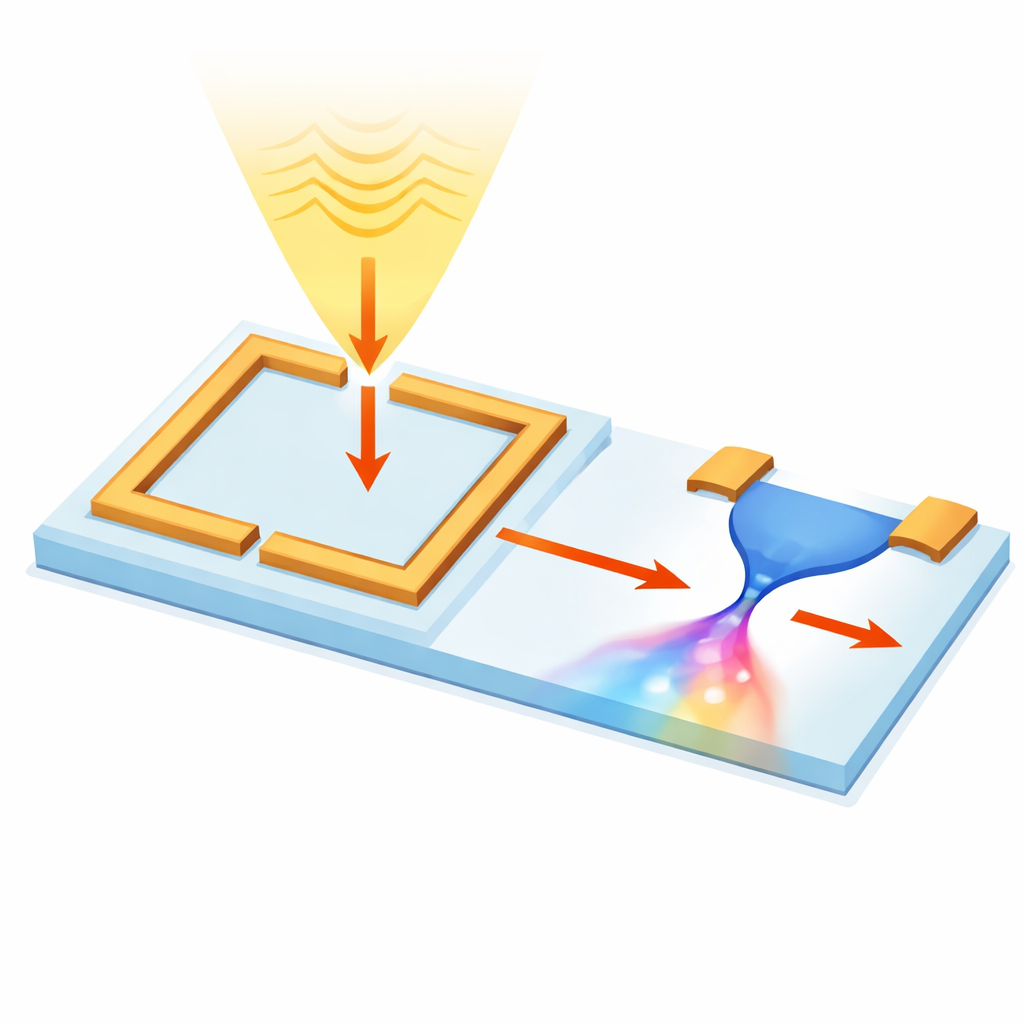
The authors build a compact device on a gallium‑arsenide semiconductor wafer that brings together two key elements. The first is a split‑ring resonator, a square metallic loop with a narrow gap that traps terahertz waves and concentrates their electric field into a microscopic region. Inside and around this resonator lies a thin, two‑dimensional sheet of electrons. The second element is a quantum point contact, a narrow, adjustable constriction in this electron sheet formed by applying voltages to nearby metal gates. By changing these gate voltages, the team can squeeze the electron channel and monitor how its electrical current responds when the device is illuminated with terahertz radiation and placed in a magnetic field.
Making Distant Excitations Talk
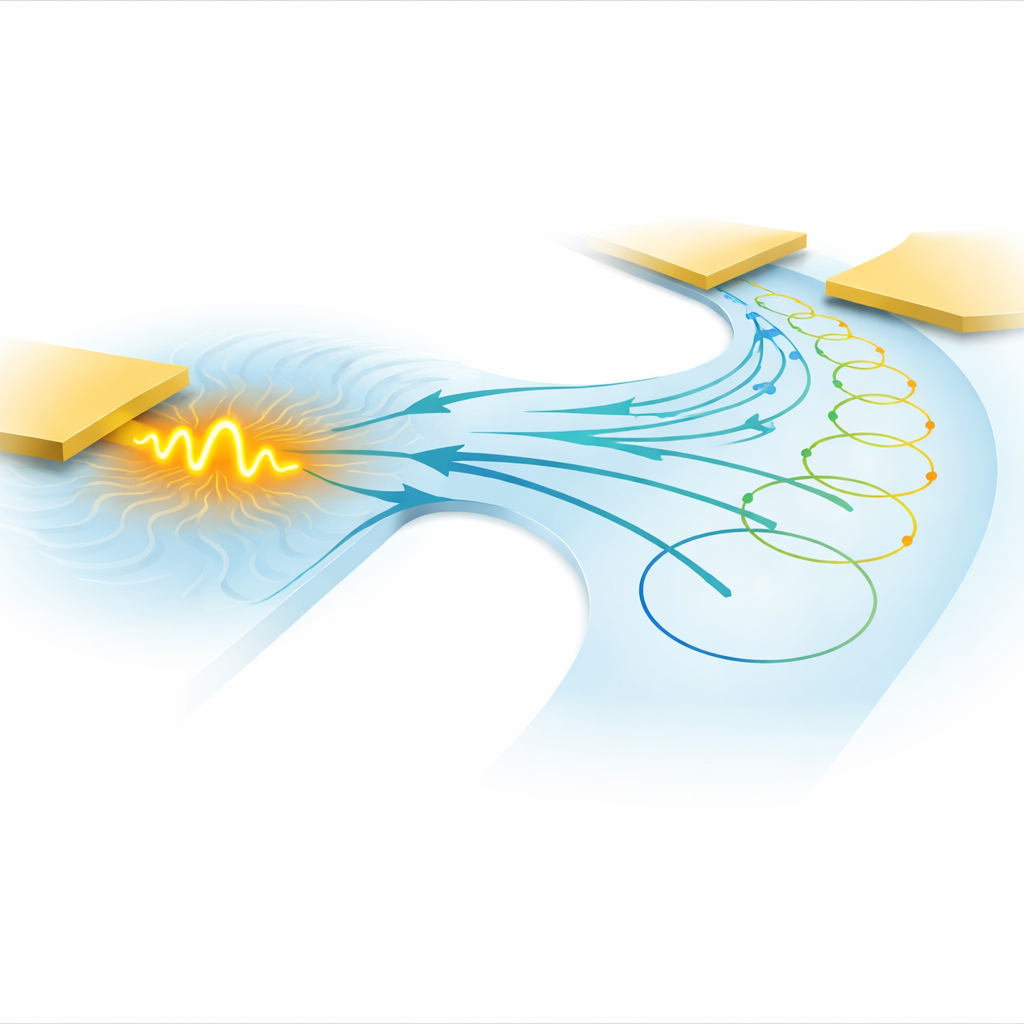
Under a magnetic field, electrons in the two‑dimensional layer naturally circle around at a characteristic frequency known as cyclotron resonance, and this motion can also occur at higher harmonics, where electrons respond at two or three times the basic frequency. Meanwhile, the resonator gap supports collective oscillations of the electrons called magnetoplasmons, which strongly concentrate and distort the local electric field. By measuring very small terahertz‑induced changes in the current through the quantum point contact, the researchers observe clear signs that a magnetoplasmon in the resonator gap and a higher‑harmonic cyclotron motion near the constriction become coherently linked. This link appears as an “anti‑crossing” pattern in the spectra, a hallmark that the two excitations have hybridized into shared light–matter modes even though they occur in spatially separated regions of the device.
Turning a Knob to Reach the Extreme
A central result of the work is that the strength of this coupling between the magnetoplasmon and the higher‑harmonic cyclotron motion can be tuned simply by tightening the quantum point contact. As the electron channel narrows, the spatial variation of the magnetoplasmon’s near field becomes steeper in the constriction region. This sharper gradient makes it easier to drive the otherwise forbidden higher harmonics of the electron motion, causing the coupling strength to grow steadily. Under the strongest confinement, the ratio of coupling strength to the natural oscillation frequency exceeds the usual 10 percent benchmark, showing that the system has entered the ultrastrong regime where quantum vacuum effects and unconventional phases are expected to be most pronounced.
Opening Doors to Designer Quantum Phases
To a non‑specialist, the practical message is that the researchers have created a tiny, electrically tunable platform where light and electrons can be merged and adjusted almost like components in a circuit. By controlling how tightly the electrons are confined, they can dial the light–matter interaction from moderately strong to ultrastrong, while selectively engaging higher‑harmonic motions that normally remain hidden. This kind of control is a key step toward engineering quantum materials whose properties can be reshaped by tailored electromagnetic fields, with potential applications ranging from quantum information processing to exploring exotic, light‑induced phases of matter that go far beyond what ordinary solids can offer.
Citation: Kuroyama, K., Bamba, M., Kwoen, J. et al. Ultrastrong coupling between magnetoplasmons and cyclotron harmonics in terahertz resonator-quantum point contact integrated systems. Commun Phys 9, 87 (2026). https://doi.org/10.1038/s42005-026-02513-x
Keywords: ultrastrong coupling, terahertz resonator, quantum point contact, magnetoplasmons, cyclotron resonance