Clear Sky Science · en
Nonlinear synchronization through vector subharmonic entrainment
Why tiny rhythms in light matter
Lasers are everywhere—from high-speed internet cables to precision surgery tools—and many of their most useful tricks depend on making light pulses tick like a perfectly kept clock. This paper explores a subtle way to steer those rhythms not by brute force, but by using a very gentle external signal that talks to the laser through its polarization—the orientation of the light’s electric field. Understanding and harnessing this effect could lead to more stable and tunable ultrafast lasers, improving communications, sensing, and measurement technologies that underpin modern life.
When oscillators learn to march together
Much of nature is built from oscillators—systems that repeat in time—such as heart cells, fireflies, or pendulums. When these oscillators interact, they often synchronize, locking to a shared rhythm. Engineers already use this idea to stabilize lasers: a weak “master” laser can pull a stronger “slave” laser into step, reducing noise and drift. A special form of this behavior, called subharmonic entrainment, occurs when a fast oscillator locks to a slower one at a simple fraction of its frequency, like a drummer keeping two beats for every one step of a marcher. Until now, most studies treated this effect as scalar, focusing only on timing or intensity. But real light has direction in space—its polarization—and that extra “vector” dimension opens up new ways for oscillators to talk.
Adding polarization as a hidden control knob
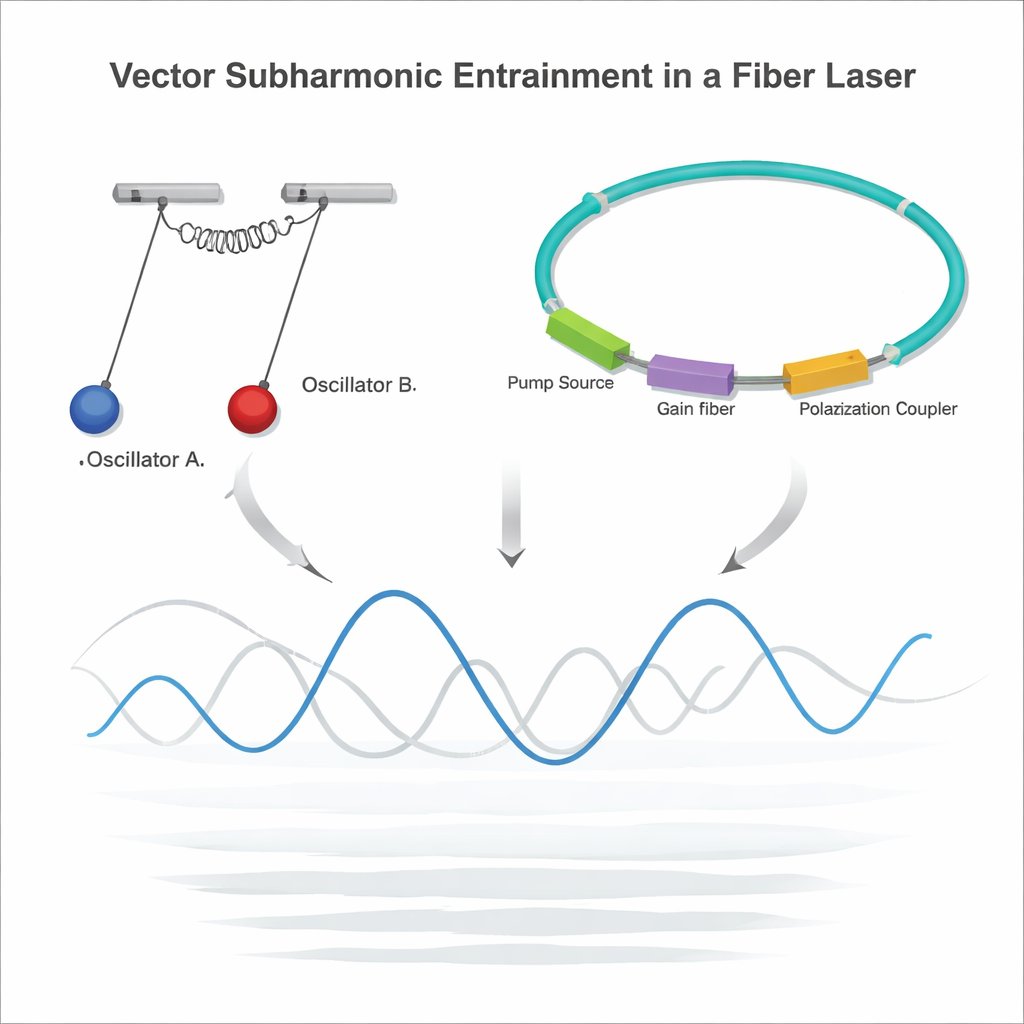
The authors show that a laser’s internal dynamics can be locked not just by nudging its timing, but by gently rotating the polarization of a weak continuous beam inside the laser cavity. To picture this, the paper first uses a mechanical analogy: two pendulums of different lengths linked by a spring. Each pendulum stands in for one polarization direction of light inside the laser. Even if they prefer to swing at different speeds, the spring coupling can make them adjust to each other. In the optical system, the spring is replaced by components that mix polarization states, such as birefringent fibers and polarization controllers. By carefully injecting a low-power, polarization-modulated signal into a mode-locked fiber laser, the team observes that internal polarization oscillations begin to follow this weak external drive at specific fractional frequency ratios—evidence of what they call vector subharmonic entrainment.
Pulse trains on two time scales
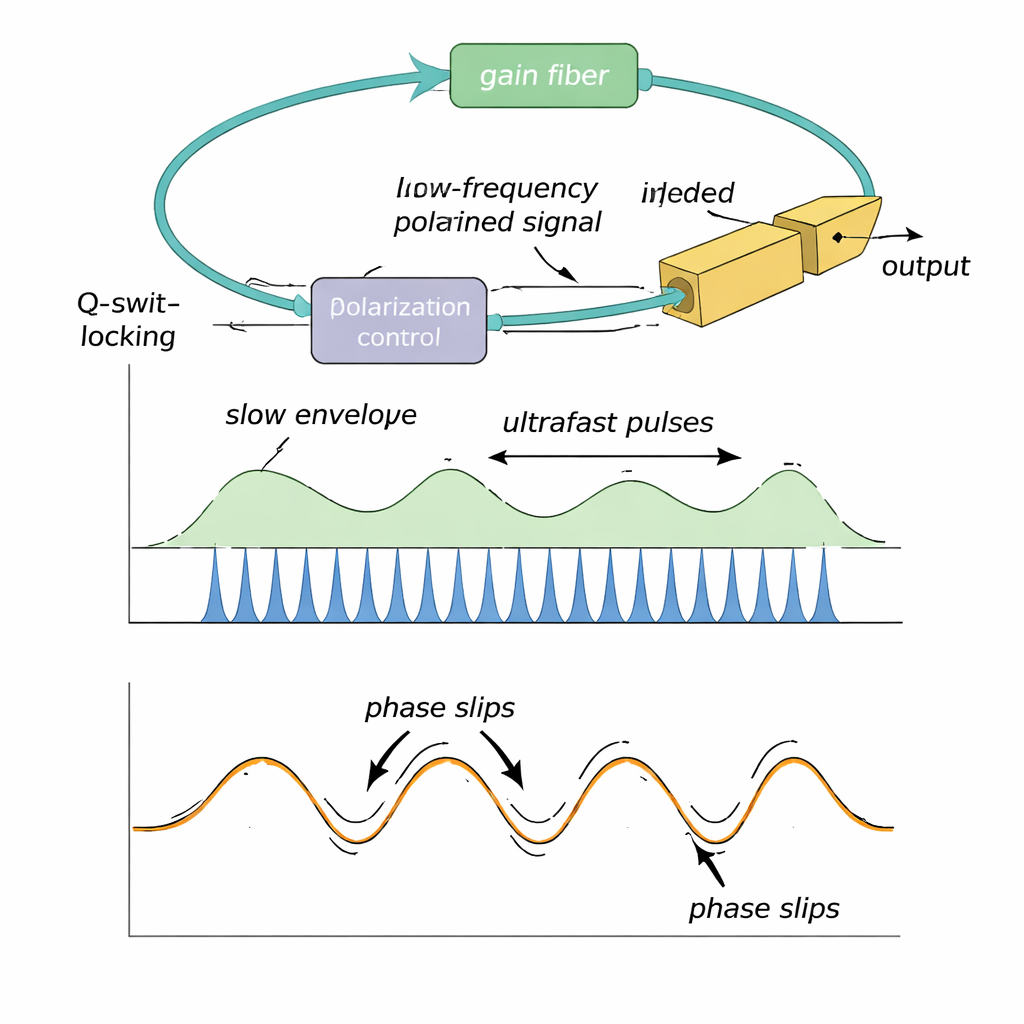
Experimentally, the researchers work with an ultrafast fiber ring laser that produces regular trains of very short pulses. Using fast polarization-resolving detectors, they watch how the power in two orthogonal polarization components, their sum, and their relative phase evolve over time. Under certain settings, the laser enters a regime called Q-switched mode-locking: extremely rapid pulses ride on a slower, breathing envelope, like fine ripples on a slow ocean swell. The Fourier spectra of these signals reveal a clear separation between low-frequency and high-frequency components, along with sidebands that show the two are interacting. When the external polarized signal is injected and tuned so that its slow modulation overlaps with these internal frequencies, the pulse envelope and polarization phase begin to synchronize at subharmonic ratios—multiples of ten in their setup—while still leaving room for complex oscillations and phase slips.
Models that capture a vector dance
To understand the mechanism, the authors extend an existing theoretical model of polarization dynamics in erbium-doped fiber lasers. Instead of treating polarization as fixed, they allow the orthogonal components of the light field to have their own amplitudes and phases, driven by a rotating injected polarization and by the gain medium’s response. This vector model shows that the injected continuous wave signal can trigger dual-scale oscillations similar to those seen in the lab: fast pulse bunching, slow envelopes, and characteristic slips of about half a cycle in the phase difference between polarizations. As the strength and polarization pattern of the injected light are changed, the synchronization region widens, sidebands grow, and the system shifts from loose phase entrainment toward tight phase and frequency locking.
What this means for future light technology
In simple terms, the paper demonstrates that tiny, carefully shaped polarization signals can steer the complex rhythms of an ultrafast laser without heavy-handed control. By exploiting vector subharmonic entrainment, engineers gain an extra dial—the time-varying polarization waveform—alongside frequency and power. This could enable smarter control of pulse envelopes, timing, and polarization encoding in applications such as optical communications, metrology, and advanced signal processing. More broadly, the work shows that synchronization in systems with many internal directions, not just a single scalar variable, can be harnessed in a controlled way—linking laser physics to the wider study of coupled oscillators in fields ranging from biology to network science.
Citation: Stoliarov, D., Sergeyev, S., Kbashi, H. et al. Nonlinear synchronization through vector subharmonic entrainment. Commun Phys 9, 71 (2026). https://doi.org/10.1038/s42005-026-02509-7
Keywords: laser synchronization, polarization dynamics, mode-locked fiber lasers, subharmonic entrainment, ultrafast photonics