Clear Sky Science · en
Characterizing second-order topological insulators via entanglement topological invariant in two-dimensional systems
Why this study matters
Electronics, photonics and even future quantum computers all rely on how waves and particles behave in tiny structures. A class of materials called topological insulators can host extremely robust signals on their edges. More exotic still are “higher-order” topological insulators, where the action moves from edges to the corners. This article introduces a new way to reliably detect and count these fragile corner states by looking at quantum entanglement, potentially giving scientists a sharper tool for designing resilient devices at the nanoscale.
Corners that carry current
In ordinary topological insulators, a two-dimensional sheet behaves like an insulator in the interior but supports special conducting channels along its one-dimensional edges. Higher-order topological insulators push this idea further: in a two-dimensional sample, the edges can remain insulating while tiny, zero-dimensional spots at the corners host protected electronic states. These corner states are of interest because they are shielded by the material’s symmetries and topology, making them resistant to many types of defects. However, different microscopic mechanisms can create similar-looking corner states, and existing mathematical markers of topology often work only for specific models, leaving researchers without a universal way to identify and compare higher-order topological phases.
Using quantum links as a fingerprint
Instead of tracking how electrons move, the authors turn to how they are quantum mechanically linked, or entangled. They define a quantity called the entanglement topological invariant, denoted ST, built from the entanglement entropy between carefully chosen boundary regions of a finite sample. In practice, they select two non-touching strips along the boundary, labeled A and B, and compute the entanglement entropies of A alone, B alone, and of the rest of the system when A and B are removed. By combining these three numbers in a specific way, they obtain ST, which is designed to filter out short-range, local correlations and emphasize long-range quantum connections carried by corner states under open boundary conditions. When regions A and B are placed far apart along the sample edge, any remaining entanglement between them is a strong clue that corner-localized states are present and talking to each other through quantum correlations. 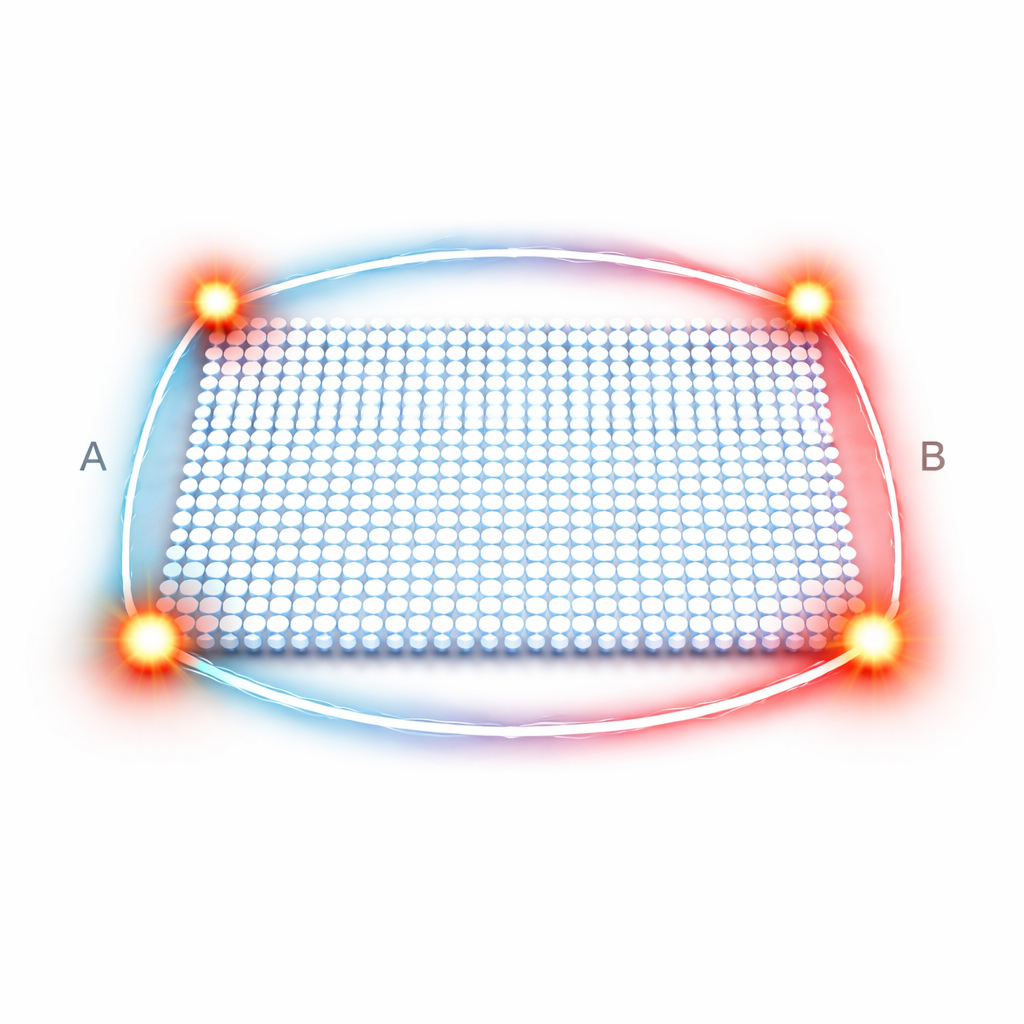
Testing the idea on a model material
To demonstrate that ST is more than a mathematical curiosity, the researchers apply it to a theoretical system known as a bilayer Bernevig–Hughes–Zhang model, which is widely used to describe quantum spin Hall insulators. By coupling two such layers and tuning parameters such as a mass term and an out-of-plane magnetic field, the model can host or lose corner states in a controlled way. Numerical simulations on a finite, rectangular “nanoflake” show that in the higher-order topological phase, four near-zero-energy states appear inside the bulk energy gap, each localized near a different corner. As the mass parameter is swept across a critical value, these in-gap levels merge with the bulk bands, signaling a transition to a trivial phase with no protected corner states.
Counting corners with an entanglement meter
Across the same parameter sweep, the entanglement invariant ST behaves in a strikingly simple way: it jumps sharply from ST = 4 in the higher-order topological phase to ST = 0 in the trivial phase, with the jump occurring exactly at the transition point identified from the energy spectrum. When a magnetic field is introduced so that only two corner states remain, ST takes the value 2. More generally, the authors find that ST reliably equals N0, the number of corner states, once the chosen boundary regions are large enough to fully cover the spatial extent of the corner wave functions and far enough apart to suppress local noise. This behavior persists as the overall system size increases, and similar results appear in other models discussed in the supplementary material, including different two-dimensional lattices, a one-dimensional chain, and a three-dimensional higher-order topological insulator. 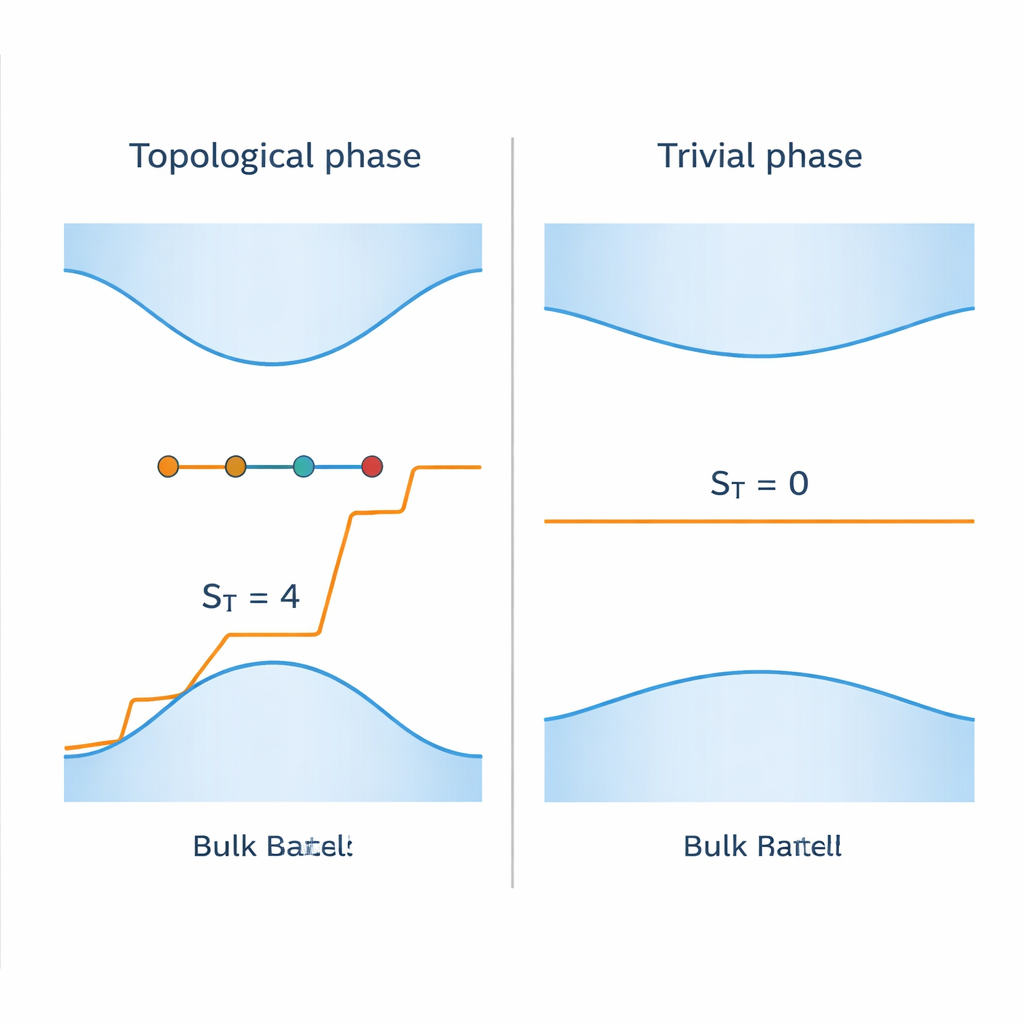
What this means going forward
In plain terms, the study provides a new “entanglement meter” that not only says whether a material is in a higher-order topological phase but also tells you how many robust corner states it hosts. Because ST is computed directly from correlation data, it connects abstract topology to real-space signatures that could, in principle, be probed numerically or even experimentally. The method works for non-interacting electrons and remains stable under weak interactions, offering a universal and precise tool to classify higher-order topological phases. As researchers push toward strongly interacting and programmable quantum materials, this entanglement-based approach may become a key ingredient for diagnosing and engineering devices that exploit protected corner modes for robust transport or quantum information tasks.
Citation: Zhang, YL., Miao, CM., Sun, QF. et al. Characterizing second-order topological insulators via entanglement topological invariant in two-dimensional systems. Commun Phys 9, 72 (2026). https://doi.org/10.1038/s42005-026-02507-9
Keywords: higher-order topological insulator, corner states, quantum entanglement, entanglement entropy, topological phases