Clear Sky Science · en
Ultralow radiative heat flux by Anderson localization in quasiperiodic plasmonic chains
Why stopping heat without touching matters
Heat usually sneaks from hot things to cold ones as invisible light, especially infrared. At the nanoscale, this radiative heat can become extremely strong, which is useful for technologies like waste‑heat harvesting and tiny thermal circuits—but it can also be a problem when we want excellent thermal insulation. This paper shows that by carefully arranging metal nanoparticles in an almost‑but‑not‑quite regular line, it is possible to choke radiative heat flow by a factor of about one thousand, without any physical contact, using a wave phenomenon known as Anderson localization.
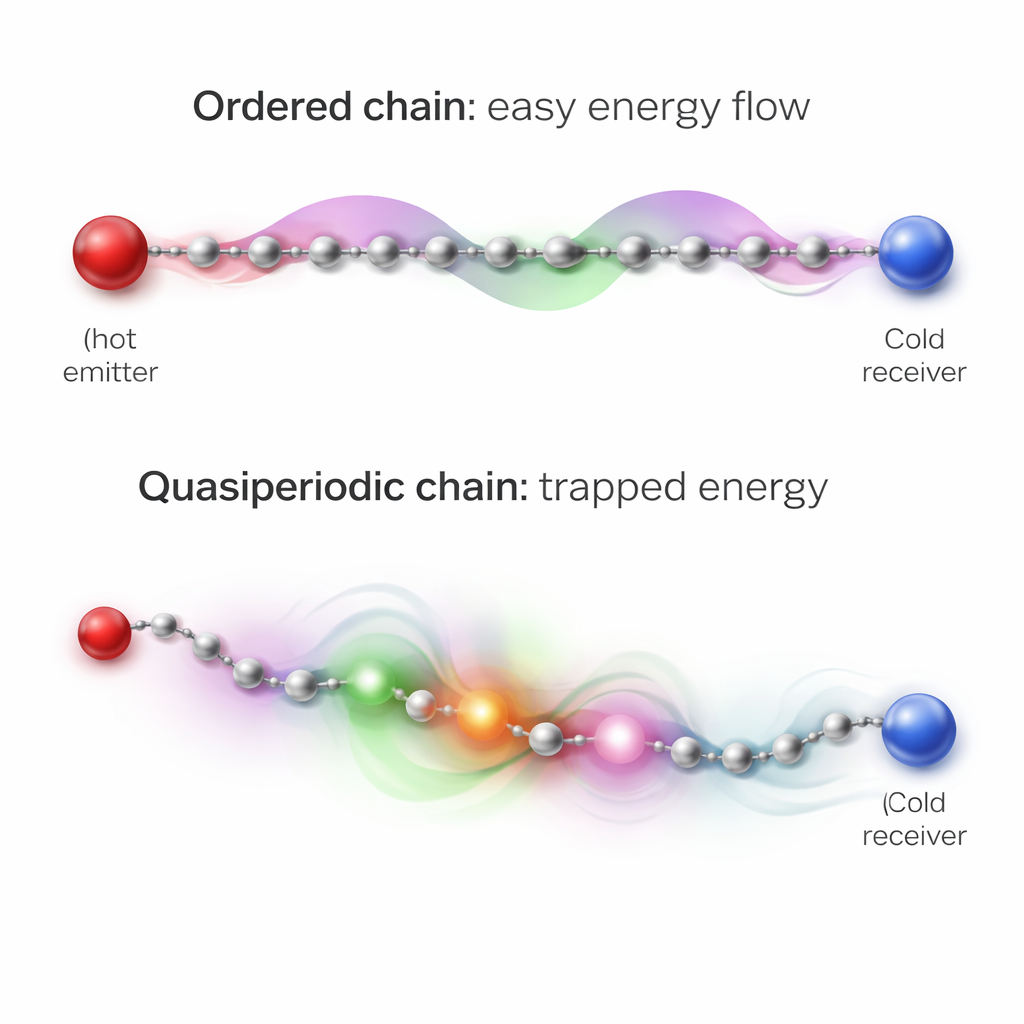
A crooked line of tiny beads
The authors study a one‑dimensional chain of identical metallic nanoparticles made of indium antimonide, a semiconductor that supports strong oscillations of electrons called plasmons in the mid‑infrared—right where room‑temperature thermal radiation is most intense. Instead of spacing the particles perfectly evenly, they follow a mathematical pattern called the Aubry–André–Harper modulation. This pattern is neither fully regular nor fully random: it is quasiperiodic, meaning the distances between neighboring particles follow a smoothly varying but incommensurate sequence. By tuning how strongly this spacing is modulated, the researchers can dial in how “disordered” the chain is, while still keeping precise control over its geometry.
Waves that refuse to travel
In an evenly spaced chain, plasmon waves launched on one nanoparticle can spread as collective modes that extend across the entire structure, carrying energy efficiently from one end to the other. As the spacing becomes quasiperiodic, however, the team finds a sharp transition: the electromagnetic modes cease to be extended and instead become localized around only a few particles. This is the optical version of Anderson localization, first proposed for electrons in disordered solids. Using numerical tools that track how strongly each mode is concentrated in space, the authors show that weak modulation produces a mix of extended and localized modes, while strong modulation drives the system into a fully localized phase, including special “edge modes” pinned to the ends of the chain.
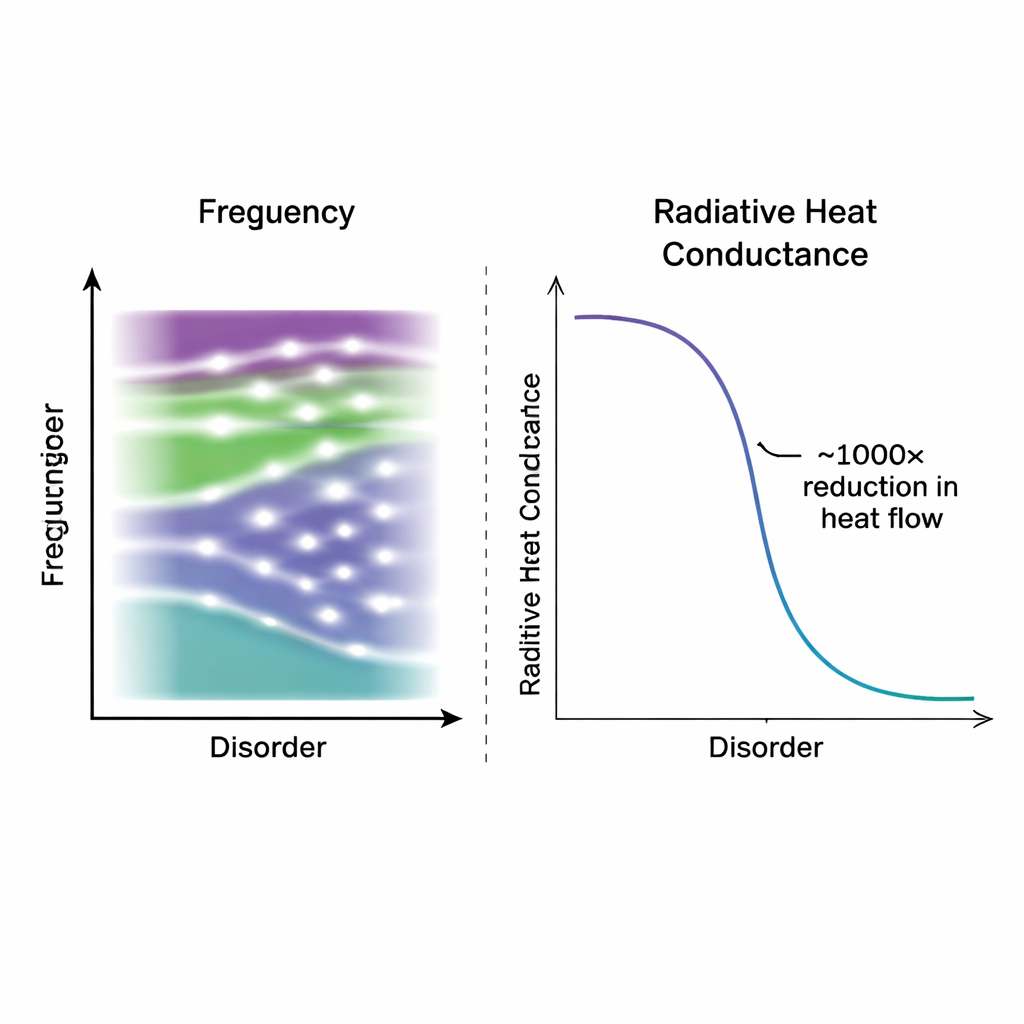
Turning down radiative heat with localization
To connect this wave behavior to heat flow, the researchers place the left‑most nanoparticle at a slightly higher temperature than the rest and calculate how much thermal radiation reaches the right‑most particle. They compute a transmission coefficient that tells how well each frequency channel carries energy along the chain, then decompose it into contributions from all the plasmonic modes. When modes are extended, many frequencies transmit efficiently, giving relatively large thermal conductance. Once localization sets in, most of these channels close: localized modes trap energy in small regions, and only a few special modes at specific frequencies contribute. In the low‑loss limit—where the material’s internal damping is very small—the resulting radiative thermal conductance can drop by more than three orders of magnitude compared with an ordered chain.
Design knobs: spacing and material loss
The work also explores two key control parameters: the average spacing between nanoparticles and the amount of Ohmic loss in the material. When particles are close, they interact strongly and many‑body effects are pronounced: ordered chains can greatly enhance heat flow compared with just two isolated particles, whereas strongly quasiperiodic chains can severely suppress it. As the spacing grows, all chains eventually behave like nearly independent particles and the conductance approaches the simple two‑body limit. Loss plays an equally crucial role. If damping inside the nanoparticles is too large, plasmon resonances broaden and overlap, washing out the distinction between extended and localized modes. The authors show that only when losses are sufficiently low—so that individual modes are well resolved—does Anderson localization manifest as a strong, tunable reduction of radiative heat transfer.
From abstract waves to practical insulation
In everyday terms, this study demonstrates a way to “freeze” the flow of thermal radiation along a line of nanoscale beads by exploiting wave interference rather than bulky insulating materials. By engineering a controlled kind of disorder in the spacing of plasmonic nanoparticles, the authors use Anderson localization to trap infrared energy and prevent it from traveling, potentially enabling ultrathin thermal barriers or finely tailored heat pathways in future thermophotonic devices. The results highlight both the promise and the practical constraints—especially material losses—of using wave physics to manage heat at the nanoscale.
Citation: Hu, Y., Yan, K., Xiao, WH. et al. Ultralow radiative heat flux by Anderson localization in quasiperiodic plasmonic chains. Commun Phys 9, 73 (2026). https://doi.org/10.1038/s42005-026-02506-w
Keywords: radiative heat transfer, plasmonic nanoparticles, Anderson localization, quasiperiodic chains, nanoscale thermal management