Clear Sky Science · en
Design of transient plasma photonic structure mirrors for high-power lasers using deep kernel Bayesian optimisation
Harnessing Lightning in a Box
Building ever more powerful lasers is a bit like trying to pipe a river through a drinking straw: the glass and mirrors that guide the light can only take so much before they break. This paper explores a radically different way to steer extreme laser beams without shattering anything. Instead of relying on solid mirrors, the authors use clouds of ionized gas—plasma—that can shrug off intensities that would destroy normal optics. With the help of advanced machine learning, they show how to shape these plasmas into temporary, highly reflective structures that could shrink and toughen the optics behind tomorrow’s highest‑power lasers.
Making Mirrors Out of Thin Air
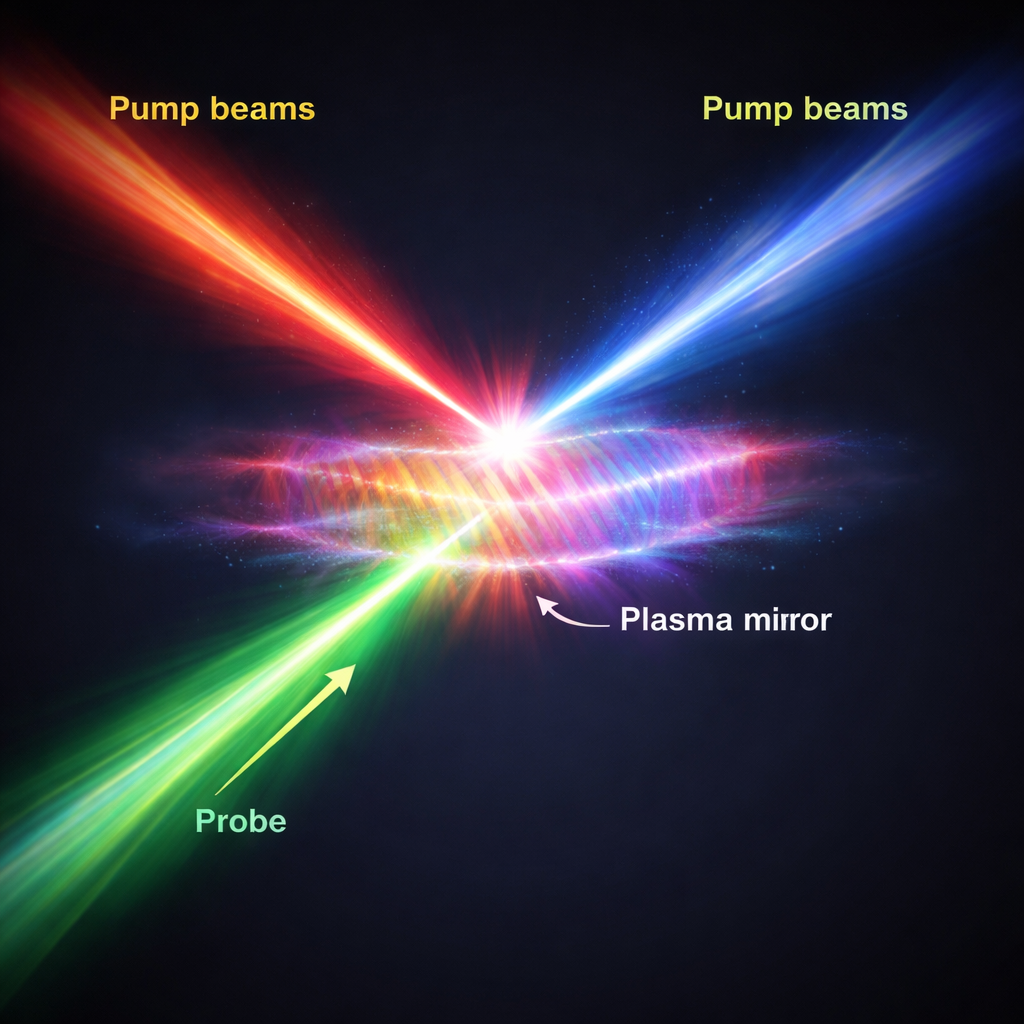
When intense laser pulses pass through a gas, they can rip electrons away from atoms and turn the gas into plasma. If two strong “pump” laser beams meet inside this plasma, their overlapping electric fields form a repeating pattern, like ripples where two sets of waves cross on a pond. This pattern pushes the light electrons back and forth much faster than the heavy ions can follow. Over a few trillionths of a second, the electrons’ motion tugs on the ions and rearranges them into a stack of dense and less‑dense layers—a kind of temporary crystal made of plasma. Because these layers are spaced just right, they act like a Bragg mirror, reflecting another “probe” laser beam very efficiently even though nothing solid is there.
Why Design Is So Hard
Turning this idea into a working optical component is not straightforward. The layered plasma structure is born, evolves, and fades on ultrafast time scales, and its properties depend on many interlocking knobs: the intensities, durations and arrival times of the pump and probe pulses, the initial gas density, and the size of the plasma region. Traditionally, physicists would run huge batches of computer simulations, scanning one parameter at a time, but this quickly becomes unmanageable when seven or more parameters all influence each other. Worse, changing one knob can shift the best values for all the others, so naïve trial‑and‑error sweeps can waste enormous computing time and still miss the best designs.
Letting an Algorithm Explore for Us
To tackle this complexity, the authors couple detailed plasma simulations to a modern optimization method called deep kernel Bayesian optimization. In essence, they train a statistical “surrogate” model that learns how different parameter combinations affect mirror performance, using only a modest number of expensive simulations as training data. A neural network first transforms the input parameters into a more informative representation, and then a Gaussian‑process layer estimates, with error bars, how good a new design is likely to be. At each step, the algorithm chooses the next simulation to run where it expects the biggest gain—either by improving a promising design or by exploring uncertain territory. This approach rapidly homes in on plasma structures that reflect more than 99 percent of the probe’s energy, or that act as 50/50 beam splitters, and it can be extended to more complex two‑dimensional focusing geometries.
A Surprise: Built‑In Pulse Compression
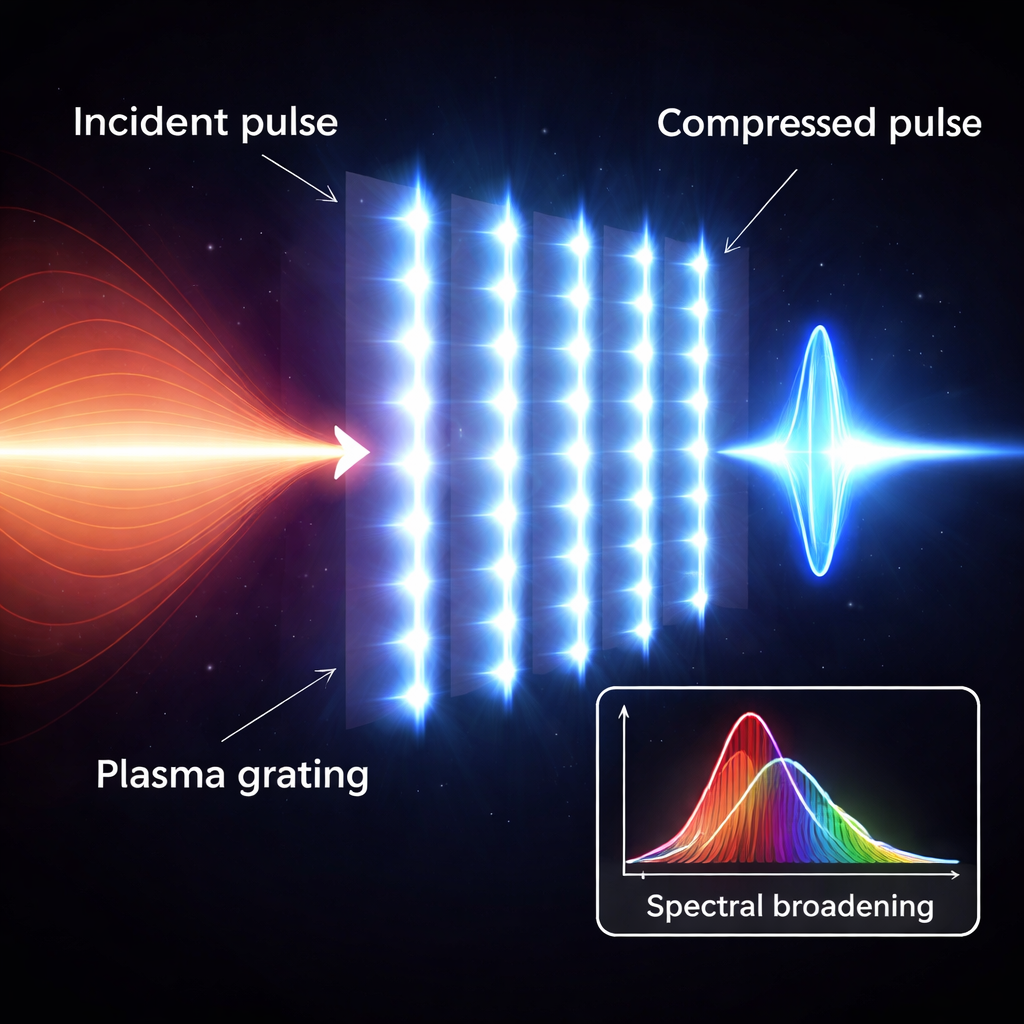
Because the optimization is guided only by a target—such as “maximize the peak brightness of the reflected pulse”—rather than by human expectations, it can stumble across unexpected behavior. When the authors asked the algorithm to maximize peak intensity, it found a regime where the plasma mirror not only reflected almost all the energy but also squeezed an initially unmodified (unchirped) laser pulse into a much shorter, brighter one. Inside the evolving plasma layers, different parts of the pulse see slightly different motion and spacing of the mirror, leading to small frequency shifts and a broader color spectrum, much like sound echoes bouncing off moving walls. The result is a compressed, more intense reflected pulse, achieved without the elaborate pre‑shaping normally needed for pulse compression.
What This Means for Future Lasers
For non‑specialists, the bottom line is that this work shows how to make “virtual” mirrors from plasma that can survive laser powers far beyond what glass can handle, and how to design them efficiently using machine learning. These transient plasma mirrors can be tuned to act as nearly perfect reflectors, beam splitters, or even as devices that sharpen and brighten laser pulses on the fly. By letting an algorithm sift through the messy physics and highlight promising configurations, researchers gain both practical designs for next‑generation laser systems and fresh insight into how light and plasma interact on extreme time and energy scales.
Citation: Ivanov, S., Ersfeld, B., Dong, F. et al. Design of transient plasma photonic structure mirrors for high-power lasers using deep kernel Bayesian optimisation. Commun Phys 9, 34 (2026). https://doi.org/10.1038/s42005-026-02505-x
Keywords: high-power lasers, plasma mirrors, laser pulse compression, Bayesian optimization, machine learning in physics