Clear Sky Science · en
Unveiling nontrivial fusion rule of Majorana zero mode using a fermionic mode
Why strange particles could power future quantum computers
Building a useful quantum computer requires qubits that can shrug off noise from the environment. A particularly exciting candidate is based on exotic quasiparticles called Majorana zero modes, which could store information in a way that is naturally protected from many types of errors. This paper proposes a comparatively simple way to test one of their most important and elusive properties—the way they "fuse" together—using devices that experimental groups are already learning to build.
Exotic building blocks for robust quantum bits
Majorana zero modes are special quantum states that can appear at the ends of certain superconducting materials. Unlike ordinary particles, they obey non‑Abelian statistics: when you exchange or merge them, the system’s quantum state changes in a way that depends on the order of operations, not just on where you end up. This order‑sensitivity is central to topological quantum computing, where logical operations are carried out by braiding and fusing such modes. Yet, despite years of indirect signatures, directly confirming this nontrivial fusion behavior has remained a major experimental challenge.
Using a simple helper to reveal a hidden rule
The authors show that you do not need to move multiple Majorana modes around in a complicated network to test their fusion rules. Instead, you can attach a single, ordinary fermionic mode—essentially a controllable electronic level, like that in a quantum dot—to just one Majorana zero mode at the end of a superconducting nanowire. In quantum language, that dot level can be thought of as two Majorana‑like pieces that are already fused together. By adjusting two knobs in time—the energy of the dot level and its coupling to the Majorana at the wire’s end—they construct sequences of “fusion” and “splitting” steps that either commute (trivial loops) or do not commute (nontrivial loops). 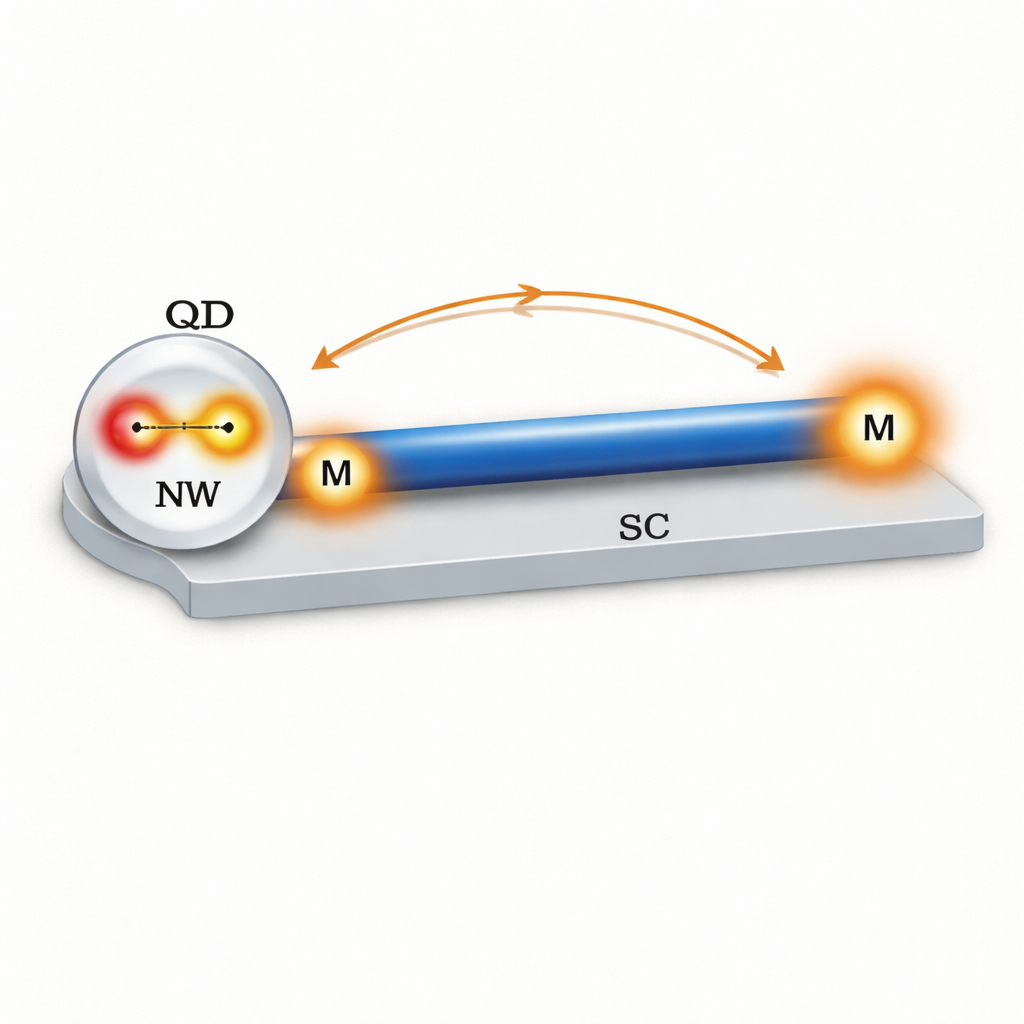
Watching electric charge as a telltale signature
When these fusion loops are carried out slowly, electric charge can be pumped between the dot and the superconducting wire. The theory predicts a striking distinction: in trivial loops, the net transferred charge after a full cycle is always zero, while in certain nontrivial loops it must be an exact integer multiple of the electron charge, or in some cases a robust half‑integer in intermediate steps. The key control is whether the dot energy and the coupling strength cross through zero energy an odd or even number of times during the loop. An odd number of crossings leads to nontrivial charge pumping tied to the underlying fusion rule of the Majorana modes; an even number yields no net transfer. This charge motion corresponds to flipping the parity—the even‑or‑odd electron count—of the superconducting segment, something that modern charge‑sensing techniques can detect in single shots.
From ideal models to realistic devices
The authors go beyond an abstract model and simulate a realistic semiconductor nanowire coated with a superconductor and coupled to a quantum dot, including imperfections that are known to produce more mundane Andreev bound states. They find that in the regime where genuine Majorana modes exist, the predicted integer charge pumping is remarkably robust: it does not depend on the initial occupancy of the dot and survives realistic energy scales and time windows. Near‑zero‑energy Andreev states can mimic some aspects of the effect, but they are less stable and their response depends sensitively on details such as whether they are more electron‑like or hole‑like. These distinctions provide practical clues for experimentalists trying to separate true topological behavior from look‑alike signals. 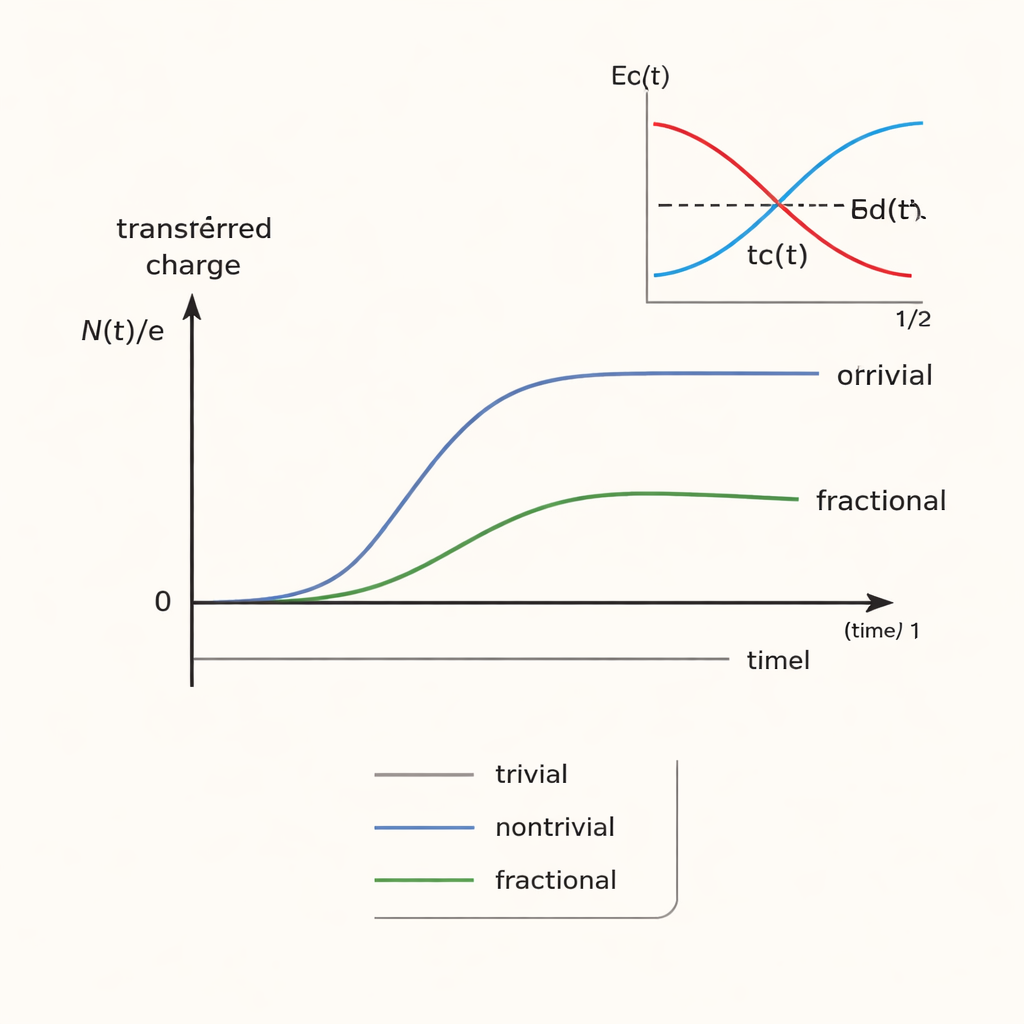
A practical roadmap toward topological quantum logic
Put simply, this work outlines a realistic experiment in which controlled variations of gate voltages should cause electrons to be pumped in or out of a device in a quantized way, if and only if the hidden fusion rules of Majorana zero modes are at play. Because the protocol uses a single quantum dot as both a participant in and a probe of the fusion process, it avoids the need to fine‑tune the topological superconductor itself during the measurement. The required device ingredients—hybrid nanowires, gate‑defined quantum dots, and sensitive charge readout—are already available in state‑of‑the‑art laboratories. If implemented, this scheme would provide one of the clearest tests yet that Majorana modes really do fuse in the peculiar, non‑Abelian way required for fault‑tolerant topological quantum computation.
Citation: Zhang, Y., Zhu, X., Li, C. et al. Unveiling nontrivial fusion rule of Majorana zero mode using a fermionic mode. Commun Phys 9, 70 (2026). https://doi.org/10.1038/s42005-026-02504-y
Keywords: Majorana zero modes, topological superconductors, quantum dots, charge pumping, topological quantum computation