Clear Sky Science · en
Nonlinear dynamics and Fermi-Pasta-Ulam-Tsingou recurrences in macroscopic ultra-low loss levitation
Levitating Objects to Explore Hidden Order
Imagine a tiny glass cube, just half a millimeter across, floating steadily in mid‑air for hours inside a vacuum chamber—without spinning out of control or needing any power to hold it up. This paper describes how researchers built exactly such a system and then used it as a playground to watch how motion and energy slosh around in surprisingly orderly ways, even when the motion becomes complex and nearly chaotic. These insights are relevant to future ultra‑precise sensors, and to deep questions about how complicated systems share and store energy.
Floating on Magnetism, Not on Magic
At the heart of the experiment is a clever magnetic trap. The team arranged eight strong permanent magnets in a ring, added a metal core up the middle, and capped it with a metal disk that has a small opening at the center. By carefully shaping the magnetic field in this region, they created a spot where a weakly magnetic piece of quartz experiences an upward push that balances gravity. The quartz cube, about 0.5 mm on a side and weighing roughly a third of a milligram, comes to rest around a fraction of a millimeter above the magnets, with no physical contact and no active control electronics. Because the quartz is an electrical insulator, it avoids energy loss from swirling electrical currents, and the trap can hold it with extraordinarily little friction-like damping.
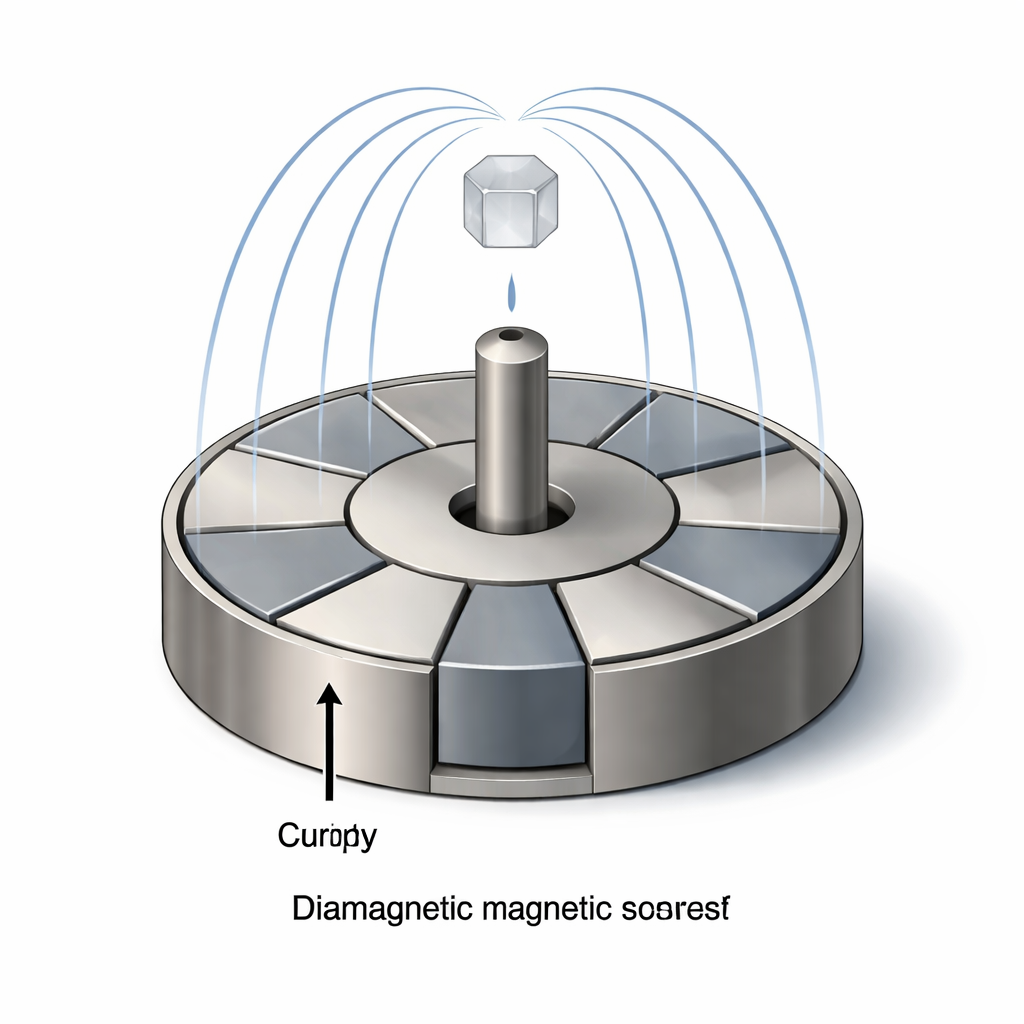
Measuring Motion with Almost No Friction
To study the cube’s motion, the researchers placed the trap in an ultra‑high‑vacuum chamber, reducing air drag to almost nothing. They then watched the cube using several optical methods, including high‑speed cameras and a simple single‑pixel light detector that monitors how a weak laser beam is partly blocked or scattered as the cube moves. From these signals they could identify several basic ways the cube likes to move: it can swing up and down, slide sideways, or gently rock and twist. These motions, called modes, had natural frequencies from a fraction of a hertz up to around 10 hertz. By giving the cube a tiny nudge—either mechanically or with a small drive coil—and then letting it ring down, they could see how slowly the motion decayed. The slowest decay corresponded to an effective damping rate of only a few millionths of a hertz, implying that in an ideal case the cube could keep oscillating for many days. This extreme isolation translates into a very sensitive response to tiny forces and accelerations, comparable to or better than some state‑of‑the‑art precision instruments, yet achieved at room temperature.
When Simple Vibrations Talk to Each Other
Because the magnetic field around the cube is not perfectly simple, and the cube itself is not perfectly symmetric, its different modes of motion are subtly linked. When the cube moves in one direction, it experiences a slightly different magnetic landscape in other directions, so one type of motion can feed energy into another. The team observed clear signs of this interlinked behavior. After they excited one mode strongly and then turned off the drive, the energy did not just fade away smoothly. Instead, it flowed back and forth among modes in a structured way. Higher harmonics—motions at multiples of a basic frequency—appeared and stayed coherent with the original mode. In some conditions, a multiple of a slow rocking motion nearly matched the frequency of a faster sliding motion, leading to particularly strong coupling and patterns reminiscent of intricate Lissajous figures when one motion was plotted against another. These are hallmarks of a system where nonlinearity—the tendency of restoring forces to deviate from a simple spring—plays a central role.
Echoes of a Classic Puzzle in Physics
More than half a century ago, physicists studying vibrating springs in a computer experiment found a surprise: instead of quickly sharing energy among all possible motions, the system often sent energy back to its starting point in long‑lived recurrences. This famous Fermi–Pasta–Ulam–Tsingou (FPUT) problem revealed that even fairly simple nonlinear systems can resist full “thermalization,” or equal energy sharing. The levitated cube shows a similar flavor of behavior. By tracking the kinetic energy in each main mode over time, the authors saw oscillatory exchanges where one mode’s energy decayed only to rise again later, rather than simply dying away. They quantified how spread out the energy was among modes using an entropy‑like measure and found that the system often remained in low‑entropy states, with energy concentrated in a few motions. At the same time, subtle signs of chaos emerged: neighboring trajectories in the reconstructed motion space diverged at a steady exponential rate, corresponding to a positive Lyapunov exponent. This means the motion is sensitive to initial conditions, yet still constrained enough to show partial recurrences instead of complete randomness.

From Floating Cubes to Future Sensors
For non‑experts, the key takeaway is that the team has built a nearly frictionless, power‑free way to suspend a tiny object and control its motion with exquisite precision. This platform lets them watch how energy moves through a complex but well‑understood mechanical system, illuminating why some systems fail to “forget” their starting conditions even as they flirt with chaos. Such control is not only of intellectual interest: the same levitated cubes, tuned and perhaps combined with light‑based forces, could underpin next‑generation accelerometers, gyroscopes, and tests of fundamental physics, all operating quietly at room temperature while hovering above a simple array of permanent magnets.
Citation: Malekian Sourki, M., Boinde, W., Najjar Amiri, A. et al. Nonlinear dynamics and Fermi-Pasta-Ulam-Tsingou recurrences in macroscopic ultra-low loss levitation. Commun Phys 9, 65 (2026). https://doi.org/10.1038/s42005-026-02501-1
Keywords: diamagnetic levitation, nonlinear vibrations, Fermi-Pasta-Ulam-Tsingou recurrence, precision sensing, chaotic dynamics