Clear Sky Science · en
Experimental realization of a full-band wave antireflection based on temporal taper metamaterials
Why bouncing waves matter
Whenever light, radio, or any other wave hits a change in material—like air to glass in a camera lens—part of it bounces back. These reflections waste energy, distort signals, and limit how well everything from solar cells to 5G antennas and optical chips can perform. Engineers fight them with special coatings and carefully shaped circuits, but those tricks usually work only over a limited range of colors or frequencies. This paper reports a new way to tame reflections by changing a material in time instead of stacking extra layers in space, and it has been demonstrated experimentally in real hardware for the first time.
Turning time into a design knob
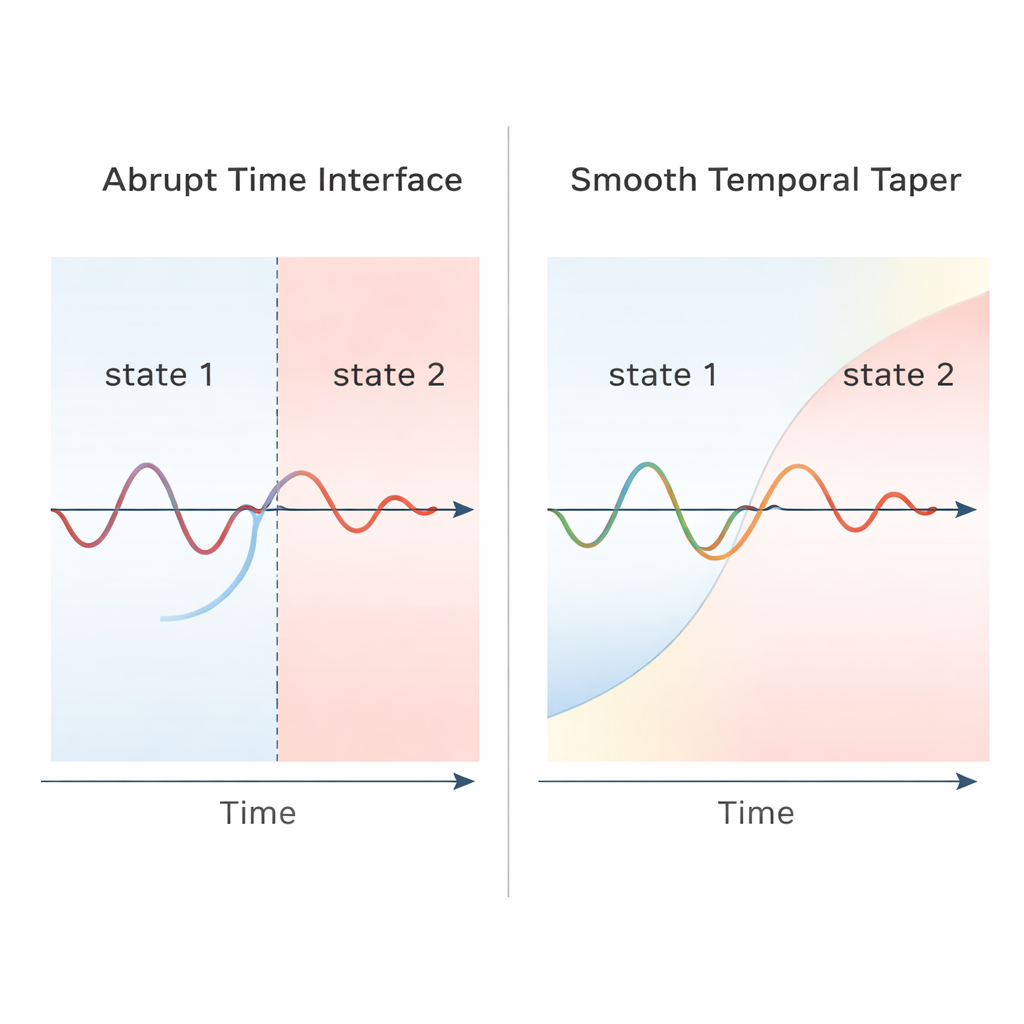
Traditional anti-reflection methods are built in space: add a thin layer on glass, or gradually vary a circuit’s geometry so the wave barely notices the transition. Over the last few years, theorists have asked a different question: what if we leave space alone and instead change the material’s properties suddenly or gradually in time while the wave is passing through? Such “temporal metamaterials” add time as a new design knob. Earlier proposals showed that a sudden change can split a wave into “time-reflected” and “time-transmitted” parts and even shift its frequency, but they assumed ideal, step-like switching that today’s electronics and photonics can’t realistically achieve at high speed.
From abrupt jumps to gentle temporal ramps
The authors focus on a more realistic and powerful idea: a “temporal taper.” It is the time-domain cousin of a spatial taper—the smooth thickness change you might use to merge two very different cables. Instead of thickness, the material’s effective electrical properties are smoothly varied over a finite time window. Theory shows that a well-shaped temporal taper can suppress reflections over almost the entire frequency band, leaving only an unavoidable quirk at exactly zero frequency. The team derives a compact formula for how much of a wave is reflected as a function of frequency for a general temporal taper, then specializes it to an exponential profile that is known to offer especially broad-band performance.
Building a time-shaped circuit
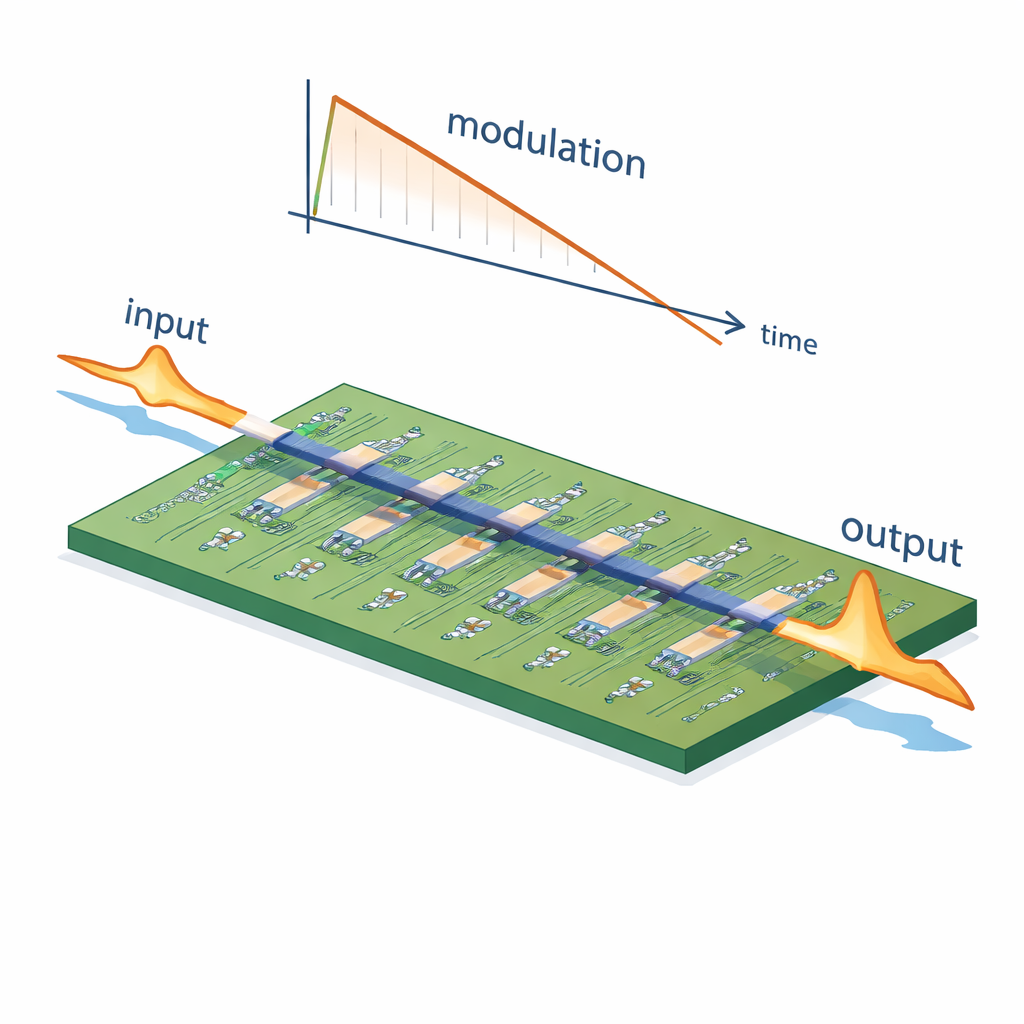
To put this idea to the test, the researchers build a one-dimensional temporal metamaterial they call a temporal-taper transmission line (TTTL). It is a microwave circuit: a microstrip line broken into 32 repeated cells, each loaded with a pair of tiny voltage-controlled capacitors known as varactors. By feeding all the varactors with a carefully crafted ramp voltage, they smoothly double the effective capacitance of the line over about nine billionths of a second, which in turn changes its wave impedance in time. A special “differential modulation” scheme wires each varactor pair in opposite directions so that the strong control voltage cancels along the main path, letting the much weaker test signal be measured cleanly without being drowned out by the modulation.
Watching waves slide in frequency, not bounce back
With this setup, the team launches a short Gaussian-shaped microwave pulse into the TTTL and triggers the temporal taper just as the pulse reaches the middle of the line. First they verify that the static properties of the line match simulations, so any later effects truly come from the time variation. They then analyze how the output pulse’s spectrum shifts: a pulse centered at 80 MHz emerges with its peak near 55 MHz, in close agreement with the frequency change predicted from basic conservation laws linking the initial and final effective media. Crucially, they compare two cases at the input port: a sharp switching of the line’s properties versus the smooth temporal taper. The abrupt change creates a clear time-reflected signal, seen tens of nanoseconds after the initial pulse and also as a broad spectral feature. When the temporal taper is used instead, that delayed reflection is nearly wiped out across a wide frequency band, leaving only a small low-frequency residue tied to a known theoretical limitation.
Adapting to whatever load is attached
Beyond proving that temporal tapers work as promised, the authors show they can be used as agile impedance transformers. In many real systems, the load at the end of a line—a power amplifier, antenna, or energy harvester—does not match the line’s impedance, causing reflections. Here, the TTTL begins with a fixed starting impedance but is time-shaped so that its impedance evolves toward the value of whatever load is connected. Experiments with several different loads reveal that the time-reflected signal drops dramatically when the temporal taper is applied, even though no extra spatial matching circuits are added. This dynamic, programmable matching contrasts with conventional fixed tapers or exotic active circuits and could be especially attractive where operating conditions change rapidly.
What this means going forward
For a non-specialist, the takeaway is that the authors have shown you can “hide” a strong mismatch between two parts of a wave system not by inserting more hardware, but by briefly and gently reshaping the system in time while the wave passes through. Their temporal taper almost completely eliminates reflections over a broad frequency range, while simultaneously shifting the wave’s color (frequency) and adapting to different end loads. Although their demonstration occurs at radio frequencies on a printed circuit board, the same principles could be pushed to optics with faster switching elements, helping future photonic chips and even nanoscale plasmonic devices move light around with far less loss and distortion.
Citation: Hou, H., Peng, K., Wang, Y. et al. Experimental realization of a full-band wave antireflection based on temporal taper metamaterials. Commun Phys 9, 64 (2026). https://doi.org/10.1038/s42005-026-02500-2
Keywords: temporal metamaterials, anti-reflection, impedance matching, microwave photonics, time-varying media