Clear Sky Science · en
Non-Hermitian skin effect without point-gap topology in 2D quasicrystals
Why edges can secretly dominate a whole material
In many everyday materials, what happens deep inside matters more than what happens at the surface. But in some exotic systems, the opposite is true: a huge number of internal vibration or wave patterns pile up right at the edges. This study explores a surprising version of that effect in a special kind of two‑dimensional lattice called a quasicrystal, revealing that edge‑dominated behavior can arise even when a key type of topological fingerprint is completely absent.
When loss and gain bend the rules
Physicists often describe systems—such as crystals, optical devices, or electrical circuits—using “Hamiltonians,” mathematical objects that summarize how waves or particles move. In ordinary, perfectly closed systems these Hamiltonians are Hermitian, which guarantees real energy levels and neat, orthogonal wave patterns. But realistic systems leak energy, experience loss and gain, or couple to an environment. Their effective Hamiltonians become non‑Hermitian, with complex energy values and unusual behaviors. One of the most striking is the non‑Hermitian skin effect, where not just a few, but a macroscopic fraction of all wave patterns accumulates at the edges, dramatically reshaping transport and response compared with a perfectly closed material.
Breaking a supposed topological rule
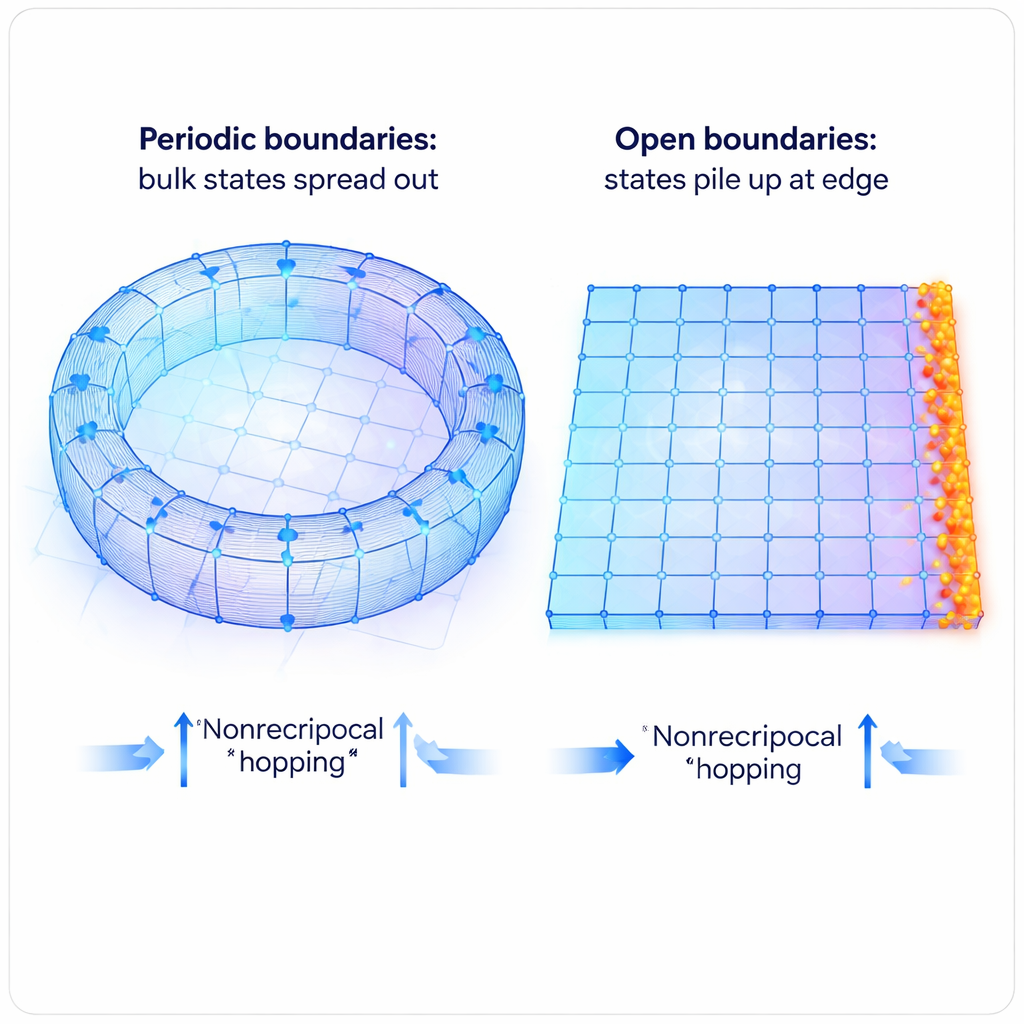
Until now, theory suggested that this skin effect in one dimension must be tied to a special kind of spectral topology called a point gap: when you track all possible energies as momentum varies under periodic boundary conditions, they form loops that wind around a chosen reference point in the complex energy plane. That winding number was believed to be the deciding criterion for skin behavior. The author challenges this view in a carefully designed two‑dimensional model: a square lattice with asymmetric hopping in one direction (waves prefer to move “up” rather than “down”) and an incommensurate magnetic field that turns the lattice into a quasicrystal. Under periodic boundaries in both directions, all energies are real, the spectrum shows no point‑gap winding, and yet the system exhibits an enormous degeneracy—many distinct states sharing the same energy.
Quasicrystal trick: hiding asymmetry with disorder
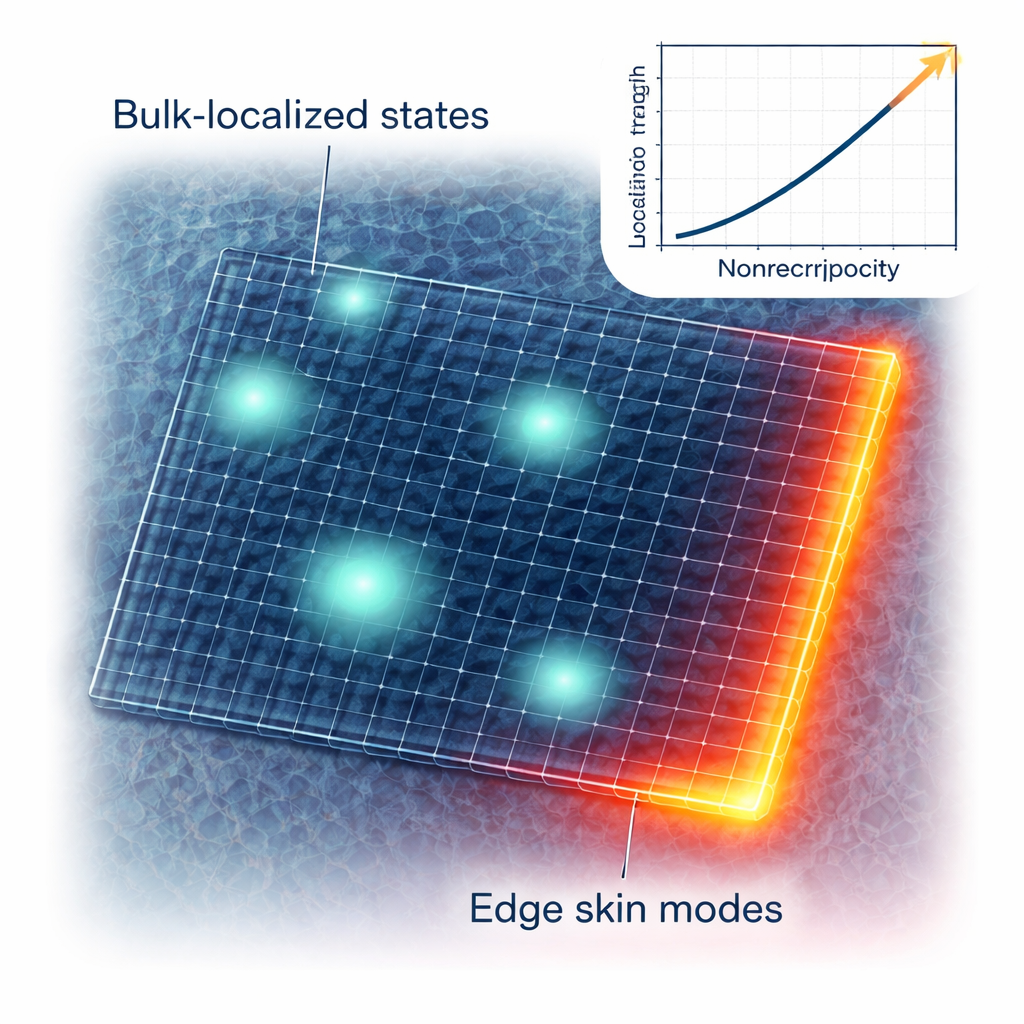
The key to the new effect lies in how the quasicrystal localizes waves along one direction. The incommensurate magnetic field induces Anderson localization along the nonreciprocal direction: each state is sharply concentrated around a particular row, even though it spreads freely along the perpendicular direction. This directional localization effectively cancels the direct impact of the asymmetric hopping on the spectrum, keeping the energies real and topologically trivial with respect to point gaps. At the same time, it generates a huge family of nearly identical localized states, differing only by where they sit along the localized direction or by their momentum along the extended direction. Together, these form highly degenerate energy levels that are exquisitely sensitive to how the boundaries are chosen.
How open edges reshuffle everything
The turning point comes when periodic boundaries are replaced by open ones. Under open conditions in both directions, a mathematical “imaginary gauge” transformation maps the nonreciprocal model to a standard Hermitian version with the same real energies but different wave shapes. The crucial change is that open edges in one direction force previously independent, localized bulk states—each with different positions and momenta—to superpose in very specific ways to satisfy the boundary constraints. This superposition breaks the large degeneracies and converts states that were localized inside the material into new states that extend across the sample but are exponentially concentrated along one edge. In other words, the degeneracy breaking induced by open boundaries turns an entire band of bulk states into skin modes, even though the underlying spectrum under periodic boundaries never developed a point gap.
Strange wave motion and future playgrounds
This boundary‑driven skin effect shows up dramatically in wave‑packet dynamics. A wave packet launched in the interior first spreads mainly along one direction, while its center of mass hardly moves along the nonreciprocal axis because bulk transport there is suppressed. Only when it reaches the boundaries do special chiral edge states and their non‑Hermitian overlaps take over, rapidly dragging the packet along the edge toward a corner, where it eventually settles into a skin‑like profile. This unusual sequence—bulk spreading without drift, followed by sudden edge‑dominated motion—differs sharply from the steady directional flow expected from more conventional skin effects. The work suggests that similar boundary‑induced phenomena could emerge in a wide range of engineered platforms, from cold atoms and photonic structures to topolectrical circuits, wherever artificial magnetic fields, quasicrystalline patterns, and nonreciprocal couplings can be combined.
Citation: Cai, X. Non-Hermitian skin effect without point-gap topology in 2D quasicrystals. Commun Phys 9, 61 (2026). https://doi.org/10.1038/s42005-026-02496-9
Keywords: non-Hermitian skin effect, quasicrystal, topological phases, Hofstadter model, edge states