Clear Sky Science · en
Optimal coloring and strain-enhanced superconductivity in LinBn+1Cn−1
Why squeezing crystals matters
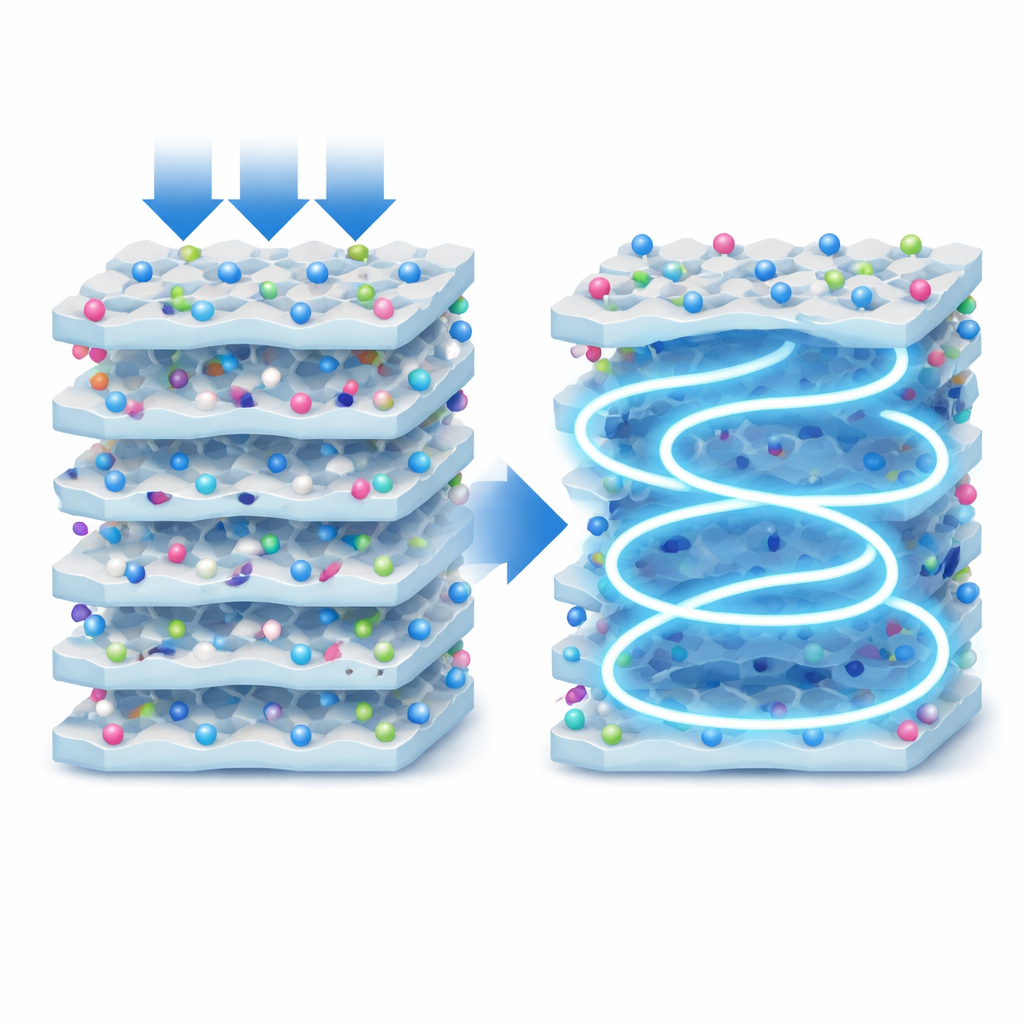
Superconductors are materials that can carry electric current without any resistance, a property that could revolutionize power grids, magnets, and electronics. But most known superconductors only work at very low temperatures, often close to absolute zero. This paper explores an unusual family of lithium–boron–carbon crystals and shows that, under the right atomic arrangement and with a controlled mechanical squeeze, one of them can switch from being almost useless as a superconductor to potentially operating at temperatures reachable with liquid hydrogen or simple cryocoolers.
Designing a new playground for electrons
The study focuses on compounds called lithium borocarbides, which are cousins of magnesium diboride, a well-known superconductor. In these materials, strong bonds between boron and carbon atoms form flat layers where electrons can move. Theory has long suggested that if the bonding electrons in such layers become metallic—that is, free to move—they could support high-temperature superconductivity. Earlier work proposed that particular recipes, named Li2B3C and Li3B4C2, might reach very high critical temperatures. However, those studies assumed simple, idealized patterns for how boron and carbon atoms sit on the lattice, leaving open a difficult “coloring” problem: exactly which sites are occupied by which element.
Finding the most stable atomic pattern
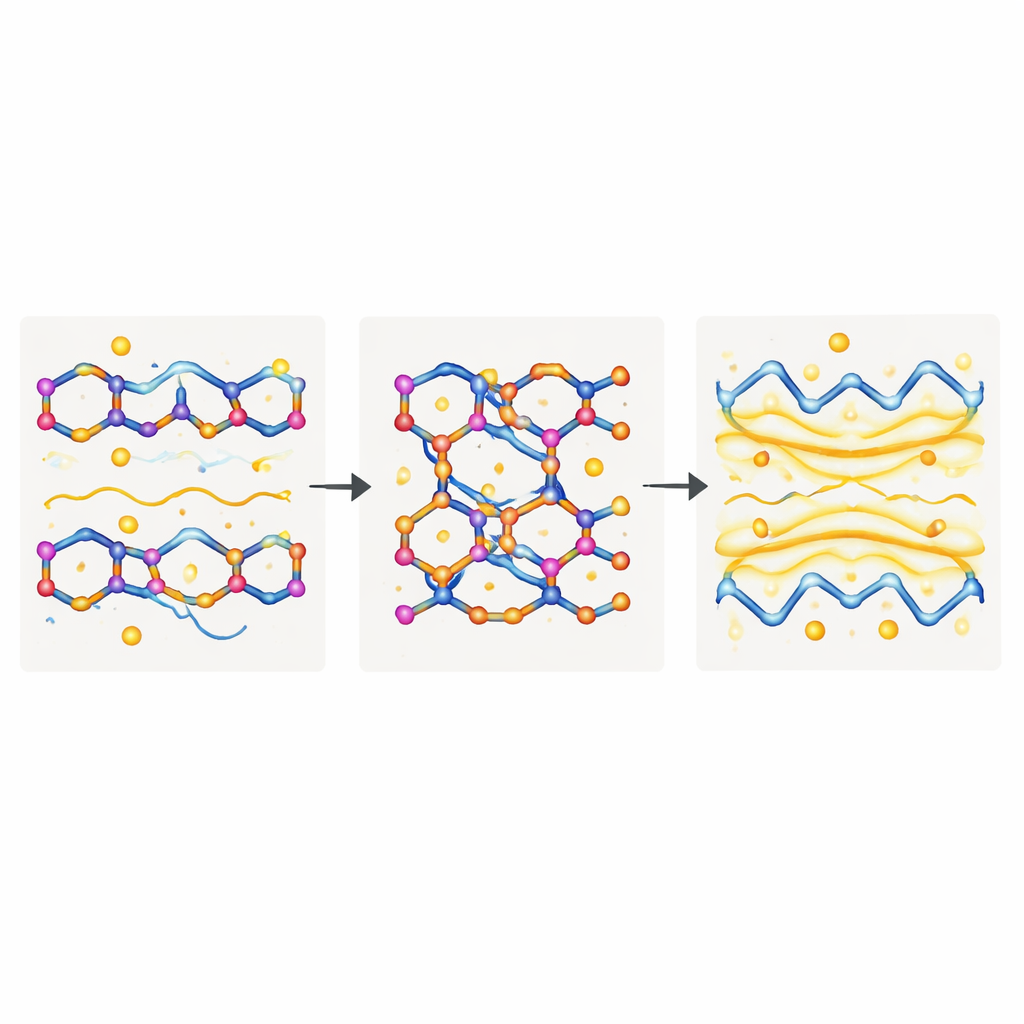
Using a statistical technique called cluster expansion, combined with detailed quantum-mechanical calculations, the authors systematically searched through many possible boron–carbon arrangements for Li2B3C and Li3B4C2. They found new, energetically favored structures that look nothing like the earlier guesses. Instead of uniform layers, each boron–carbon sheet organizes into alternating zigzag chains of pure boron–boron bonds and mixed boron–carbon bonds, linked by shorter “bridge” bonds. This subtle rearrangement lowers the overall energy of the crystal but also reshapes how electrons are distributed among the different bonds, and therefore how they respond to vibrations of the lattice.
When promising electrons go quiet
Superconductivity in these materials is driven by vibrations of the atoms (phonons) that help electrons pair up. The effectiveness of this process depends on how strongly the electronic states at the Fermi level—the energy window where conduction happens—shift when the atoms vibrate. In the newly identified ground-state structure of Li2B3C, the key bonding states that would couple most strongly to vibrations end up either completely filled or pushed away from the Fermi level. The electrons that remain at the Fermi level live in more “nonbonding” states that hardly feel the atomic motion. As a result, the calculated strength of the electron–phonon coupling is weak, and the predicted superconducting transition temperature collapses to below 0.03 kelvin, far lower than earlier optimistic estimates.
Turning pressure into performance
The story changes dramatically when the crystal is gently squeezed along one in-plane direction. The researchers simulated applying a modest uniaxial compressive strain—shrinking the lattice by a few percent along a single crystallographic axis. This distortion slightly shortens some bonds, changes bond angles, and increases the mixing between bridge and zigzag bonding states. Under about 5% compression, certain boron–boron bonding bands are pushed right through the Fermi level, creating new, nearly flat electronic states that are extremely sensitive to lattice vibrations. These states develop a large “deformation potential,” meaning phonons can efficiently modulate their energy. The combined effect is a huge boost in electron–phonon coupling and a calculated superconducting transition temperature of roughly 37 kelvin, more than four orders of magnitude higher than in the unstrained crystal.
What this means for future superconductors
This work shows that having the right chemical ingredients is not enough; the detailed atomic pattern and the mechanical environment can make or break superconductivity. In lithium borocarbides, the optimal, most stable coloring of boron and carbon atoms naturally suppresses pairing, but targeted strain engineering can resurrect and greatly enhance it by bringing the most responsive bonding states to the Fermi level. More broadly, the study highlights deformation potential—the sensitivity of electronic energies to atomic motion—as a key design metric for phonon-based superconductors. By carefully controlling both composition and strain, researchers may be able to turn other seemingly quiet materials into robust superconductors operating at technologically useful temperatures.
Citation: Gu, Y., Hu, J., Jiang, H. et al. Optimal coloring and strain-enhanced superconductivity in LinBn+1Cn−1. Commun Phys 9, 81 (2026). https://doi.org/10.1038/s42005-026-02495-w
Keywords: superconductivity, lithium borocarbides, electron phonon coupling, strain engineering, high Tc materials