Clear Sky Science · en
Time-domain field correlation measurements enable tomography of highly multimode quantum states of light
Seeing ultrafast light in greater detail
Light pulses used in modern quantum technologies can be unimaginably short and intricate, carrying information spread over many “chunks” in time and color. Yet our usual tools for looking at these pulses often blur this internal structure, making it hard to fully understand or control them. This paper presents a new way to dissect such complex quantum light, letting researchers map out how different pieces of a pulse are arranged and correlated in time without needing detailed prior knowledge of its shape.
Why quantum light pulses are hard to read
Short light pulses used in quantum communication and sensing are not simple flashes. They are built from many overlapping temporal modes—distinct patterns in time and frequency—that can each carry quantum noise, squeezing, or single photons. Conventional quantum state “tomography” aims to reconstruct the full state of such light, but scales poorly as the number of modes grows. Standard homodyne detection, where the unknown pulse is compared to a carefully shaped reference pulse, works best when that reference is already matched to the important modes. When the pulse is very broadband or its structure is unknown, this requirement becomes a serious limitation.
Sampling the field directly in time
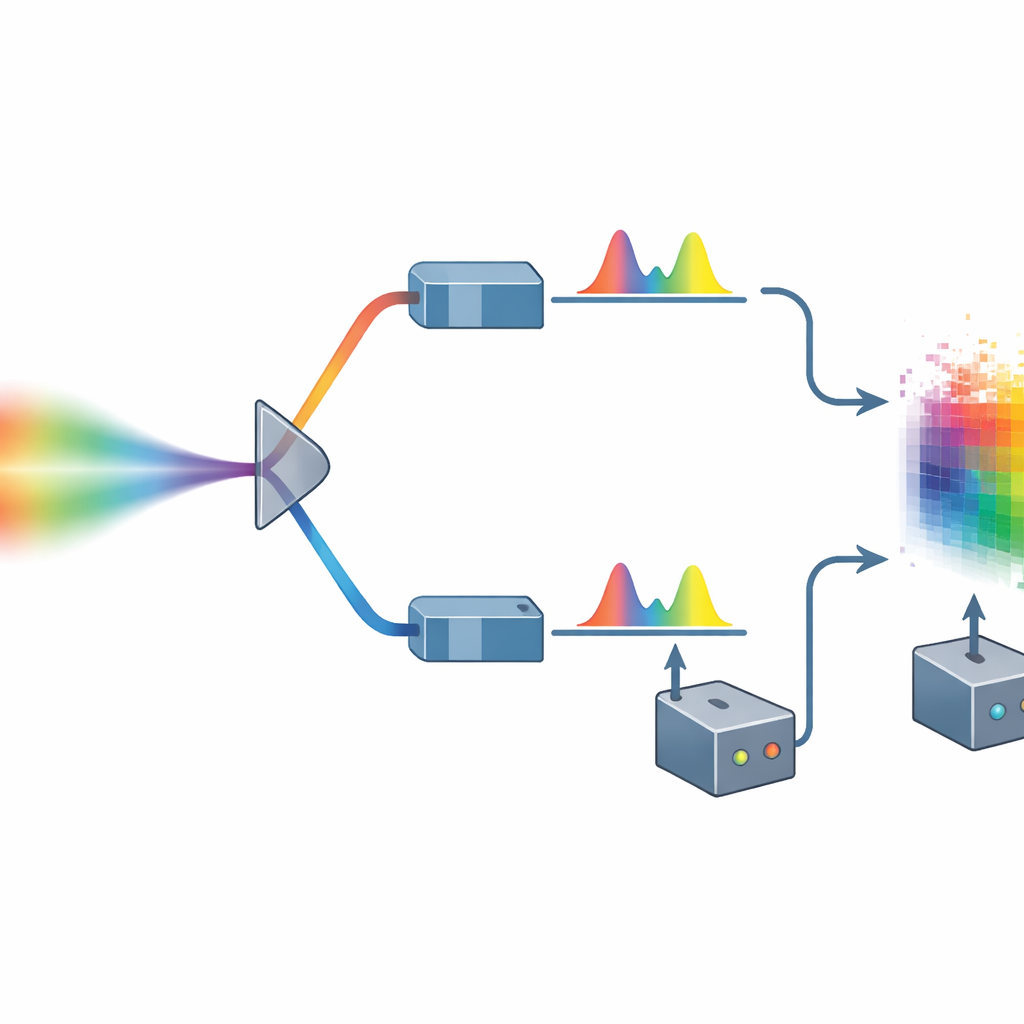
The authors propose a different route they call correlation tomography. Instead of tailoring the reference pulse to individual modes, they use very short local oscillator pulses that act like ultrafast sampling windows on the electric field. In their scheme, both the unknown quantum pulse and the reference are split into two arms. In each arm, the reference pulse can be delayed independently, so that two field measurements probe the quantum pulse at two chosen time offsets. These two measurements are performed simultaneously and their outputs are combined into time-resolved correlation data, effectively recording how fluctuations at one moment in the pulse are linked to fluctuations at another. This idea works both for standard homodyne setups at optical or microwave frequencies and for electro‑optic sampling, which converts lower‑frequency, hard‑to‑detect fields in the terahertz and mid‑infrared range into an optical signal.
Extracting hidden modes by smart post‑processing
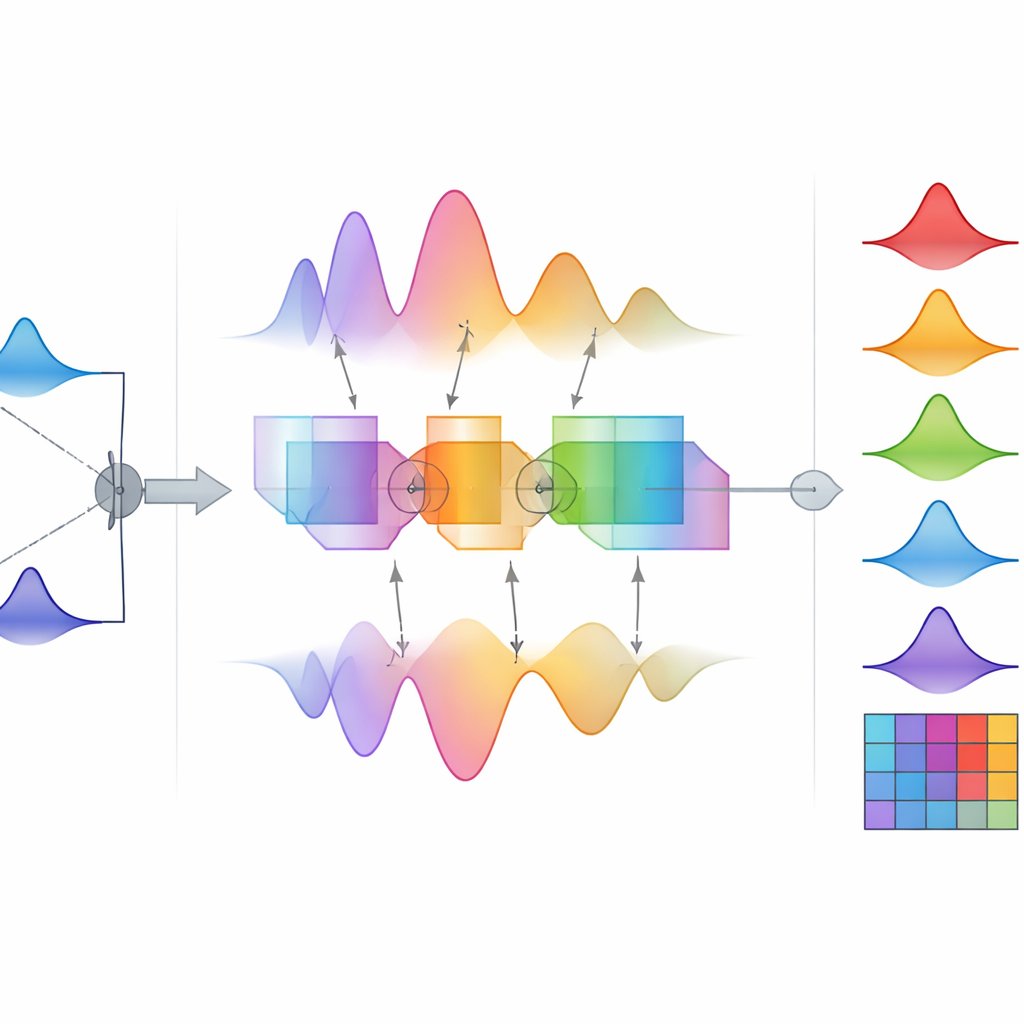
The key advance lies in how the authors turn overlapping time samples into a clean set of underlying modes. The local oscillator pulses at different delays are not orthogonal—each measurement window partly covers the same parts of the quantum pulse. Using a mathematical procedure based on singular value decomposition, they treat all the reference pulses used in the experiment as a set of basis functions and orthogonalize them after the fact. This process effectively builds a new mode basis tailored to the measurement bandwidth and the chosen set of time delays. From the measured correlation matrix and the known properties of vacuum noise, they reconstruct the covariance matrix of the quantum field in this new basis. For Gaussian states—an important class that includes squeezed light—this covariance matrix fully characterizes the state, even when it occupies many modes.
Revealing when simple sampling fails
The paper also explores what the time‑resolved correlations tell us physically. If one only measures the field locally in time, without correlating two arms, strongly squeezed pulses can appear deceptively similar to warm, noisy light. This apparent “thermalization” arises because the ultrafast measurement only sees part of the entangled multimode state, effectively tracing over the rest. By analyzing measures such as entropy, entanglement between the two arms, and more general quantum correlations, the authors show that correlation measurements recover information lost in purely local sampling. They quantify how the number of modes that can be reconstructed grows with the detection bandwidth and the density of time delays, and highlight how electro‑optic sampling can shift the accessible modes toward lower frequencies, reaching sub‑cycle resolution where electronics cannot follow.
First steps toward more exotic quantum light
While the method is naturally suited to Gaussian states, the authors go further by deriving the full joint probability distribution for correlation measurements on non‑Gaussian states, focusing on Fock states with a fixed number of photons. Even though such states look rotationally symmetric in standard phase‑space plots, the way the correlation statistics change as one arm’s delay is scanned carries information about the internal temporal shape of the photon wave packet. This opens the possibility of iteratively matching the reference pulse to the unknown mode and, ultimately, extending the reconstruction to more complex non‑Gaussian states that are central to advanced quantum technologies.
What this means for future quantum technologies
In everyday terms, this work provides a sharper “ultrafast camera” for quantum light. Instead of guessing the right viewing mode in advance, experimenters can scan the pulse in time with short sampling windows, measure how the results correlate, and then let post‑processing uncover the natural building blocks of the field. For devices ranging from quantum key distribution links to ultrafast quantum sensors, being able to reliably reconstruct many‑mode quantum states—even in spectral regions where detectors struggle—will be crucial. Correlation tomography thus offers a practical and numerically stable path to mapping the full internal structure of complex quantum light pulses.
Citation: Hubenschmid, E., Burkard, G. Time-domain field correlation measurements enable tomography of highly multimode quantum states of light. Commun Phys 9, 89 (2026). https://doi.org/10.1038/s42005-026-02493-y
Keywords: quantum state tomography, squeezed light, electro-optic sampling, temporal modes, quantum correlations