Clear Sky Science · en
Exceptional points preceding and enabling spontaneous symmetry breaking
When Symmetry Fails in Surprising Ways
Many of the most striking effects in modern physics depend on symmetry— and on how that symmetry can suddenly collapse. This paper explores a subtle twist in that story for light trapped inside tiny optical rings and cavities. It shows that two ideas often treated as twins in advanced photonics—"exceptional points" and "spontaneous symmetry breaking"—are not in fact the same event, even though one reliably foreshadows the other. That insight matters for next‑generation sensors, lasers, and optical chips that aim to harness these effects for real‑world devices.
Light Chasing Its Tail in Tiny Cavities
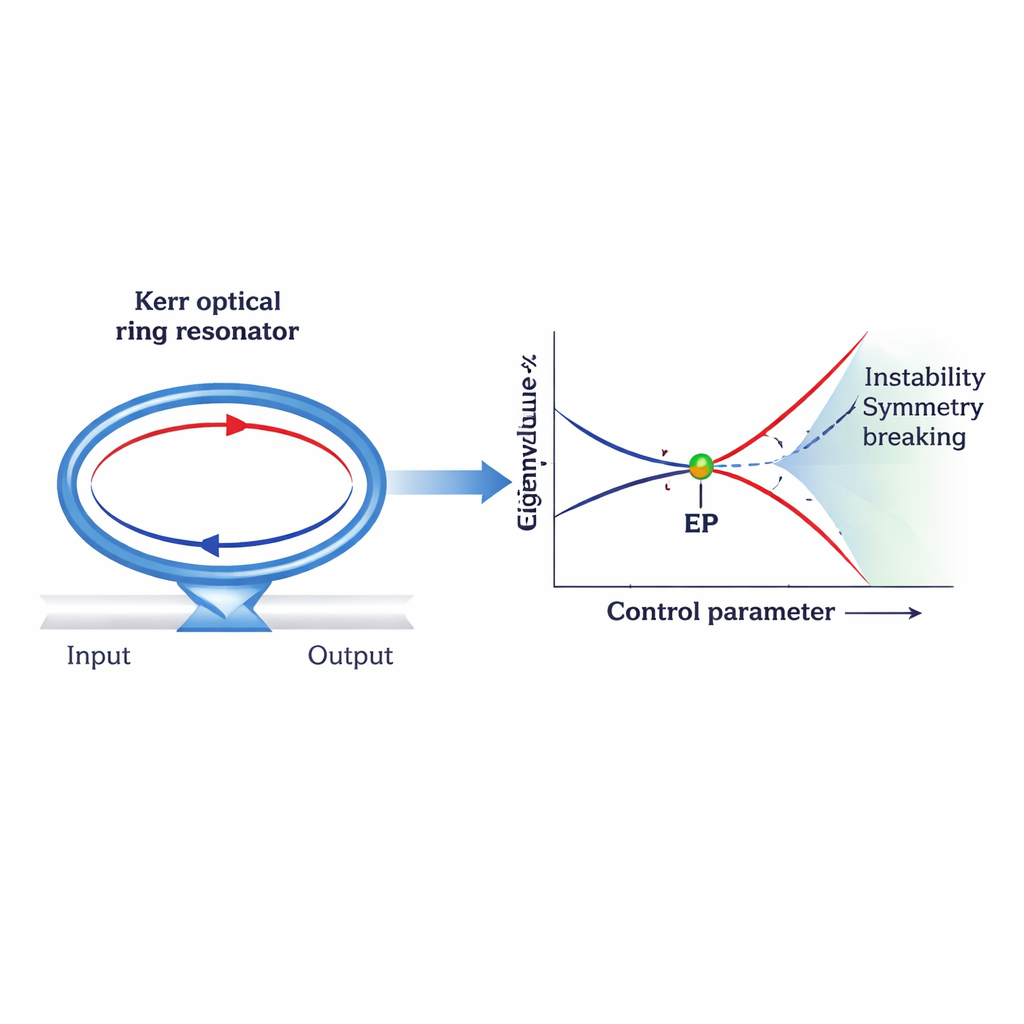
The authors focus on Kerr resonators, optical cavities where light circulates many times through a transparent material whose properties change slightly with intensity. In ring geometries or Fabry–Pérot cavities, light can circulate in two directions or in two polarizations. Under the right conditions, these two pathways are perfectly balanced: the circulating intensities are equal, and the system looks symmetric. But increase the input power or tweak the laser frequency, and that balance can suddenly tip so that one direction or polarization dominates. This abrupt loss of balance is called spontaneous symmetry breaking and underpins applications from ultrasensitive gyroscopes to all‑optical logic switches.
What Makes an Exceptional Point So Exceptional?
Exceptional points arise in systems that lose or gain energy—so‑called non‑Hermitian systems—where not only the characteristic frequencies but also the associated vibration patterns merge into a single state. In optics, they occur in coupled cavities or waveguides with gain and loss, and they are known to produce unusual behaviors such as one‑way transparency or enhanced sensing. Mathematically, the dynamics of small disturbances around a steady optical state are captured by a matrix called the Jacobian. When the eigenvalues and eigenvectors of this Jacobian coalesce, the system hits an exceptional point, marking a sharp change in how disturbances grow or decay.
Decoupling Two Often‑Linked Phenomena
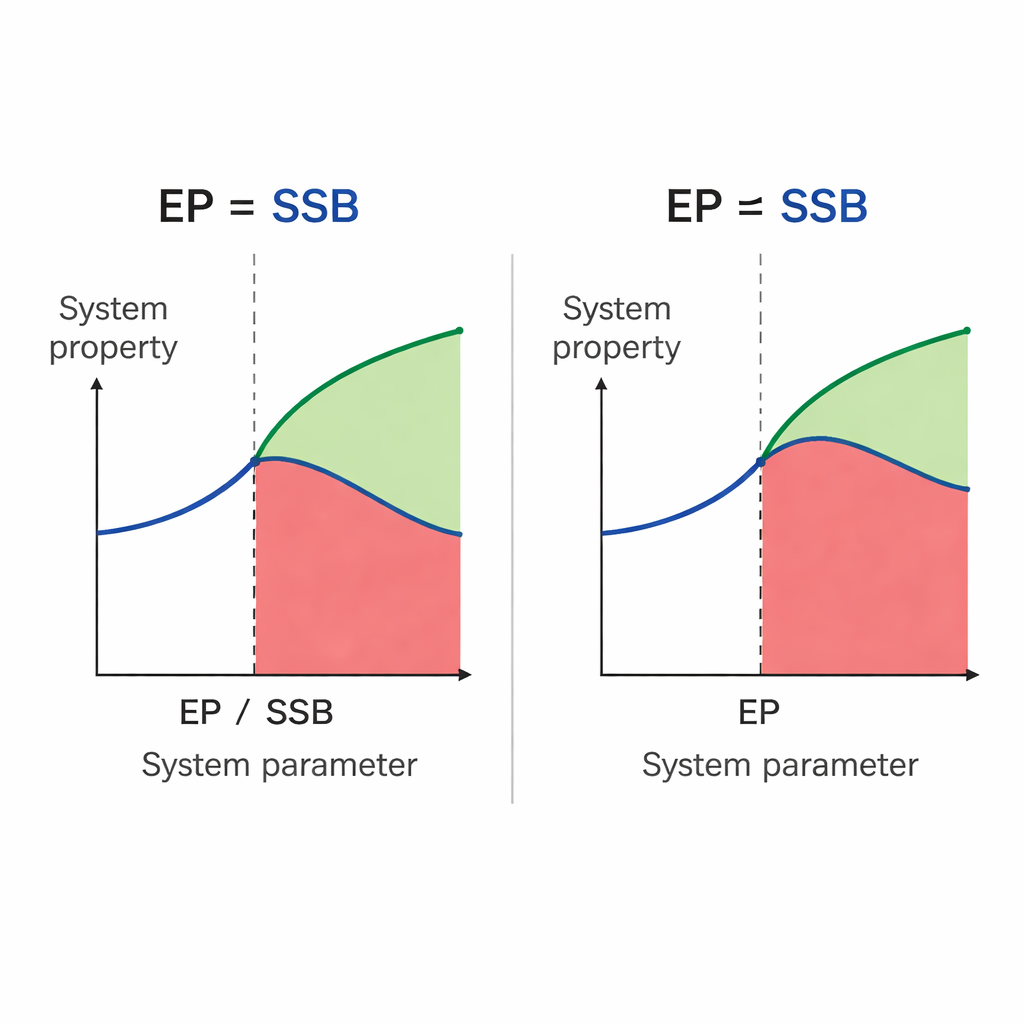
A widespread assumption in nonlinear optics is that symmetry breaking of light flows and exceptional points occur at the same operating conditions. The authors challenge this view by analyzing three realistic Kerr resonator configurations—co‑propagating polarizations in a ring, counter‑propagating beams in a ring, and two polarizations in a Fabry–Pérot cavity—all described by a unified theoretical model. By solving for steady states and then examining the Jacobian, they map how circulating intensities and eigenvalues change with input power and detuning. Their calculations show that the parameter values where the symmetric state becomes unstable and splits are not the same as those where the Jacobian’s eigenvalues and eigenvectors coalesce. At the symmetry‑breaking points, all eigenvalues remain distinct; no exceptional point is present there.
Exceptional Points as Early Warning Markers
Although the two landmarks do not coincide, they are closely related. For every route in parameter space that leads from a stable symmetric state to symmetry breaking, the system must first pass through an exceptional point of the Jacobian. Crossing that point flips internal symmetry properties of the Jacobian—related to so‑called parity‑time and quasi‑chiral symmetries—and marks the onset of conditions where instabilities can form. Only after this transition does the real part of one eigenvalue become positive, signaling that small perturbations will grow and ultimately drive the system into a symmetry‑broken state. In this sense, Jacobian exceptional points act as structural precursors or “early warning signs” for symmetry breaking, rather than as the symmetry‑breaking event itself.
Implications for Future Photonic Technologies
By carefully disentangling where and how these two phenomena occur, the study urges researchers and engineers not to treat exceptional points as synonymous with symmetry breaking. Instead, exceptional points in the Jacobian should be used as design markers that indicate where a device is about to enter a regime of rich nonlinear behavior, but not necessarily where its output becomes unbalanced. This refined picture is expected to hold broadly for many nonlinear, dissipative systems beyond optics. For practical photonic platforms—such as microresonator‑based sensors, switches, and frequency comb sources—it offers a more precise roadmap for tuning devices to harness symmetry‑driven effects without misidentifying the critical operating points.
Citation: Hill, L., Gohsrich, J.T., Ghosh, A. et al. Exceptional points preceding and enabling spontaneous symmetry breaking. Commun Phys 9, 58 (2026). https://doi.org/10.1038/s42005-026-02491-0
Keywords: spontaneous symmetry breaking, exceptional points, Kerr resonators, nonlinear optics, microresonators