Clear Sky Science · en
Optical determination of snow density via sub-surface scattering
Why the brightness of snow matters
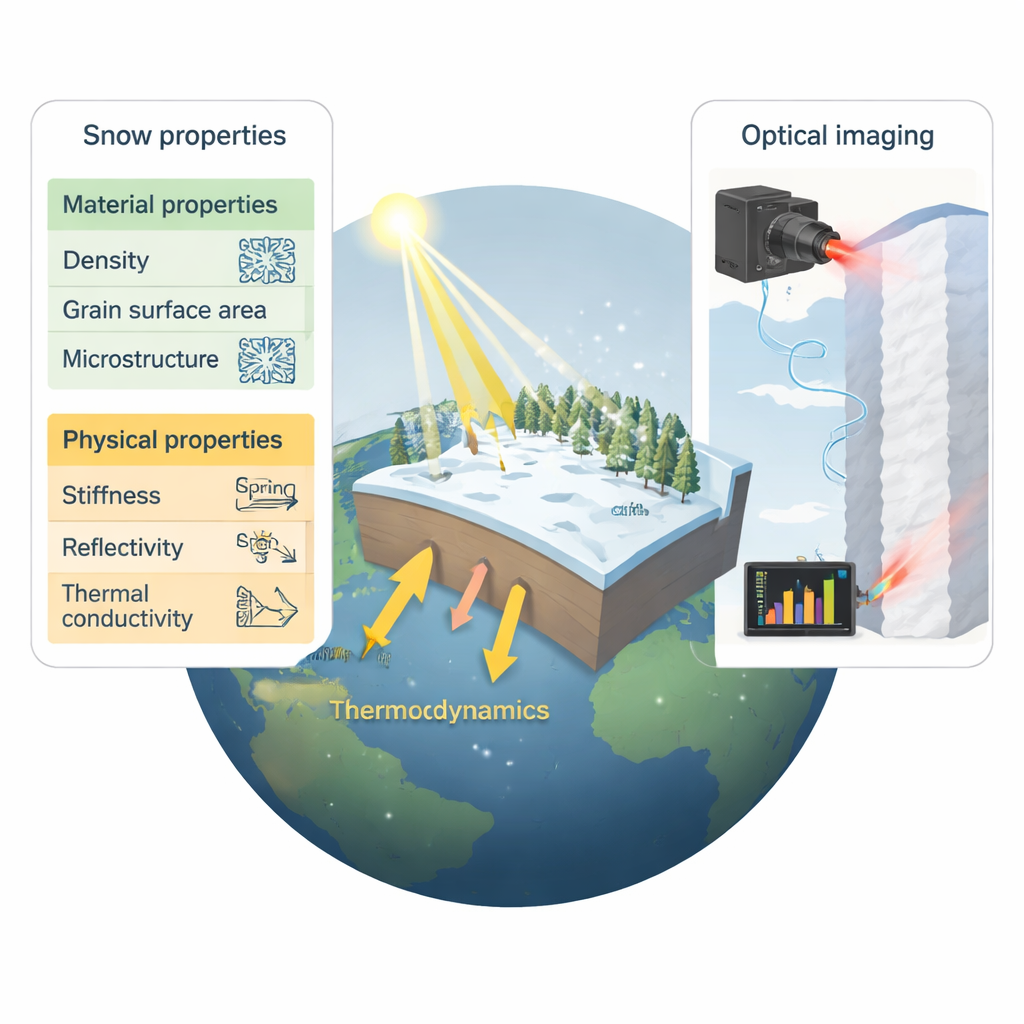
Snow does far more than decorate winter landscapes. Its brightness helps cool the planet by reflecting sunlight back to space, and its structure controls how heat moves between air, snow, and ground. Those same properties influence water supply, weather forecasts, and avalanche danger. Yet one key quantity, snow density, is still hard to measure quickly outside the lab. This study presents a new way to determine snow density simply by shining light on it and recording how that light scatters back from below the surface.
Looking beneath the white surface
When light hits snow, it does not just bounce off the top. Snow is a jumble of ice grains and air pockets, so incoming light penetrates a few centimeters, scattering from grain to grain before some of it emerges again. Scientists already use the overall brightness—or total diffuse reflectance—of snow to estimate its specific surface area, a measure of how much ice surface there is per unit mass. But density, which tells us how much ice is packed into a given volume, has been much harder to retrieve optically. Traditionally, density is measured by cutting and weighing samples or by using X-ray micro–computed tomography, both accurate but slow and labor‑intensive. The authors ask: can the way light is scattered beneath the surface reveal density directly, without cutting the snow?
Turning light patterns into material properties
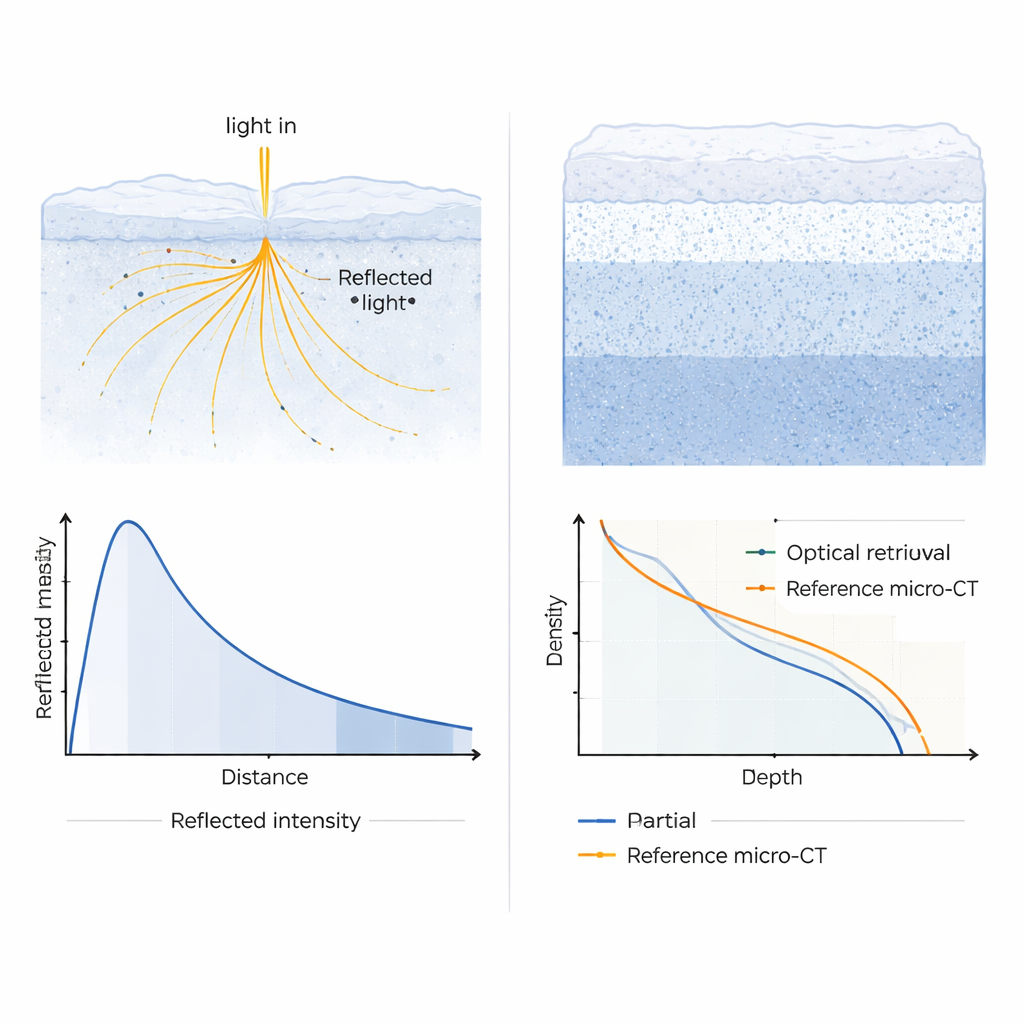
The researchers build on radiative transfer theory, which links how light travels through a material to that material’s microscopic structure. They focus on snow that weakly absorbs near‑infrared light but strongly scatters it, a good description of dry natural snow. Two optical numbers matter most: how often light is absorbed and how often it is scattered. These, in turn, depend on two material properties: the specific surface area (encoded in an “optical equivalent diameter” for ice grains) and the fraction of space filled by ice, which directly reflects density. Using the diffusion approximation—a simplified description of light transport when scattering dominates—they calculate how much of the back‑scattered light escapes within a certain radius of where the light enters. This quantity, called partial diffuse reflectance, turns out to depend on both grain surface area and density, unlike the total reflectance, which depends mainly on grain surface area.
Capturing only part of the returning light
The key idea is to deliberately collect only part of the light that comes back from the snow, by spatially “truncating” the signal. In the mathematical model, this is done by integrating the reflectance only out to a finite radius around a point light source. In the experiment, the team mimics this by placing a mask with slits in front of a vertical snow wall. A near‑infrared light source illuminates the snow, and a camera records two kinds of images: one of the full reflectance, and one where only light passing through the slits is seen. From the total reflectance image, they determine the optical equivalent grain size. From the partially masked image, and their theoretical expressions, they invert the problem to estimate the ice‑volume fraction—and thus the density—at different depths in the snowpack.
Testing the method in layered snow
To check whether the theory works in practice, the authors build a 30‑centimeter‑high snow block in a cold laboratory with three layers of known, different densities but similar grain surface areas. They expose a clean vertical face, illuminate it, and record reflectance images with and without the slit mask. Independently, they cut out small samples and measure their structure using high‑resolution X‑ray micro‑CT, which serves as the reference. By applying their formulas—and accounting for how the air–snow boundary affects light escape—they compute a vertical profile of ice‑volume fraction from the optical data. The optically derived profile matches the micro‑CT profile well in both shape and absolute values, with a strong statistical correlation. Transitions between layers appear somewhat blurred in the optical profile, because scattered light mixes information over a few millimeters, but the main density steps are clearly recovered.
From snow pits to broader applications
The authors conclude that partial reflectance imaging can provide fast, non‑destructive estimates of snow density profiles with millimeter‑scale sampling and centimeter‑scale effective resolution. Unlike traditional methods, it does not require extracting and weighing cores or transporting fragile samples to a scanner, and it can be applied along long profiles to capture how snow structure varies across a slope. While developed for environmental snow science—supporting climate research, hydrology, and avalanche forecasting—the underlying theory applies to any porous, strongly scattering material. That means similar optical tricks could help infer microscopic properties of other media, from soils and foams to certain biological tissues, simply by analyzing how light scatters back from beneath their surfaces.
Citation: Mewes, L., Löwe, H., Schneebeli, M. et al. Optical determination of snow density via sub-surface scattering. Commun Phys 9, 57 (2026). https://doi.org/10.1038/s42005-026-02490-1
Keywords: snow density, subsurface scattering, diffuse reflectance, snow microstructure, optical snow measurements