Clear Sky Science · en
Smile-shaped electron gradient distributions observed during magnetic reconnection at Earth’s magnetopause
Electrons That Seem to Smile
High above our heads, where Earth’s magnetic shield meets the stream of particles from the Sun, space can suddenly and violently rearrange itself. These magnetic upheavals power auroras, affect satellites, and may even influence future fusion reactors. In this study, scientists report something both whimsical and profound: when they look carefully at how electrons behave in this tumultuous region, the patterns in their motion form a shape that looks like a smiling face. That “smile” turns out to be a new clue to how invisible magnetic energy is rapidly turned into particle energy in space plasmas.
Where Earth’s Magnetic Shield Breaks and Reconnects
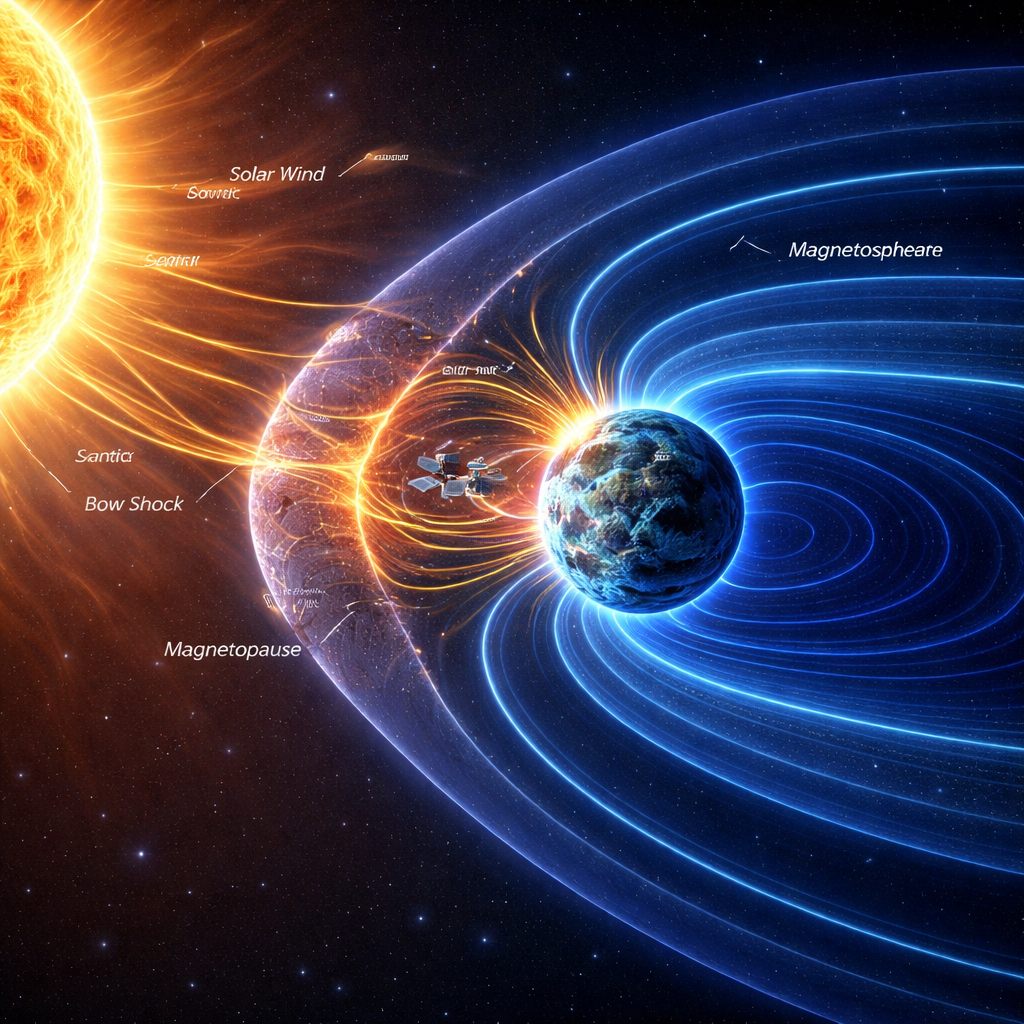
Earth is wrapped in a magnetic bubble, the magnetosphere, which deflects most of the charged particles streaming from the Sun. At the front edge of this bubble, called the magnetopause, the Sun’s magnetic field and Earth’s magnetic field can break and reconnect, a process known as magnetic reconnection. This process unleashes stored magnetic energy and hurls particles along new paths, helping to drive bright auroras and disturbances in near-Earth space. A tiny central zone, the electron diffusion region, is where electrons temporarily slip free from the usual tight grip of magnetic fields. NASA’s Magnetospheric Multiscale (MMS) mission, a formation of four closely spaced spacecraft, was designed specifically to fly through this region and measure what electrons are doing there in extraordinary detail.
From Simple Distributions to Subtle Gradients
Earlier MMS observations and computer simulations had already revealed unusual “crescent-shaped” patterns in how electron speeds are distributed in this region. Those crescents showed that electrons were moving in complex, noncircular paths, but they did not uniquely pinpoint where the spacecraft were within the reconnection zone. The new work adds a crucial twist: instead of looking only at the electron distribution itself, the authors examine how that distribution changes from place to place. Using data from the Fast Plasma Investigation instruments on all four MMS spacecraft, they reconstruct the spatial gradients of the electron distribution – in effect, how the electron population shifts as you move through the plasma. This is like going from a static photograph to a map of how the picture would change if you stepped sideways.
A Surprising Smiley Face in Electron Motion
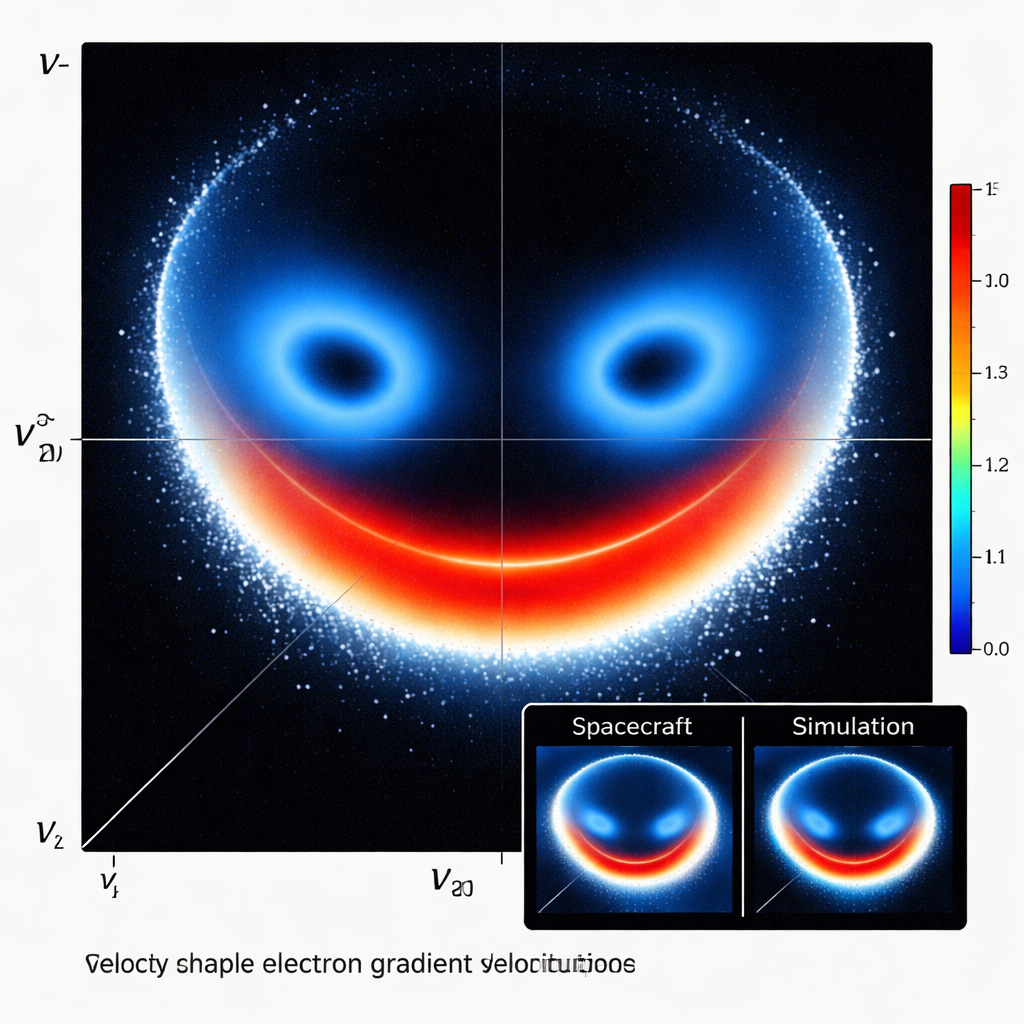
When the team calculated these gradients during a well-known reconnection event on October 16, 2015, they found a striking pattern in “velocity space” (a plot of electron speeds in different directions). Regions where the electron population decreased formed two dark patches, while regions where it intensified traced a bright band. Together, these features created a clear smiley face: two blue “eyes” and a red “smile.” The “eyes” appear because the spread of the crescent-shaped electrons in angle shrinks as the spacecraft move through the region, so those edge areas lose particles. The “smile” forms because electrons in the center of the crescent become more concentrated, enhancing their numbers there. This smile-shaped structure persisted for a short but significant time as MMS crossed a zone only tens of kilometers wide – a very narrow layer on cosmic scales.
Simulated Smiles and Hidden Electric Fields
To test whether this smile was just a quirk of one event, the researchers turned to high-resolution particle-in-cell simulations that model reconnection from first principles. With enough simulated particles to capture fine details, the same smile-shaped gradient patterns emerged in both directions along and across the magnetic field. In the simulations, these smiling gradients line up with strong electric fields that do not follow the usual “frozen-in” rule, which normally ties plasma to magnetic field lines. By connecting the gradient patterns to terms in the fundamental Vlasov and momentum equations of plasma physics, the authors show that these smile-shaped structures are directly linked to how electron pressure changes in space. Those pressure changes, in turn, are what balance the intense parallel electric fields that drive reconnection in a collisionless plasma.
Why This Matters for Space and Fusion
In everyday terms, the discovery means that when electrons “smile” in velocity space, they are revealing exactly where and how magnetic energy is being converted into particle energy. The smile-shaped gradients act as a fingerprint of the heart of reconnection, providing a way to locate spacecraft within the tiny electron diffusion region and to distinguish truly reconnecting layers from nearby look-alike structures. Because similar magnetic processes occur in solar flares, distant astrophysical plasmas, and laboratory fusion devices, understanding these subtle patterns will help scientists better predict space weather and design more effective fusion experiments. The electrons’ hidden smile, once teased out of complex data and simulations, turns out to be a powerful new diagnostic of one of nature’s most important energy-release mechanisms.
Citation: Shuster, J.R., Bessho, N., Dorelli, J.C. et al. Smile-shaped electron gradient distributions observed during magnetic reconnection at Earth’s magnetopause. Commun Phys 9, 56 (2026). https://doi.org/10.1038/s42005-026-02489-8
Keywords: magnetic reconnection, Earth magnetosphere, space plasma, electron diffusion region, NASA MMS mission