Clear Sky Science · en
Skyrmion generation through the chirality interplay of light and magnetism
Twisting Light to Write Tiny Magnetic Whirlpools
Imagine storing movies, photos, and entire archives in chips so small that each bit of data is a swirling pattern of magnetism only billionths of a meter across. This article explores how specially shaped beams of light can "draw" and control those tiny whirlpools—called skyrmions and skyrmioniums—inside magnetic materials. By learning to command these structures quickly and precisely with light, researchers move closer to ultrafast, low‑energy memory and information‑encoding technologies.
What Makes This Light So Special?
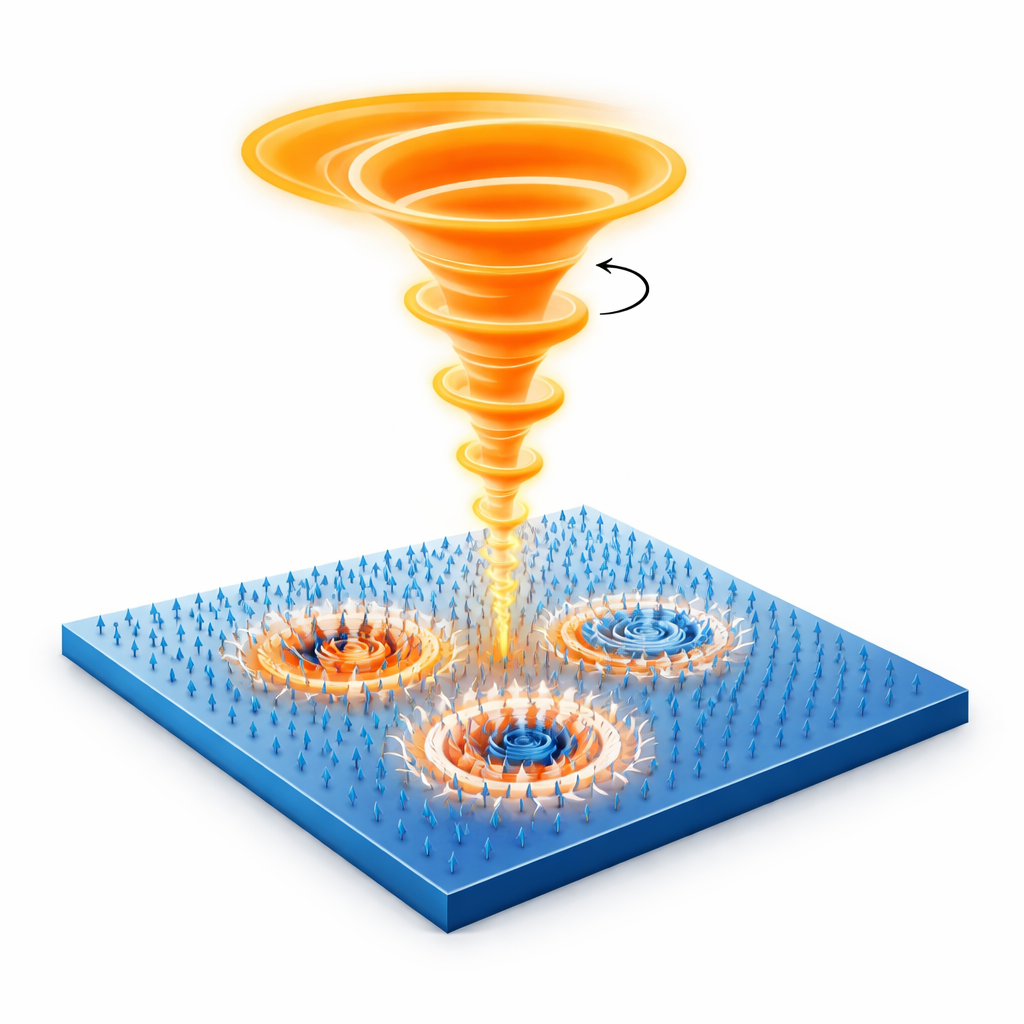
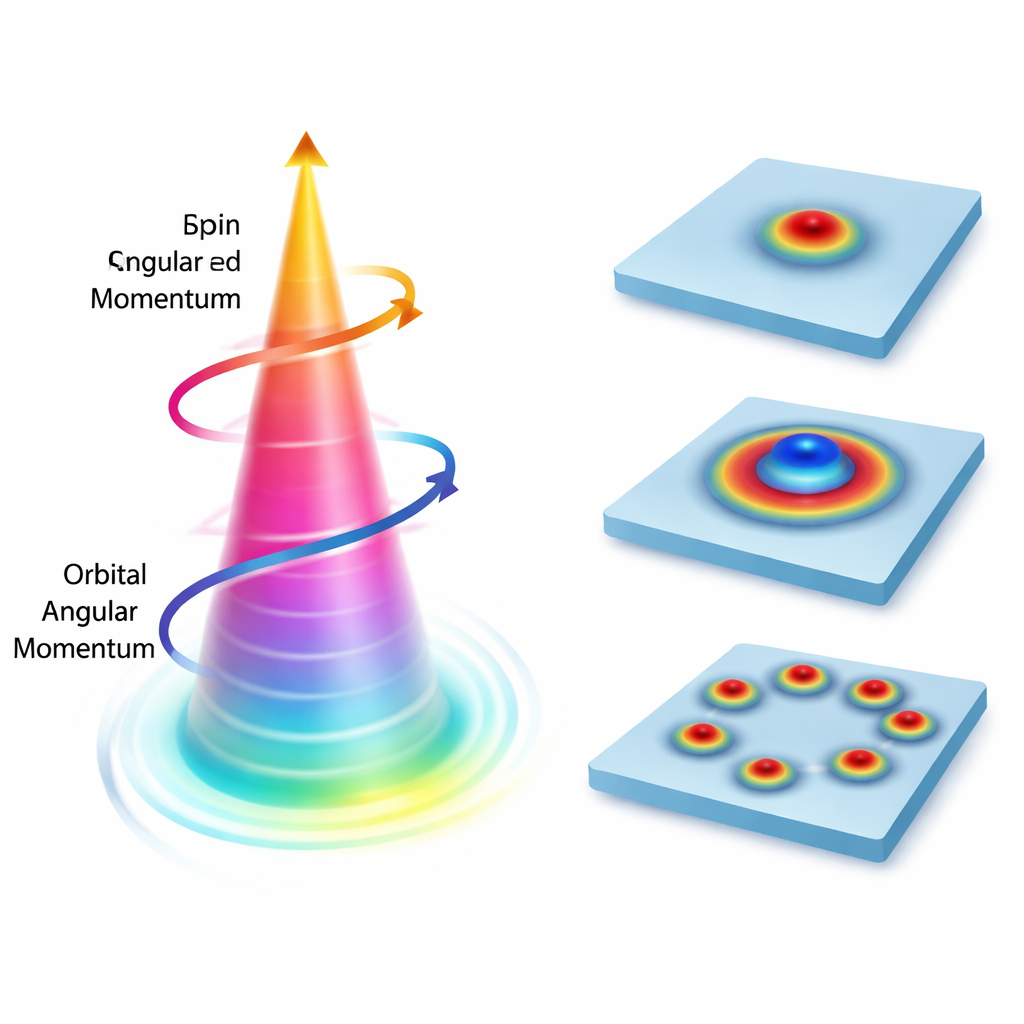
Light is more than just brightness and color. It can also spin. One kind of spin, called polarization, describes how the electric and magnetic fields twist as light travels; circular polarization means those fields rotate like the blades of a fan. Another kind, known as orbital angular momentum, makes the light’s wavefront spiral like a corkscrew, forming a “vortex” beam with a dark center and bright ring. When both types of spin are present in a circularly polarized Laguerre–Gaussian (CPLG) beam, the magnetic field of the light itself develops intricate whirl patterns in space. The authors show that by choosing how the light twists—its handedness and its topological charge—they can create magnetic fields with different chiral (left‑ or right‑handed) patterns above a magnetic film.
Magnetic Whirlpools as Data Carriers
Inside certain magnetic materials, the atomic magnets—or spins—can wind into stable, particle‑like textures called skyrmions. A single skyrmion looks like a tiny vortex: spins point up far away, twist through the plane, and point down in the middle. A skyrmionium is more like a magnetic doughnut: an inner skyrmion and an outer ring that cancel some of each other’s twists. These objects are attractive for technology because they can be small, robust, and movable, and because their presence or absence can encode information. Until now, skyrmions have usually been created using electric currents, heat, or static magnetic fields, methods that are often slower or harder to control precisely at the nanoscale.
Simulating How Twisted Light Imprints Magnetism
The researchers build a numerical model of a thin magnetic film whose spins initially all point in the same direction. They then expose this virtual film to a short burst of CPLG light whose magnetic field interacts with the spins through the Zeeman effect—the same basic principle that aligns a compass needle in Earth’s field. Using standard equations of spin dynamics, they track how every microscopic magnet tilts and precesses in time. Different choices of light parameters—such as whether the beam carries orbital angular momentum and how intense it is—produce different magnetic outcomes: a single skyrmion, a doughnut‑like skyrmionium, or several skyrmions arranged around a ring.
Dialing In the Number and Shape of Whirlpools
A key finding is that the "handedness" of the light and of the material work together. Even a circularly polarized beam without orbital angular momentum, whose magnetic field is uniform in space, can create a single skyrmion if the material’s internal chiral forces are strong enough—contrary to earlier claims. When the light carries a specific amount of orbital twist (for example, a topological charge of −1), its hollow, ring‑shaped magnetic field closely matches a skyrmionium and naturally imprints that pattern into the film. For other charges, the beam’s magnetic field splits into multiple chiral regions. Depending on the light intensity, these regions may seed between a minimum and maximum number of skyrmions, which can sometimes merge or stretch into stripes if they are too close together. In this way, the authors show that the count and arrangement of skyrmions can be tuned simply by changing the light’s angular momentum and strength.
Why This Matters for Future Memory
To a non‑specialist, the message is that we can now use carefully sculpted flashes of light as a kind of ultrafast pen to draw and edit tiny magnetic patterns that could act as data bits. By understanding how the different spins of light combine to form chiral magnetic fields, and how those fields nudge spins in a material into skyrmions or skyrmioniums, the authors outline a recipe for on‑demand, light‑based magnetic encoding. This approach could enable new memory devices where information is written and rewritten at terahertz speeds, with minimal energy, simply by changing how the light beam twists.
Citation: Zhang, Q., Lin, S. & Zhang, W. Skyrmion generation through the chirality interplay of light and magnetism. Commun Phys 9, 55 (2026). https://doi.org/10.1038/s42005-026-02488-9
Keywords: skyrmions, structured light, magnetic memory, orbital angular momentum, topological magnetism