Clear Sky Science · en
Generation of wave turbulence in dipolar gases driven across their phase transitions
Why quantum ripples can turn turbulent
When we think of turbulence, we picture stormy skies or churning oceans, not clouds of atoms cooled to a billionth of a degree above absolute zero. Yet this study shows that even these delicate quantum gases can become turbulent in a surprisingly universal way. By shaking an exotic state of matter called a “supersolid” made of strongly magnetic atoms, the authors watch its orderly structure break down into a turbulent sea of waves, revealing how energy cascades across scales in the quantum world.
A strange state between solid and liquid
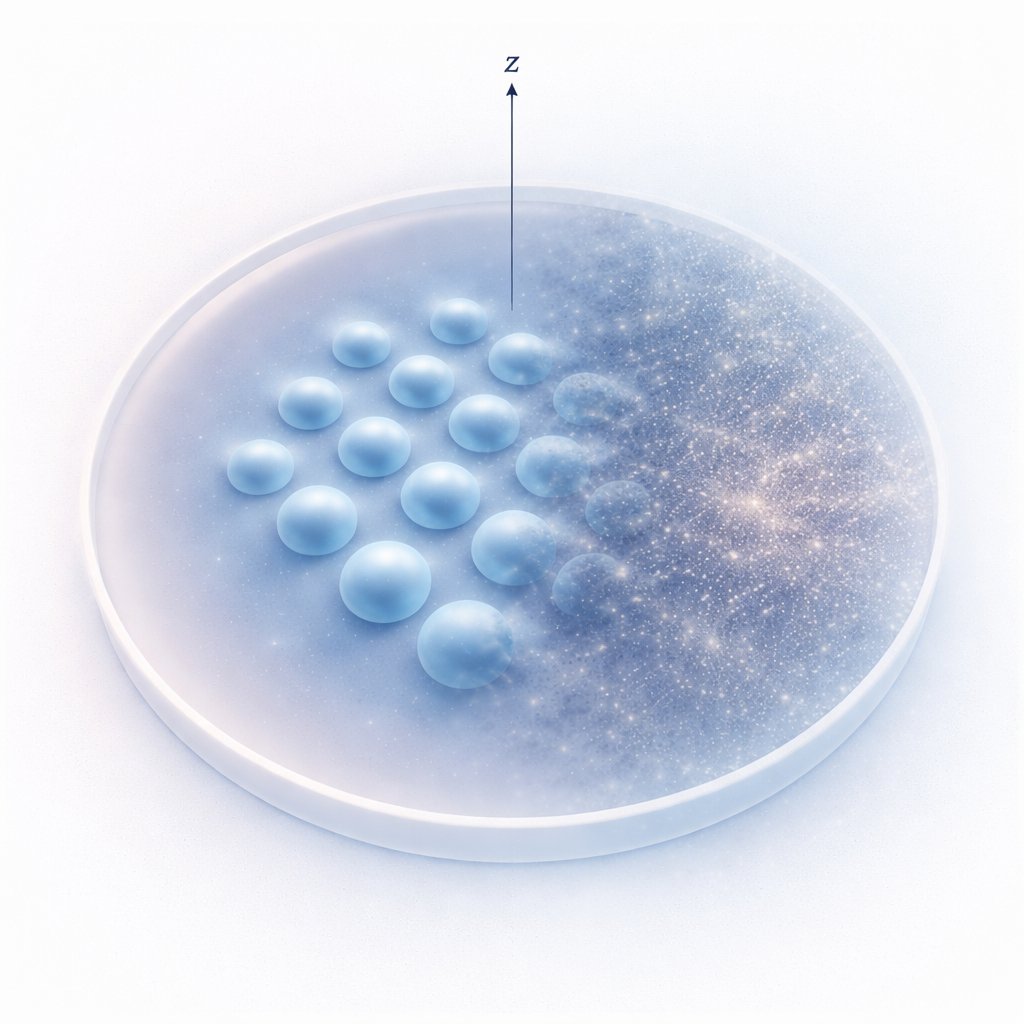
The work focuses on ultracold gases of dysprosium atoms, whose magnetic moments make them interact over relatively long distances. Under the right conditions, these atoms arrange themselves into tiny, self-bound droplets that still share a common, frictionless flow—a hybrid phase known as a supersolid. It has both crystal-like order (repeating density peaks) and superfluid behavior (mass can flow without resistance). This unusual combination makes supersolids an ideal playground to explore how structured quantum matter responds when it is pushed far from equilibrium.
Driving the system through its quantum phases
In the simulations, the researchers trap about eighty thousand dysprosium atoms in a cigar-shaped, three-dimensional harmonic “bowl.” They then periodically tune the strength of the atomic interactions, a trick that modern experiments achieve using magnetic fields. By modulating this interaction, they force the gas to repeatedly cross phase boundaries: from supersolid to ordinary superfluid, from superfluid back to supersolid, and from supersolid into a lattice of nearly isolated droplets. This periodic driving injects energy into the system in a controlled way, like shaking a container of water at a chosen frequency.
From ordered patterns to turbulent waves
As the drive proceeds, the initially neat hexagonal array of droplets begins to melt. The crystal symmetry breaks, high-density peaks move and merge, and small vortex pairs appear and disappear in the fluid background. Over longer times, the detailed structure of the droplets fades, and the gas develops irregular density ripples similar to those seen in non-magnetic superfluids undergoing “wave turbulence.” Instead of being dominated by swirling eddies, this form of turbulence is governed by nonlinear waves that exchange energy and particles over a broad range of length scales.
Universal fingerprints of a turbulent cascade
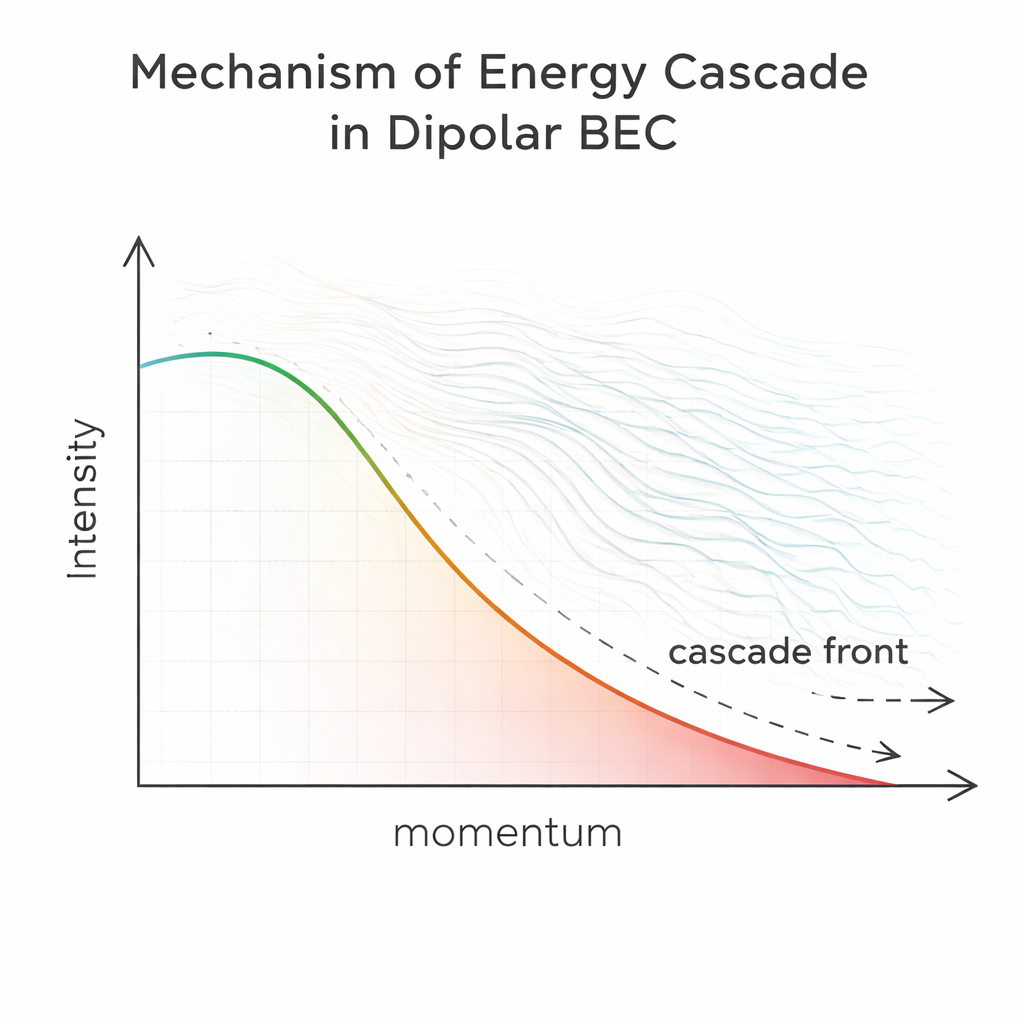
To diagnose turbulence, the authors analyze how atoms are distributed over different momenta, which corresponds to how wavy the density patterns are. They find that, at late times, this momentum distribution becomes nearly direction-independent and follows a simple power law: the intensity falls off roughly as a fixed power of the momentum. The same kind of power-law behavior appears in the kinetic energy spectrum. Together, these features signal a direct energy cascade—energy flows from large, slowly varying structures to ever finer ripples. Remarkably, the key exponents that describe this scaling settle to similar values regardless of whether the system starts as a supersolid, a superfluid, or a droplet array, and regardless of the precise driving frequency.
Supersolids: a fast track to turbulence
A central finding is that supersolids reach the turbulent state faster than plain superfluids. Because supersolids naturally support excitations at higher momenta—linked to a dip in their excitation spectrum known as a “roton minimum”—their initial momentum distribution already extends further into the high-wave-number region. This gives the energy cascade a head start: the so-called cascade front, which marks the advancing edge of the turbulent spectrum, moves outward in time with a universal power-law, but begins from larger momenta in the supersolid case. Even when realistic three-body loss processes are included (which gradually remove atoms from dense regions), the same turbulent scaling emerges, though the highest-momentum components decay more strongly.
What this means for the bigger picture
To a non-specialist, the main message is that turbulence in the quantum world obeys surprisingly universal rules, even in systems with long-range, highly directional interactions and exotic phases like supersolids. By showing that the same kind of wave turbulence appears across different initial states and survives realistic losses, this work paves the way for laboratory studies of turbulent cascades using tunable quantum gases. Such experiments could help bridge our understanding of turbulence from cold-atom systems all the way to plasmas, oceans, and astrophysical flows, revealing deep commonalities in how energy moves and structures break down across nature.
Citation: Bougas, G.A., Mukherjee, K. & Mistakidis, S.I. Generation of wave turbulence in dipolar gases driven across their phase transitions. Commun Phys 9, 54 (2026). https://doi.org/10.1038/s42005-026-02487-w
Keywords: quantum turbulence, supersolid, dipolar Bose-Einstein condensate, wave cascade, ultracold atoms