Clear Sky Science · en
Highly efficient three-dimensional optical condensation of nano- and micro-particles using a gold-coated optical fibre module
Why pulling tiny germs together matters
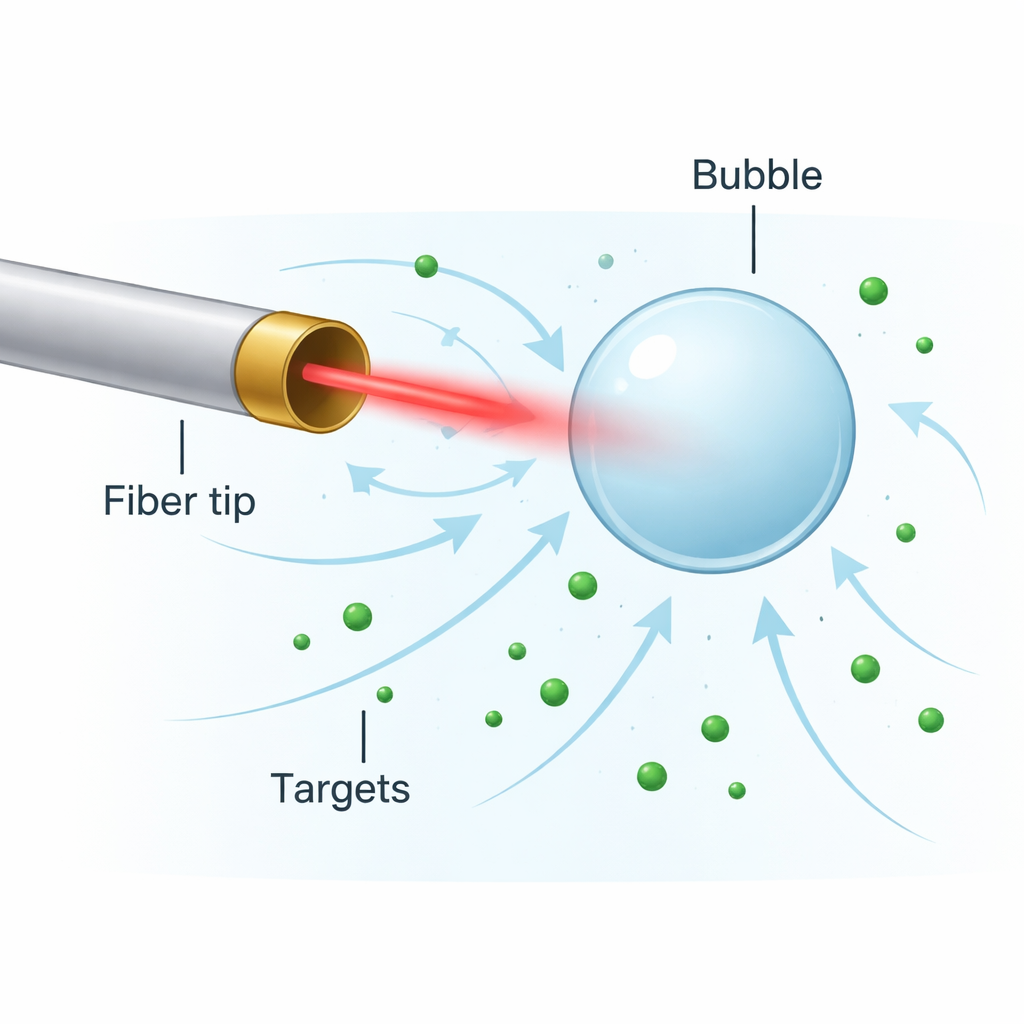
Detecting dangerous bacteria or nanoscale markers of disease usually requires hours or even days of lab work, and often misses very low concentrations. This study introduces a compact light‑based tool that can rapidly “sweep up” tiny particles and bacteria from a liquid into a small volume, making them far easier to detect. The approach uses an ordinary optical fiber whose tip is coated with a thin gold film and heated by a laser, creating a bubble and swirling flows that herd microbes into one place.
Using light, heat and bubbles as a micro‑vacuum
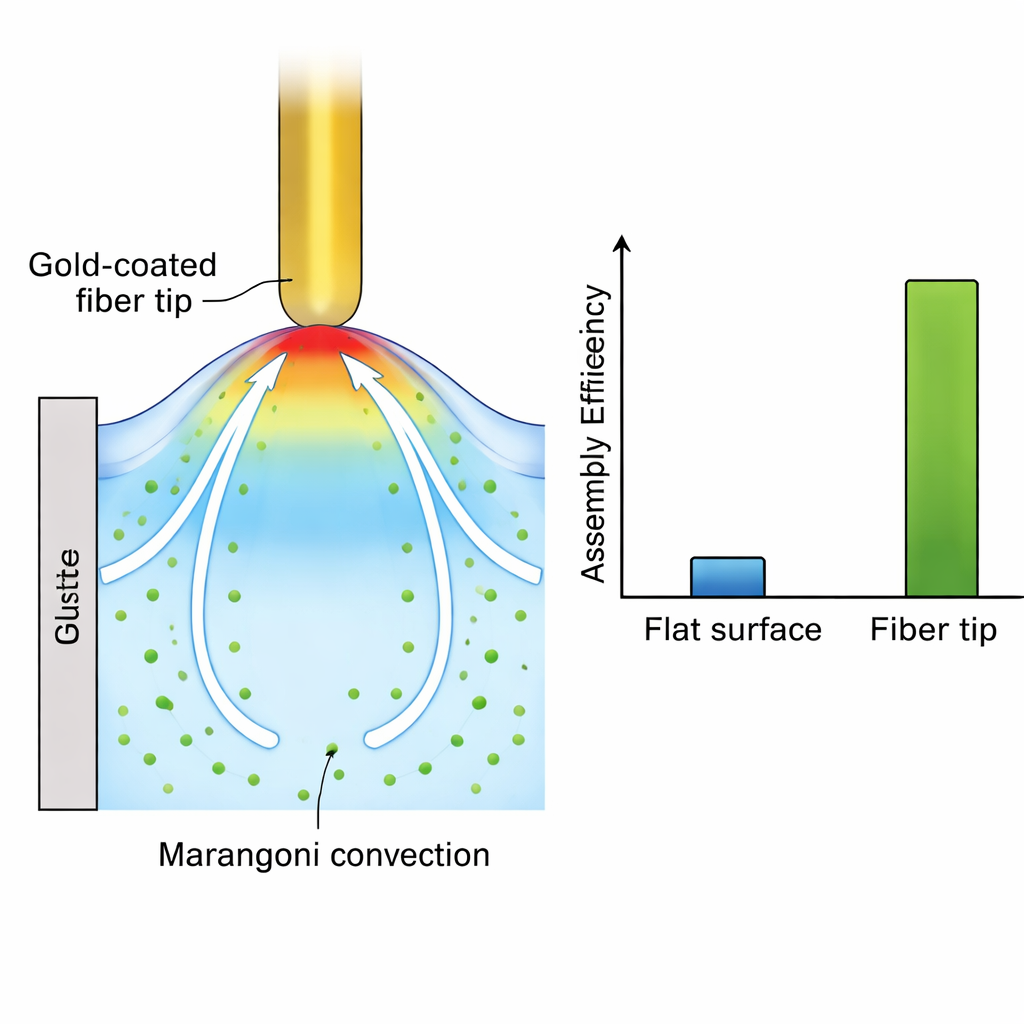
The heart of the method is a standard glass optical fiber dressed with a nanometer‑thin layer of gold at its tip. When infrared laser light travels down the fiber and reaches this coated tip, the gold absorbs part of the light and converts it into heat. In water, this heating produces a microscopic bubble. Because the bubble’s bottom, near the hot gold, is warmer than its top, the surface tension around it is uneven. That imbalance drives Marangoni convection—circulating flows that sweep surrounding particles toward a slow‑flow “parking zone” between the bubble and the fiber tip, where they pack together densely.
From a flat floor to a truly 3‑D gathering
Earlier optical “condensation” methods relied on a flat, gold‑coated glass slide. There, the bubble sits on the surface and flows mainly move sideways, limiting how many particles can be collected. By moving the heat source to the fiber end, which can be positioned freely in the liquid, flows now come from both above and below as well as sideways. Experiments with fluorescent plastic beads showed that, in just 60 seconds and from a 20‑microliter droplet, the fiber‑based design can draw in about 103–105 beads to the tip and capture more than 10% of all the particles in the sample—over ten times better than the flat‑slide approach at low concentrations.
Simulating the invisible water currents
To understand why the new geometry works so well, the researchers used computer simulations to map out temperature and flow patterns around the heated fiber tip and bubble. The models show a hot zone at the bottom of the bubble and cooler regions above it, confirming the temperature gradient needed for strong Marangoni flow. Streamlines reveal that water moves both vertically and horizontally toward the bubble, with the fastest currents skimming along its surface. Just between the bubble and the fiber, the flow slows dramatically, matching the region where particles are seen to accumulate. This explains how the system acts like a three‑dimensional funnel that feeds particles into a compact clump.
Gathering living microbes and nanosized particles
The team went beyond plastic beads to test real bacteria (Escherichia coli) and 100‑nanometer nanoparticles. Fluorescent staining confirmed that bacteria also collect at the fiber tip, with assembly efficiencies of roughly 7–10%. Many of these microbes are heat‑damaged under the current conditions, but earlier work suggests that tailoring the gold structures and laser wavelength could make the heating more gentle. The fiber system also concentrates nanoparticles with nearly an order‑of‑magnitude higher efficiency than previous flat‑surface methods, hinting at uses in boosting the sensitivity of nanoscale sensors, including those based on tiny diamonds.
A path toward portable microbe detectors
By simply sputtering a thin gold film onto an off‑the‑shelf optical fiber, the researchers created a moveable micro‑collector that concentrates particles and bacteria far more efficiently than conventional light‑driven methods. The fiber can be brought close to any spot in a tiny volume of water, where laser‑driven bubbles and cleverly directed flows gather targets into a tight cluster. With further refinements to reduce laser power and protect fragile cells, this technique could underpin handheld devices that rapidly enrich and count harmful microbes, screen drug responses, or feed tiny samples to sensitive optical sensors—shrinking complex lab assays into the tip of a fiber.
Citation: Hayashi, K., Tamura, M., Fujiwara, M. et al. Highly efficient three-dimensional optical condensation of nano- and micro-particles using a gold-coated optical fibre module. Commun Phys 9, 68 (2026). https://doi.org/10.1038/s42005-025-02480-9
Keywords: optical fiber sensing, bacterial detection, nanoparticle concentration, photothermal microbubbles, microfluidic diagnostics