Clear Sky Science · en
A universal framework for the quantum simulation of Yang–Mills theory
Why this matters for future physics
Many of the deepest questions in physics—from what happens inside quark–gluon plasma to how quantum gravity might work—are encoded in mathematical frameworks called gauge theories, such as quantum chromodynamics (QCD). These theories are so complex that even the fastest supercomputers struggle with them, especially when particles interact strongly or evolve in real time. This article presents a way to translate a huge family of such theories into a single, simple form that is naturally suited for quantum computers, opening a practical route toward simulating high‑energy physics and even candidate models of quantum gravity on future fault‑tolerant devices.
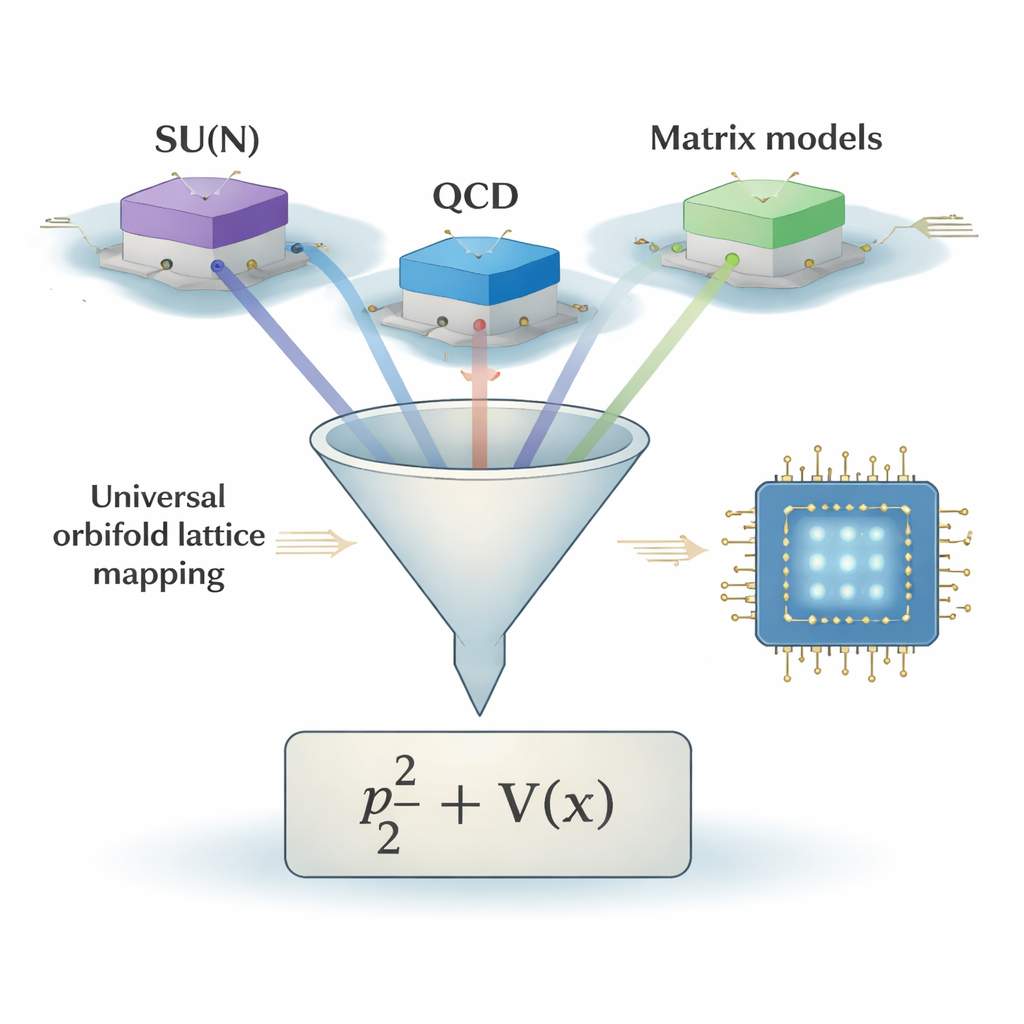
A single recipe for many different theories
Gauge theories describe how particles interact through force fields; Yang–Mills theories are the most important examples and include QCD, the theory of quarks and gluons. Different theories use different “gauge groups” (SU(3) for QCD, SU(5) or SO(10) for some grand unified models, large-N SU(N) theories for exploring new limits), and each traditionally requires a custom, technically intricate treatment on a lattice. Existing formulations, such as the widely used Kogut–Susskind Hamiltonian, rely on complex group structures and special unitary link variables. Truncating these infinite, curved spaces into something a quantum computer can store demands heavy group theory and case-by-case engineering, which quickly becomes unmanageable for realistic four-dimensional theories with N ≥ 3.
Orbifold lattices: simplifying the building blocks
The authors show that an alternative called the orbifold lattice sidesteps these complications by using non-compact complex link variables instead of unitary ones. In this setup, both Yang–Mills gauge theories on a lattice and closely related matrix models (which also appear in proposals for non-perturbative quantum gravity) can be expressed using ordinary bosonic coordinates and their conjugate momenta, much like simple harmonic oscillators. Crucially, all these systems share the same universal Hamiltonian form: a sum of kinetic energy terms p²/2 plus a potential energy V(x) that is at most quartic (fourth-order) in the coordinates. That means once you know how to simulate a single anharmonic oscillator with a quartic potential, you already understand the essential ingredient needed for the full Yang–Mills case.
From continuous fields to qubits
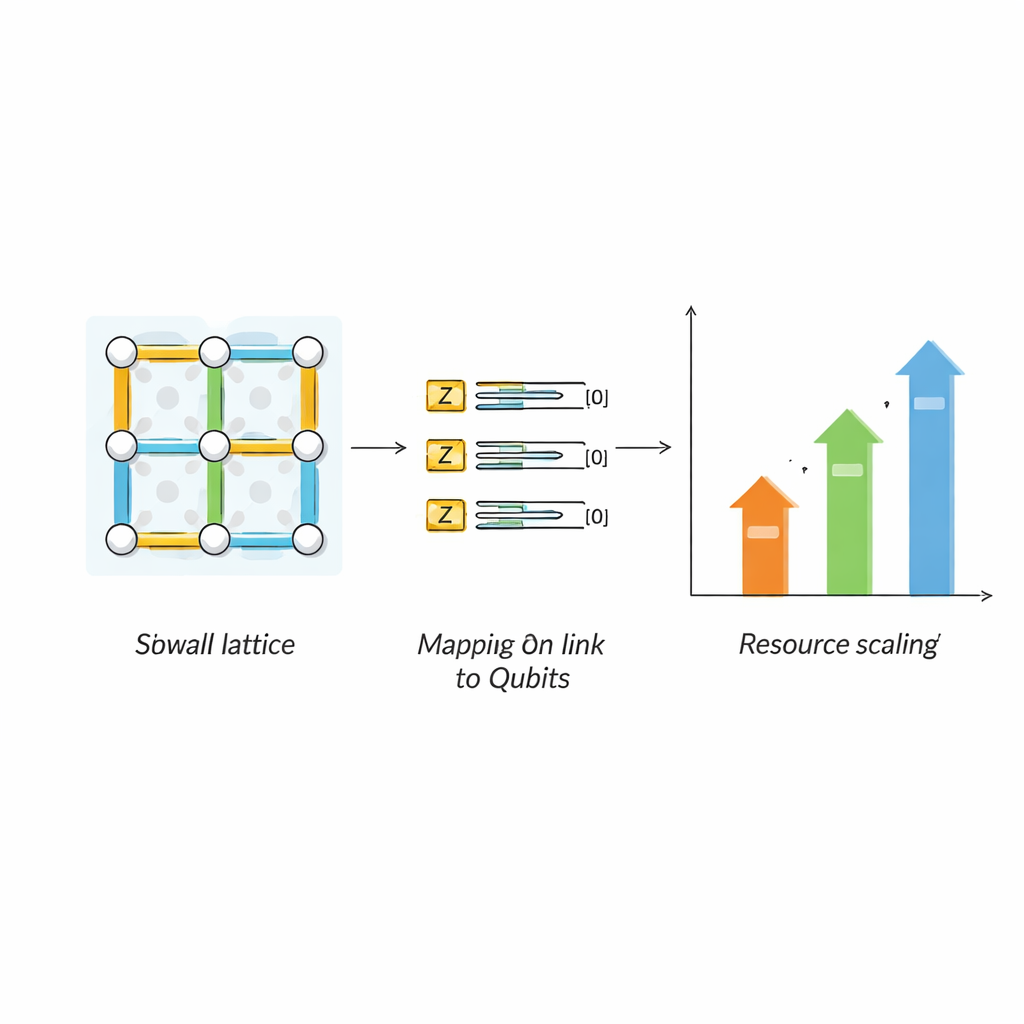
To make this universal Hamiltonian fit on a quantum computer, the continuous coordinates are cut off in range and replaced by a finite grid of values. Each bosonic degree of freedom is then encoded using Q qubits, representing 2^Q possible positions. In this coordinate basis the potential energy is simple: it becomes combinations of Pauli Z operators acting on these qubits. The kinetic energy is simpler in the momentum basis, reached via a quantum Fourier transform, which is straightforward here because it no longer depends on complicated group manifolds. This clean separation means that constructing the full time-evolution operator reduces to well-understood components: quantum Fourier transforms, diagonal phase rotations, and products of Pauli operators. The authors explicitly show how to build all needed interactions from only single-qubit rotations and controlled-NOT gates.
Scaling up and counting quantum resources
Because the Hamiltonian has a uniform structure, it becomes possible to derive general scaling rules for how many qubits and gates are required, regardless of which specific SU(N) Yang–Mills theory one studies. The number of logical qubits grows linearly with the number of bosonic degrees of freedom (set by the gauge group size N, the number of spatial dimensions, and the number of lattice sites) and with the truncation parameter Q. The dominant cost in time evolution comes from quartic interaction terms, whose gate counts scale in a transparent way, such as proportional to N⁴, the square of the number of spatial or matrix directions, the lattice volume, and Q⁴. The kinetic terms, treated via Fourier transforms, are relatively cheaper. The paper also distinguishes between needs in today’s noisy devices—where minimizing controlled-NOT gates is essential—and in future fault-tolerant machines, where the main cost is in expensive “T” gates used to compile precise rotations.
What this enables for physics
By reducing a wide class of gauge theories and matrix models to the same simple Hamiltonian form, the orbifold lattice framework offers a general, scalable recipe rather than a collection of custom tricks. It shows that simulating Yang–Mills theory on a quantum computer is, at its core, no more structurally complicated than simulating a scalar field with a quartic interaction: the differences lie mostly in how many terms and degrees of freedom appear. This universality means that progress on small, toy models—such as a single anharmonic oscillator or a modest matrix model—can be systematically scaled up to realistic theories of quarks, gluons, and potential physics beyond the Standard Model as larger fault-tolerant quantum computers become available.
Citation: Halimeh, J.C., Hanada, M., Matsuura, S. et al. A universal framework for the quantum simulation of Yang–Mills theory. Commun Phys 9, 67 (2026). https://doi.org/10.1038/s42005-025-02421-6
Keywords: quantum simulation, Yang–Mills theory, gauge theories, orbifold lattice, quantum computing resources