Clear Sky Science · en
Zero- to ultralow-field J-spectroscopy with a diamond magnetometer
Seeing Chemistry Without a Giant Magnet
Nuclear magnetic resonance (NMR) is one of the workhorses of modern chemistry and medicine, but the machines behind it are usually massive, expensive magnets. This paper shows that you can capture the same kind of chemically specific signals using a tiny diamond chip instead of a room-filling magnet. That shift opens the door to handheld scanners that can read out molecular information in cramped labs, inside metal pipes, or even next to living tissue.
Listening to Atomic "Radio Stations"
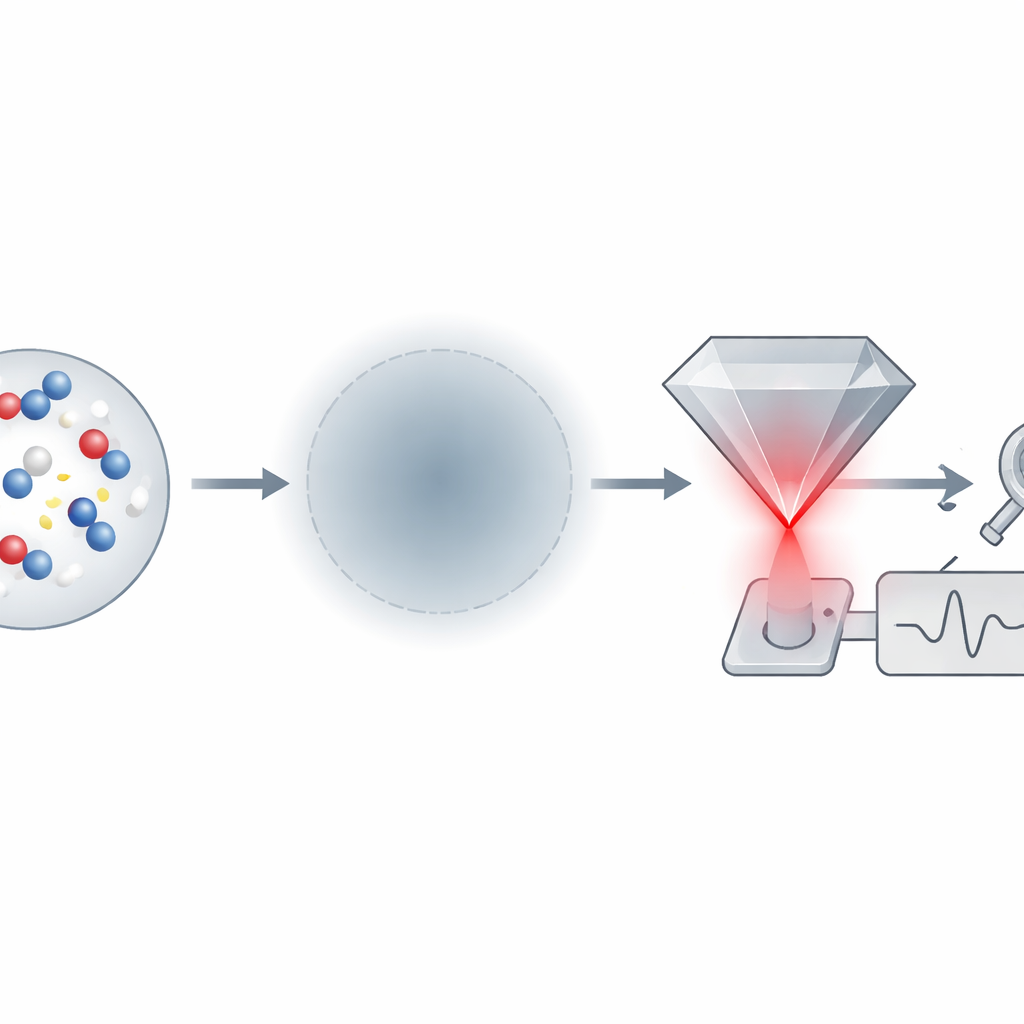
NMR works by treating atomic nuclei like tiny radio transmitters whose frequencies depend on their chemical surroundings. Conventional scanners use a very strong magnetic field to tune in to those broadcasts. The authors explore a different regime known as zero- to ultralow-field NMR, where there is essentially no external magnetic field at all. In this quiet environment, the signals no longer depend on a huge magnet but instead on the internal couplings between nearby nuclei. Because the magnetic surroundings are far more uniform than in a big magnet, the resulting lines can actually be sharper, providing high-resolution fingerprints of molecules even when samples are in awkward shapes or complex surroundings.
A Diamond that Measures Tiny Magnetic Whispers
The core of the new platform is a sliver of diamond containing defects called nitrogen-vacancy (NV) centers. These defects behave like ultra-sensitive compasses whose orientation can be read out with laser light and microwaves. The team shapes the diamond into a small truncated pyramid only a few hundred micrometers tall and engineers the optics so that red glow from the NV centers is collected efficiently. They then run the diamond in a special operating mode that does not require a steady background magnetic field, but instead uses a gently oscillating field to keep the sensor stable and to convert changing magnetic fields into a measurable light signal. The setup reaches sensitivities of about a dozen picotesla per square-root hertz—enough to hear nuclear spins precessing at just a few cycles per second.
Supercharging the Sample Instead of the Magnet
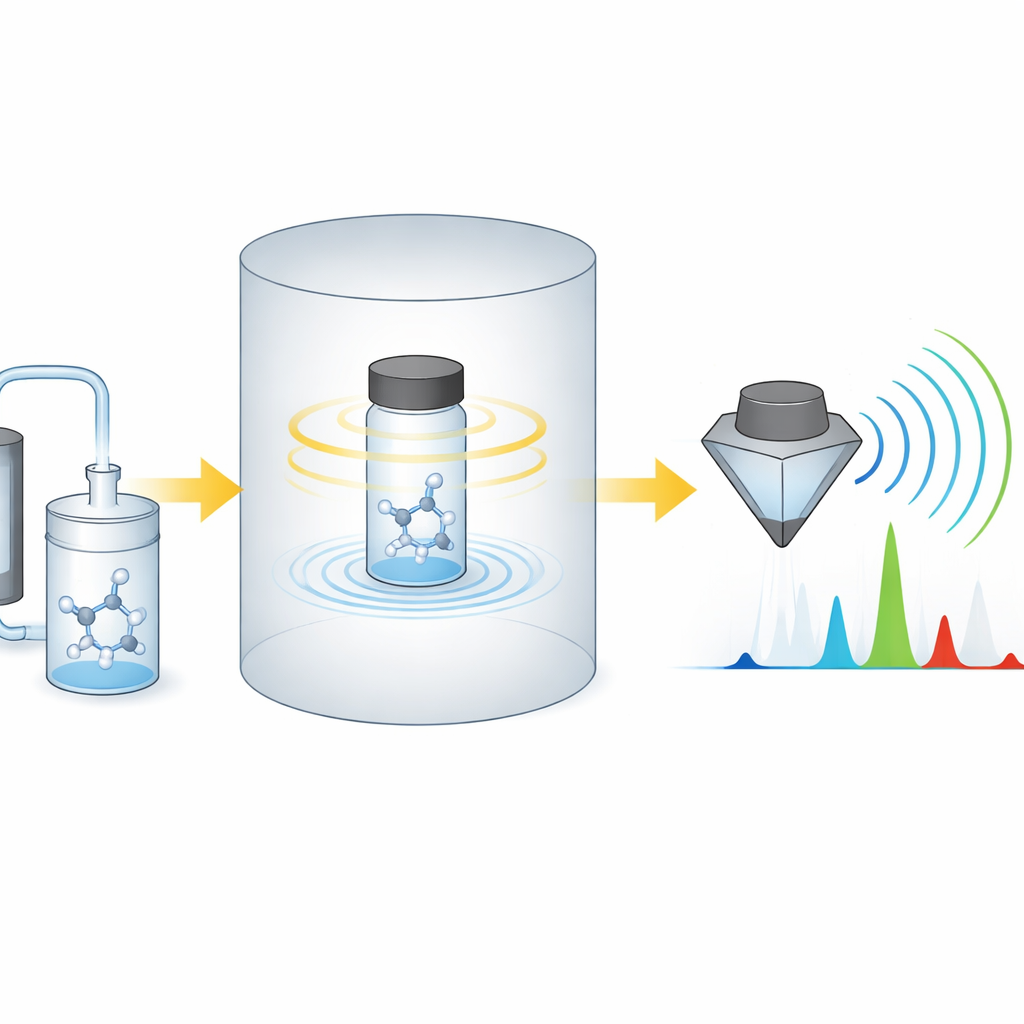
Because there is no big magnet to amplify the nuclear signals, the researchers instead supercharge the sample itself. They work with acetonitrile in which the nitrogen atoms are enriched with a rare isotope and mix it with a catalyst and a special form of hydrogen gas called parahydrogen. Through a process known as reversible exchange, the orderly spin state of the hydrogen is transferred into the acetonitrile, dramatically boosting its nuclear magnetization. After bubbling the gas through the liquid, they apply a brief magnetic pulse and then simply watch the sample’s magnetization decay in the shielded, near-zero-field region. The diamond sensor, placed less than a millimeter away, picks up clear oscillations at frequencies of about one to a few hertz that correspond exactly to the internal coupling pattern between hydrogen and nitrogen atoms in the molecule.
Comparing to Existing Sensors and Stretching the Limits
To put their diamond sensor in context, the authors compare it with a state-of-the-art commercial atomic vapor magnetometer housed in the same shielded chamber. The vapor cell boasts better raw sensitivity for distant, low-frequency signals but is physically larger and limited to a few hundred hertz of bandwidth. The diamond, by contrast, can be brought to within a few tenths of a millimeter of the sample and detects signals up to hundreds of hertz without hardware filters cutting them off. By moving the diamond and vapor sensors closer and farther from the sample, the team tracks how the signal strength grows with proximity and shows that the diamond follows the expected dipole behavior until it is so close that small stray magnetic fields from the sensor hardware begin to broaden the spectral lines.
From Lab Benches to Real-World Scanners
In everyday terms, this work shows that a chip-sized diamond can replace bulky equipment for certain types of chemical “listening.” With the help of hyperpolarization techniques such as the parahydrogen method used here—or other schemes that boost nuclear magnetization—the same diamond platform could read out signals from many different molecules at zero or ultralow field. Its compact size, high bandwidth, and ability to sit right next to tiny samples make it a strong candidate for portable diagnostic tools that inspect chemicals through metal walls, monitor reactions in industry, or probe small volumes in biology and medicine, all without the need for a giant superconducting magnet.
Citation: Omar, M., Xu, J., Kircher, R. et al. Zero- to ultralow-field J-spectroscopy with a diamond magnetometer. Commun Chem 9, 123 (2026). https://doi.org/10.1038/s42004-026-01962-3
Keywords: zero-field NMR, diamond magnetometer, nitrogen-vacancy centers, hyperpolarization, portable chemical sensing