Chemical plants that make medicines and specialty materials are steadily moving from traditional “batch” production—big pots filled and emptied in cycles—to continuous flow, where ingredients stream through pipes and reactors non‑stop. This switch can cut waste, improve safety, and shrink factory footprints. But there is a stubborn obstacle: solid particles. Powders, crystals and insoluble salts easily plug the narrow tubes used in flow systems, threatening shutdowns just when reliability matters most. This review explores how chemists and engineers are learning to tame those solids so that continuous manufacturing can truly replace the batch plant.
What goes wrong when particles meet tiny pipes
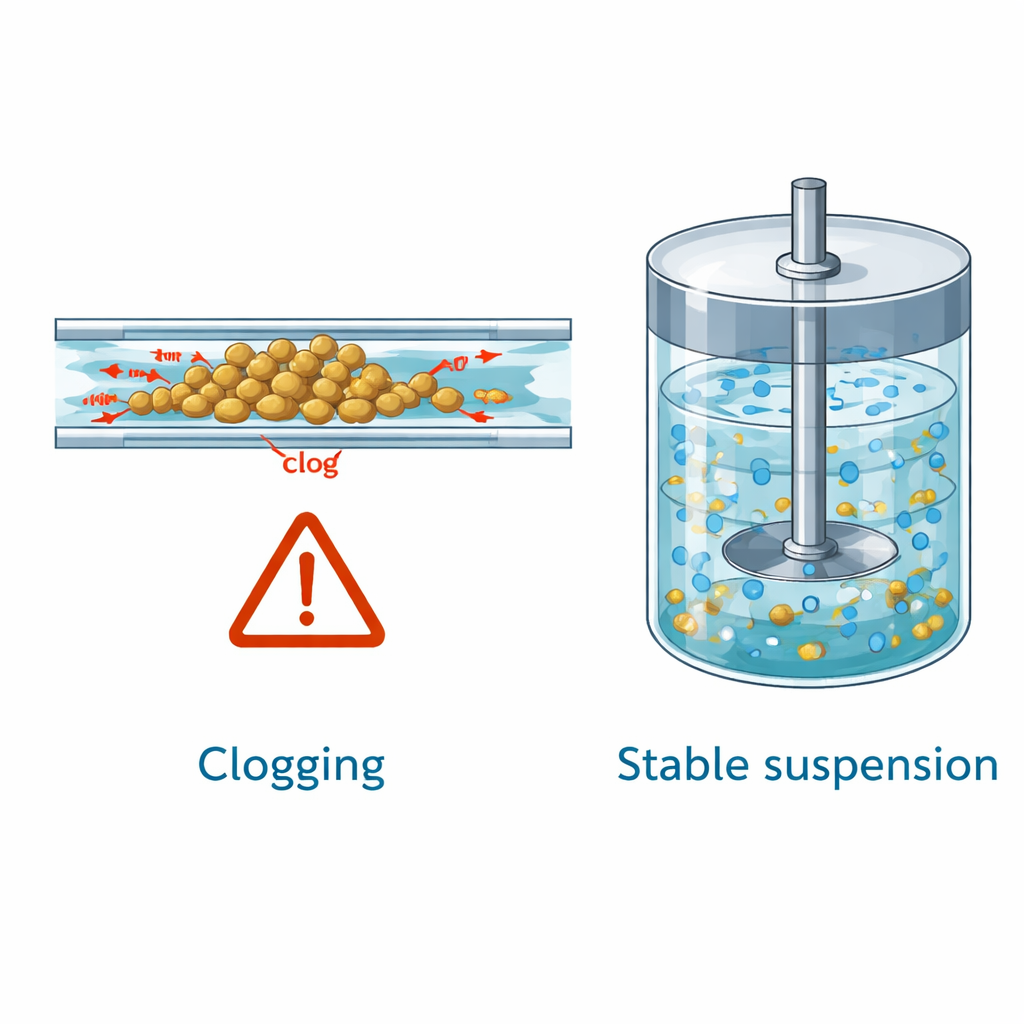
At the heart of the problem is simple physics. Flow reactors often use channels only millimetres—or even micrometres—wide to gain excellent heat and mass transfer. When solid particles are present, their size, shape and tendency to stick together strongly affect how they move. Very fine powders can clump via weak attractive forces, while long, needle‑shaped crystals can interlock like logs in a river, both leading to blockages. Insoluble by‑products such as inorganic salts or polymer fragments may start dissolved and then crystallise as conditions change, quietly coating the walls or building dams inside the tubing. The resulting fouling raises pressure, distorts how long molecules stay in the reactor, and can abruptly stop production.
Re‑engineering reactors to welcome solids Figure 1.
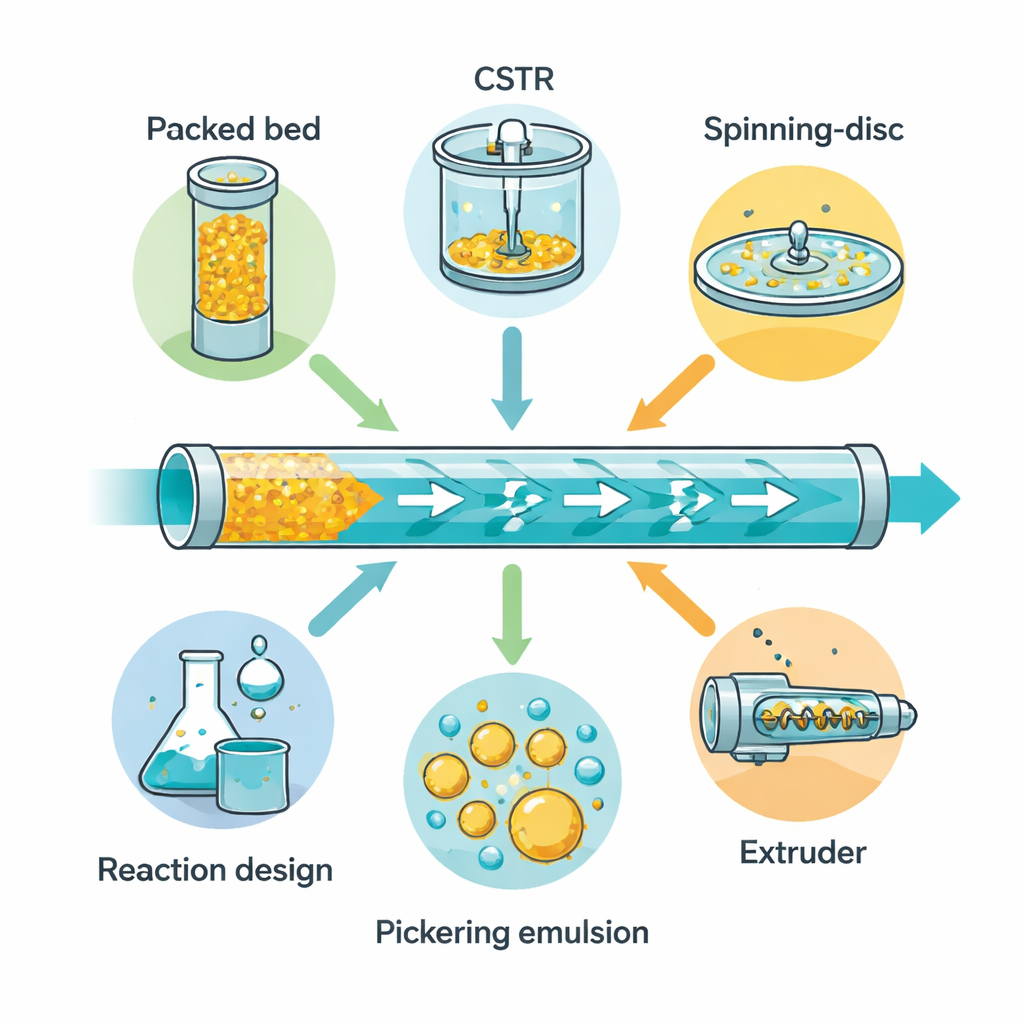
One family of solutions redesigns the equipment itself so that solids are either immobilised or constantly kept moving. Packed‑bed reactors trap catalysts or reagents on fixed supports in columns, allowing liquid or gas to wash through while the solid stays put. This approach powers everything from hydrogenation reactions to multi‑step drug syntheses, and can double as a built‑in purification step by catching excess reagents or metals. Where moving slurries are unavoidable, dynamic mixing reactors come into play. Continuous stirred‑tank reactors, agitated cell reactors and spinning‑disc devices use stirrers, shaking or rapidly rotating surfaces to keep particles suspended and to smooth out concentration and temperature variations. Oscillatory baffled reactors go further by pulsing fluid back and forth through internal obstacles, creating gentle vortices that hold solids aloft even at low overall flow rates.
New ways to move and transform solids
Other strategies rethink how solids enter and travel through a process. Flow mechanochemistry, for example, uses twin‑screw or single‑screw extruders to grind and mix solid reactants directly, often with little or no solvent. The screws apply controlled shear that both activates chemical reactions and prevents clumps from forming, enabling kilogram‑scale production of organic molecules that would be awkward in liquid flow. In microreactors, suspensions of nanoparticles or so‑called Pickering emulsions—droplets stabilised by particles at their surface—allow solid catalysts to behave more like mobile liquids. Because the particles ride at interfaces or as stable colloids, they are less prone to settling or sticking to walls, yet they remain easy to separate and recycle after the reaction.
Changing the chemistry to avoid clogs Figure 2.
Alongside hardware innovations, chemists can often redesign reactions so that problematic solids never appear. Many key pharmaceutical steps, such as acylations and substitutions, generate inorganic salts that precipitate in organic solvents. By swapping common bases for special organic “acid scavengers” that turn into liquid salts (ionic liquids) instead of crystals, researchers have run these reactions at useful concentrations without any visible solids. Adjusting solvent blends, temperatures, reagent order or even whole synthetic routes can steer by‑products toward forms that stay dissolved or form manageable slurries. Case studies show this logic applied to everything from local anaesthetics to antiviral building blocks, where modest molecular tweaks unlock stable, continuous processing.
Toward plug‑free continuous medicine factories
Taken together, these advances show that there is no single magic fix, but a toolbox. Fixed beds, stirred tanks, oscillating and spinning reactors, solvent‑free extruders, particle‑stabilised emulsions and smart reaction design each solve different aspects of the solids puzzle. The review argues that the next step is to integrate these tools with better sensors and control systems that can detect early signs of clogging and adjust conditions on the fly. For non‑specialists, the message is straightforward: by learning how to keep powders, crystals and salts behaving in tight spaces, chemists are making it possible to manufacture vital drugs and fine chemicals more safely, efficiently and sustainably in compact, continuous plants rather than sprawling batch facilities.
Citation: Johnston, Z., Peme, T., Mabasa, T. et al. Advances in solid handling for continuous flow synthesis of specialty chemicals and pharmaceuticals.
Commun Chem9, 101 (2026). https://doi.org/10.1038/s42004-026-01954-3