Clear Sky Science · en
A versatile self-cleaning fabric coating as a detergent-free laundry product
Why this laundry research matters to you
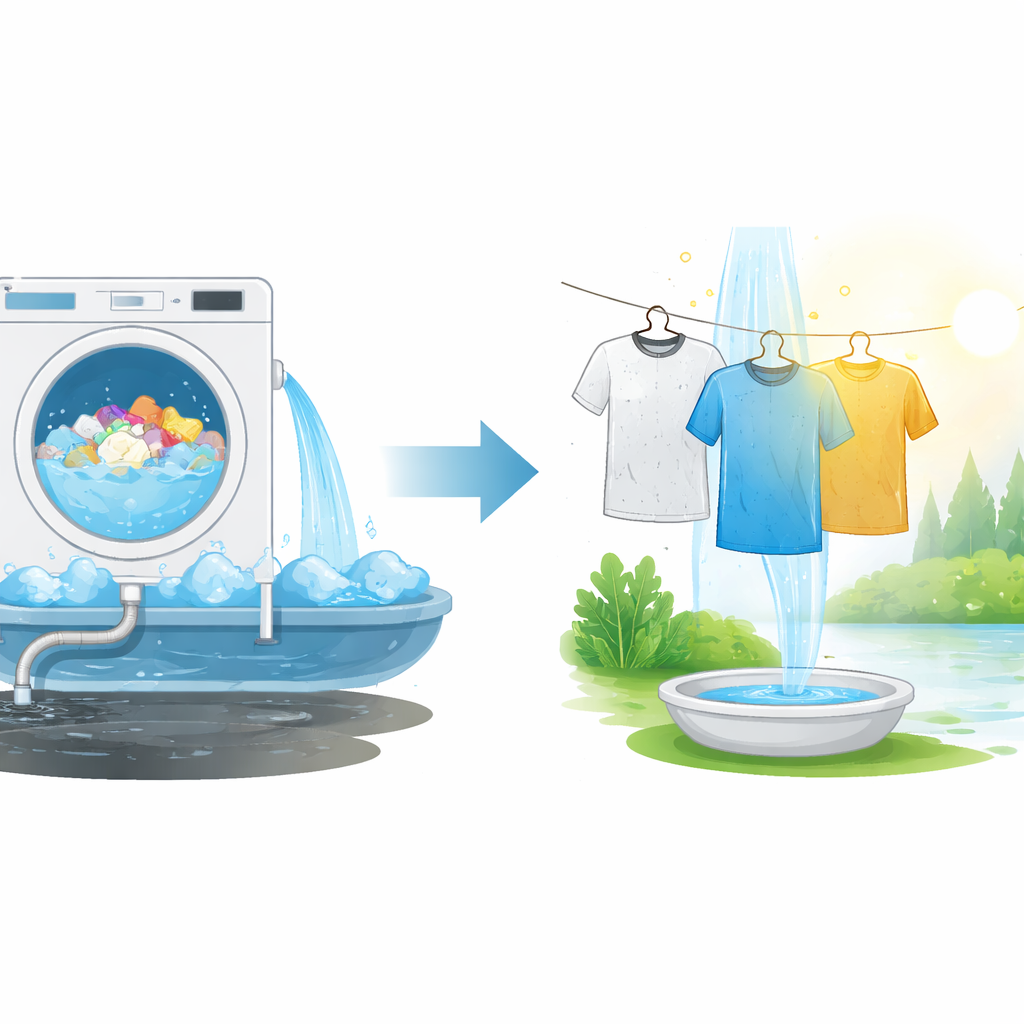
Every time we run a load of laundry, we turn precious drinking water into soapy wastewater. Modern detergents get clothes clean, but they also send chemicals and microplastics down the drain and demand lots of water, electricity, and time. This paper presents a new way to keep clothes clean and hygienic using a special fabric coating that allows most stains and germs to be rinsed away with plain tap water—no detergent needed. If widely adopted, it could reshape an everyday chore into a much more water‑ and planet‑friendly routine.
A simple coating with a big promise
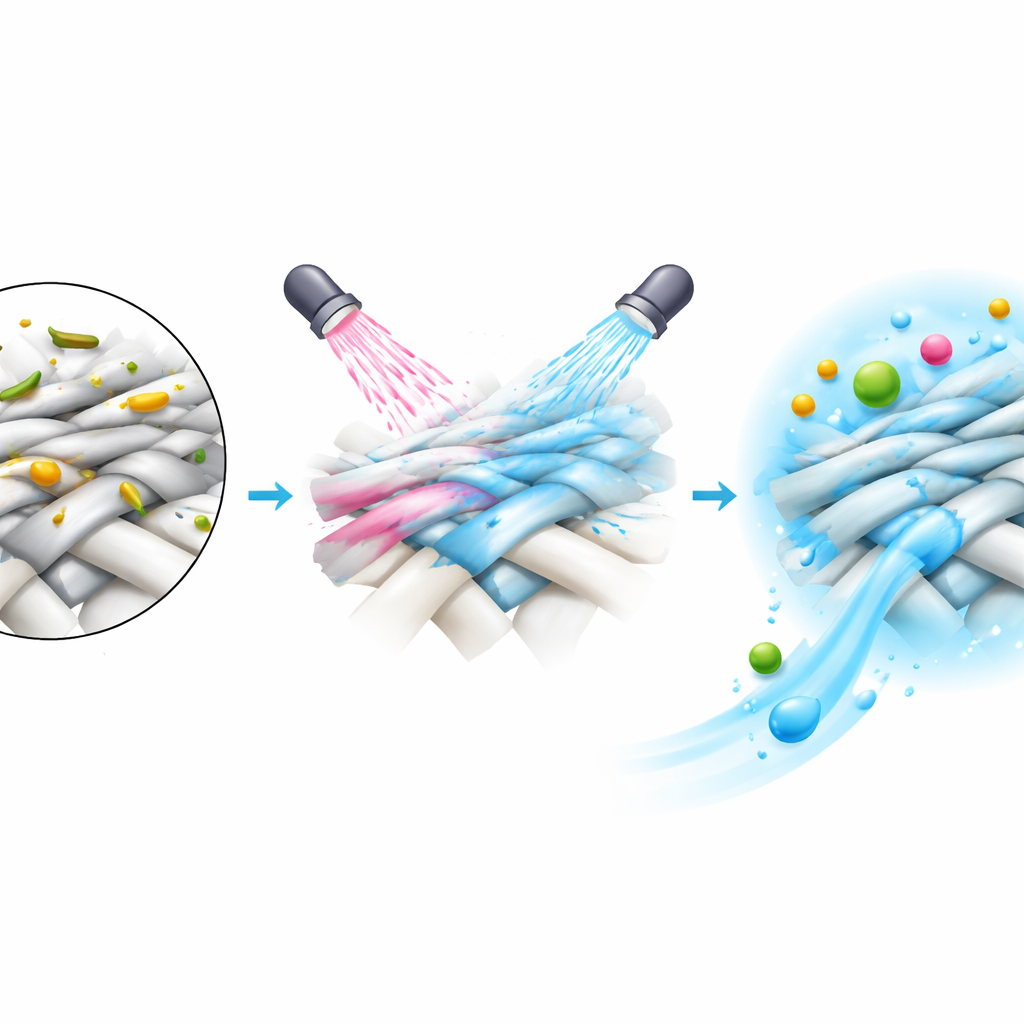
The researchers developed a very thin, invisible coating that can be sprayed onto many common fabrics, from cotton T‑shirts to synthetic fibers used in sportswear. It is built by alternately spraying two charged polymers so they stack into multiple layers on each fiber. One of them is rich in sulfonate groups, which strongly attract and hold onto water. When enough layers are applied, the fabric surface becomes wrapped in an ultra‑dense, stable layer of bound water molecules. Instead of relying on soap to loosen dirt and oil, this watery skin makes it hard for stains and germs to stick in the first place and easy for them to slide away when rinsed.
How the self‑cleaning action works
To understand what happens on the fabric surface, the team used sensitive optical techniques that probe how water and polymer groups are arranged at the interface. They found that once about five bilayers are built up, the sulfonate groups are packed so tightly that they completely cover underlying hydrophobic (water‑hating) parts of the coating. At this point the surface becomes extremely wettable, and a continuous hydration layer forms that behaves like a smooth, slippery cushion of water. Oil droplets and other low‑polarity substances normally cling stubbornly to fibers, but on this coated surface their adhesion is weakened so much that a quick rinse in tap water is enough to wash them away, even after the fabric has dried and been soiled in air.
Putting the coating to the test on real stains
The scientists then moved from flat test surfaces to actual textiles. Fabrics coated with the optimized version, called PEM‑5, shed a wide variety of everyday messes—cooking oils, chili oil, ketchup, soy sauce, and other food and drink spills—after a single rinse with hard tap water, with no added detergent. In controlled laundry trials, coated cotton, silk, and polyester reached levels of whiteness and soil release that matched or even surpassed uncoated fabrics washed through a full machine cycle with commercial detergent and multiple rinses. Crucially, the rinse water from the coated fabrics had almost the same organic content and surface tension as clean tap water, showing that little residue or hidden grime remained and that almost no extra organic pollution was created.
Guarding against germs, mold, and microplastics
Clean clothes are not only about stains but also about hygiene. The coated surfaces strongly resisted buildup of proteins and biological fluids like milk and blood in lab tests, cutting their adhesion to a small fraction of that seen on bare materials. When exposed to bacteria and fungi commonly found in daily life, coated fabrics picked up far fewer organisms and released almost none into growth media after rinsing. In real‑world demonstrations, the coated half of a pair of cotton trousers remained free of visible mildew after being worn, rinsed, and then incubated under warm, humid conditions that caused the uncoated half to develop obvious mold patches. The coating also helped trap microplastic fragments, meaning fewer fibers escaped into wash water, and showed good compatibility with cells and plants, suggesting it is unlikely to pose new health or environmental hazards.
Durability, savings, and environmental impact
For any household technology, durability and cost matter. The self‑cleaning coating stayed effective after soaking for days in very acidic, alkaline, and salty water, after strong ultraviolet light exposure, after thousands of folds, sandpaper abrasion, and more than 100 cycles of staining, rinsing, and drying—roughly the lifetime of a typical T‑shirt. Although adding the coating initially costs more per square meter than a box of detergent, the analysis shows that over tens of laundry cycles it becomes cheaper than both ordinary and premium detergents, largely because it eliminates detergent purchases and cuts water and electricity use by about 82%. On a national scale, the authors estimate that if such coatings were widely used in China, they could save billions of tons of potable water each year and nearly eliminate detergent‑laden wastewater from household laundry.
What this could mean for future laundry
In everyday terms, the study shows that our clothes can be made to clean themselves with plain water, thanks to a microscopic, water‑loving coating that keeps stains and microbes from grabbing hold. This turns laundry from a soap‑heavy, resource‑intensive routine into a quick rinse that protects both fabrics and freshwater supplies. While more work is needed to scale up production and adapt the technology to industrial manufacturing and new uses such as medical textiles, the core idea is clear: by engineering the surface of fabrics to carry their own built‑in water shield, we can enjoy clean, hygienic clothes while dramatically reducing the environmental cost of staying fresh.
Citation: Wang, R., Wang, H., Chen, Y. et al. A versatile self-cleaning fabric coating as a detergent-free laundry product. Commun Chem 9, 120 (2026). https://doi.org/10.1038/s42004-026-01942-7
Keywords: detergent-free laundry, self-cleaning fabrics, water-saving technology, anti-fouling coatings, sustainable textiles