Clear Sky Science · en
Crystallisation triggered by mass diffusion at a lower local supersaturation
Why this matters beyond the lab
Salt crystals might seem mundane, but the way they form has huge consequences—from how medicines are made to how we recover resources from salty wastewaters. This study reveals that crystals can start forming earlier, and in different places, when the liquid is gently pushed out of balance by temperature and concentration gradients. Understanding this subtle behaviour could help design cleaner, cheaper ways to manage brines, make better materials, and control unwanted scaling in pipes and equipment.
How crystals usually come to life
Crystallisation happens when a dissolved substance, like potassium chloride (KCl) in water, goes beyond the amount that can comfortably stay dissolved. This state is called supersaturation. Classical theories say that crystals appear only when supersaturation is high enough to overcome an energy barrier, and that nucleation should begin where the solution is most supersaturated. In industry, people usually push solutions into this state by cooling them, evaporating solvent, or adding an "antisolvent." Under these conventional, nearly uniform conditions, researchers have mapped out a metastable zone—a window where the liquid is supersaturated but no visible crystals have yet formed.
Three different ways to make the same salt crystallise
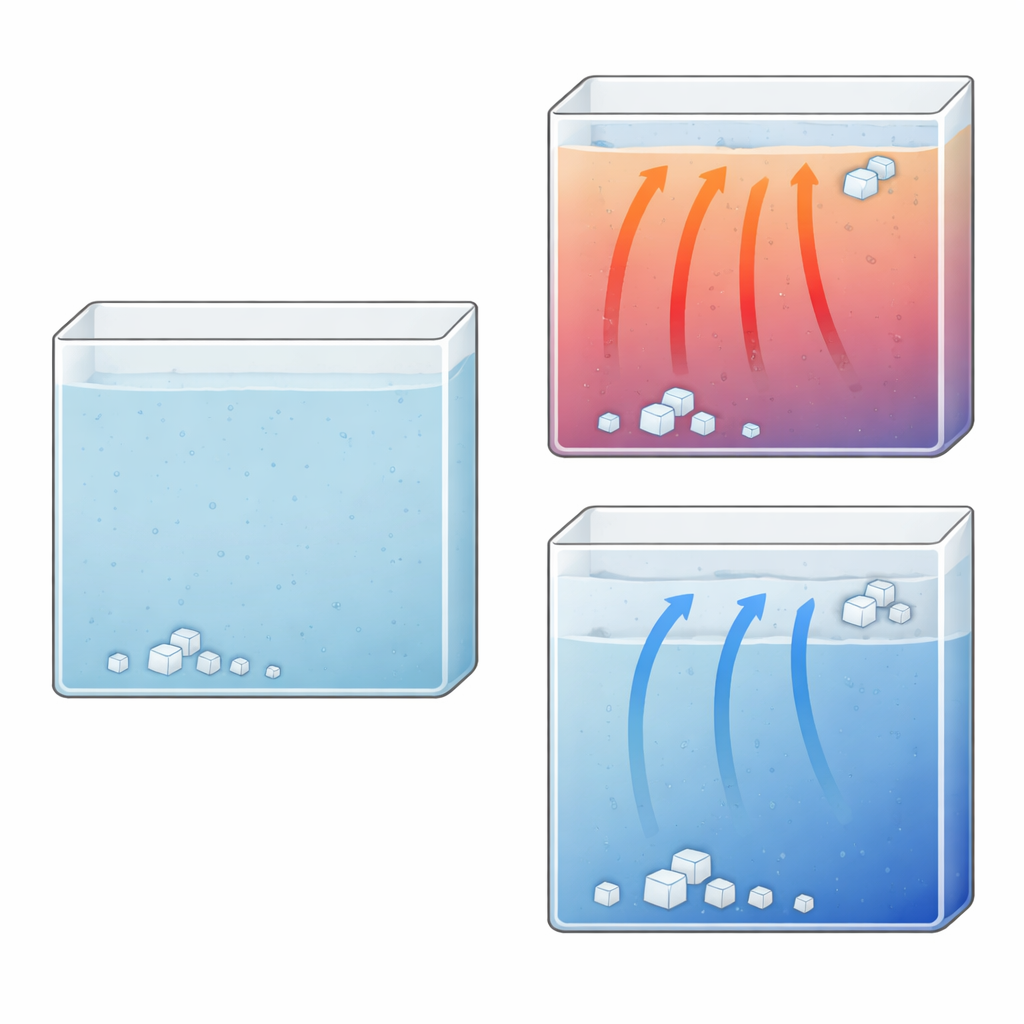
The authors examined how KCl crystals appear under three carefully controlled scenarios inside a custom-built, flat cell with separate temperature control at the top and bottom. First, they performed standard cooling experiments, lowering the temperature uniformly from 20 °C and watching when the first crystals appeared. This established a reference boundary in the concentration–temperature map: below a certain temperature, crystals always formed; above it, the solution stayed crystal-free for hours. They then compared this benchmark with two more complex situations in which the solution experienced directional mass transport rather than simple, uniform cooling.
When heat drives salt to move
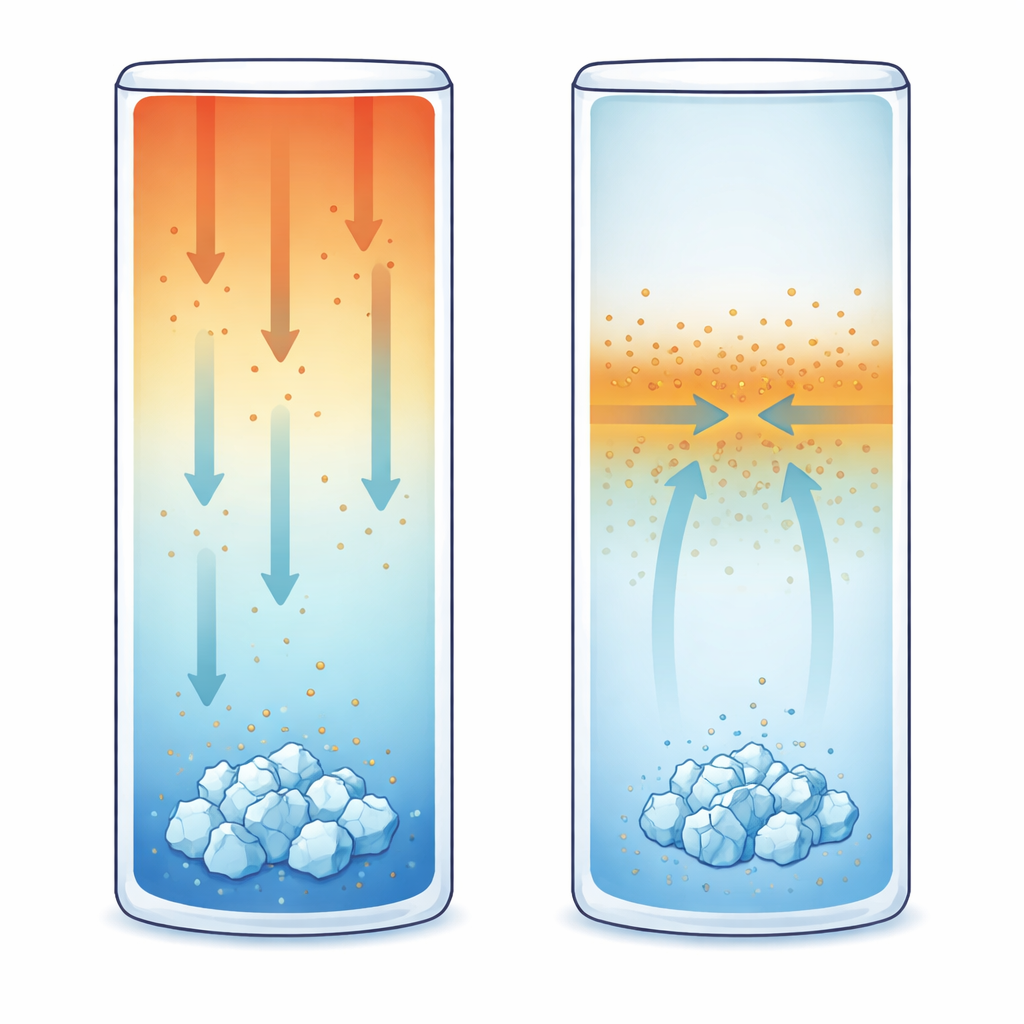
In the second set of experiments, the solution started at the same composition but was held with the top at 20 °C and the bottom cooled to 15 °C. This vertical temperature gradient causes thermodiffusion, meaning dissolved ions drift in response to temperature, not just concentration. For KCl in the tested range, the behaviour is thermophobic: ions tend to move toward the colder region, building up more salt near the bottom. Using a sensitive optical method called phase-shifting interferometry, the researchers tracked tiny changes in refractive index that reveal how concentration and temperature evolve. They found that crystals consistently formed at the cold lower wall in regions where the concentration gradient was steepest—yet the local supersaturation there was slightly lower than in the uniform cooling case. In other words, the presence of a sustained mass flux allowed crystallisation to start earlier than expected.
When salt diffuses in a perfectly even temperature
The third scenario removed temperature differences altogether. The entire cell was kept at a uniform 17 °C, initially filled with the reference solution. Then a smaller volume of more dilute KCl solution was injected gently from one corner at the top, creating a sharp concentration contrast but almost no fluid stirring. Diffusion then smoothed out this contrast as ions migrated from the more concentrated region into the dilute one. Again, interferometry revealed how the concentration field evolved over time. Surprisingly, the first visible crystals did not appear where the solution was most supersaturated. Instead, they formed roughly halfway up the cell, near the interface where the concentration gradient—and thus the diffusive mass flux—was strongest.
What this means for theory and technology
Across all three methods—cooling, thermodiffusion, and isothermal diffusion—the first crystals to appear looked very similar: mostly cubic KCl crystals with familiar growth shapes. What changed was not the crystal structure but the conditions that triggered their birth. Under imposed mass fluxes, crystals emerged at lower local supersaturation and at locations governed by gradients rather than peaks in concentration. This suggests that directional molecular traffic in the liquid may help ions align into dense patches that act as early nuclei, effectively narrowing the metastable zone. While classical nucleation theory cannot fully account for this behaviour, newer multi-step nucleation ideas are consistent with the findings. Practically, the work points toward smarter control of crystallisation in processes like zero-liquid-discharge desalination, where harnessing thermodiffusion could help turn waste brine into solid salts using less energy and fewer chemicals.
Citation: Xu, S., Torres, J.F. Crystallisation triggered by mass diffusion at a lower local supersaturation. Commun Chem 9, 125 (2026). https://doi.org/10.1038/s42004-026-01925-8
Keywords: crystallisation, thermodiffusion, supersaturation, desalination, mass transport