Clear Sky Science · en
Frustrated magnetism in 227 rare-earth iridium pyrochlores
Hidden magnets that refuse to line up
Most of us picture magnets as orderly: tiny compass needles that snap neatly into place. But in some crystals, the atoms sit on a lattice so awkwardly arranged that their tiny magnetic arrows cannot all point where they would like. This "frustration" can produce strange states of matter with excitations that behave a bit like the long-sought magnetic monopoles—isolated north or south magnetic charges. This review looks at a particularly rich family of such materials, the rare-earth iridium pyrochlores, and asks how their crystal structure, heavy atoms, and internal conflicts might host monopole-like particles that could eventually be steered with electric and magnetic fields.
When shapes make magnets disagree
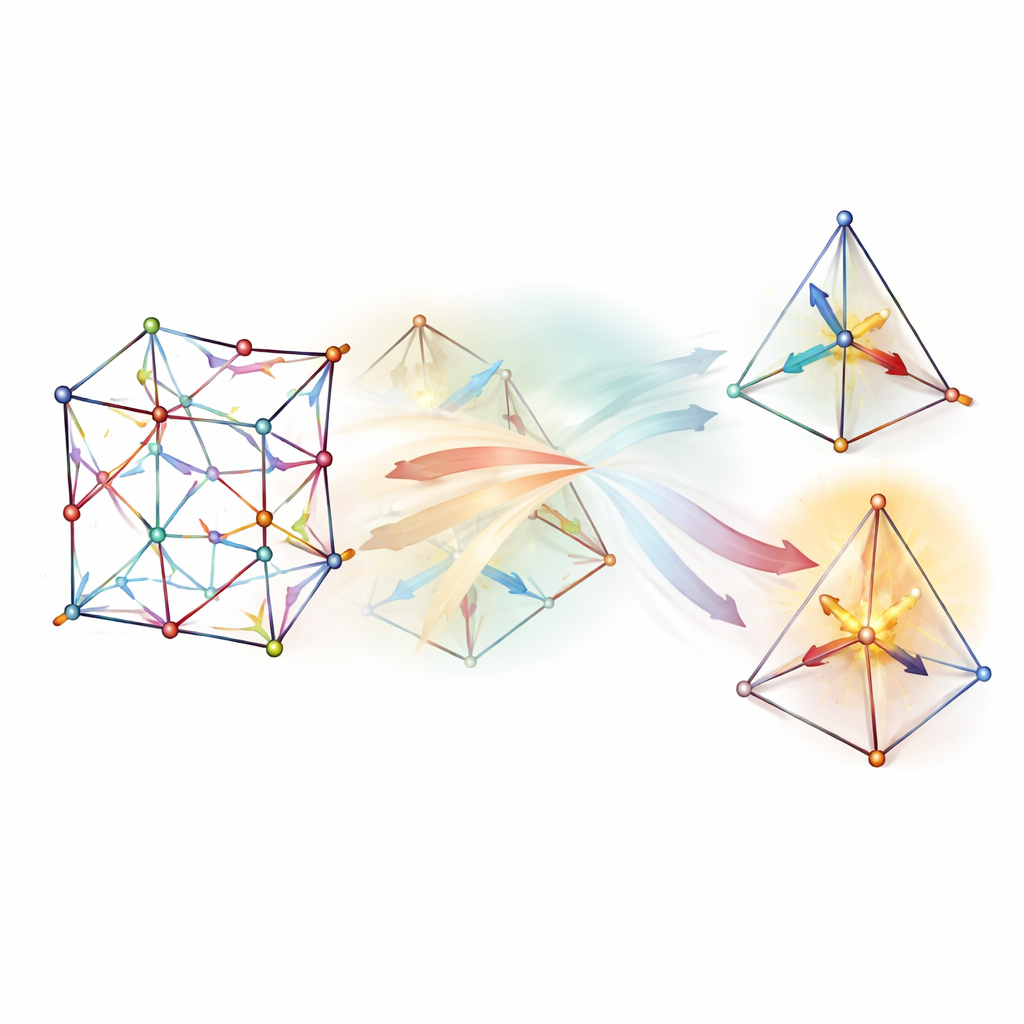
The story begins with geometry. In many everyday magnets, atoms sit on simple grids where neighboring moments can happily alternate up and down. In frustrated magnets, the building blocks are triangles and tetrahedra. If neighboring spins prefer to point in opposite directions, arranging three of them on a triangle—or four on a tetrahedron—makes it impossible to satisfy everyone at once. The pyrochlore lattice at the heart of this review is a three-dimensional network of corner-sharing tetrahedra made from rare-earth and iridium ions. This architecture supports a zoo of unusual magnetic states, including spin ice (where two spins point into each tetrahedron and two point out) and quantum spin liquids (where spins remain in constant motion even near absolute zero). These states are not just curiosities: they are promising platforms for robust, topology-based ways of storing and processing information.
Heavy atoms, strong twisting, and strange conductors
Rare-earth iridium pyrochlores, written chemically as A₂Ir₂O₇, add extra layers of complexity. The iridium atoms carry 5d electrons whose motion is strongly entangled with their spin through spin–orbit coupling. At the same time, electrons repel each other and feel the local electric fields created by surrounding oxygen atoms. Depending on details such as bond lengths and angles, these competing effects can produce metals, narrow-gap semiconductors, or insulators, and even topological phases like Weyl semimetals. As one moves across the rare-earth series (changing the A ion from Pr to Lu or Y), the lattice shrinks and the oxygen atoms shift slightly, tuning the bandwidth of the iridium electrons and the temperature at which the iridium moments order into a so‑called “all-in–all-out” pattern. Subtle changes in pressure, chemistry, or oxygen content can shift a sample from more conducting to strongly insulating without altering the overall crystal framework.
Magnetic domains, hidden walls, and monopole-like spots
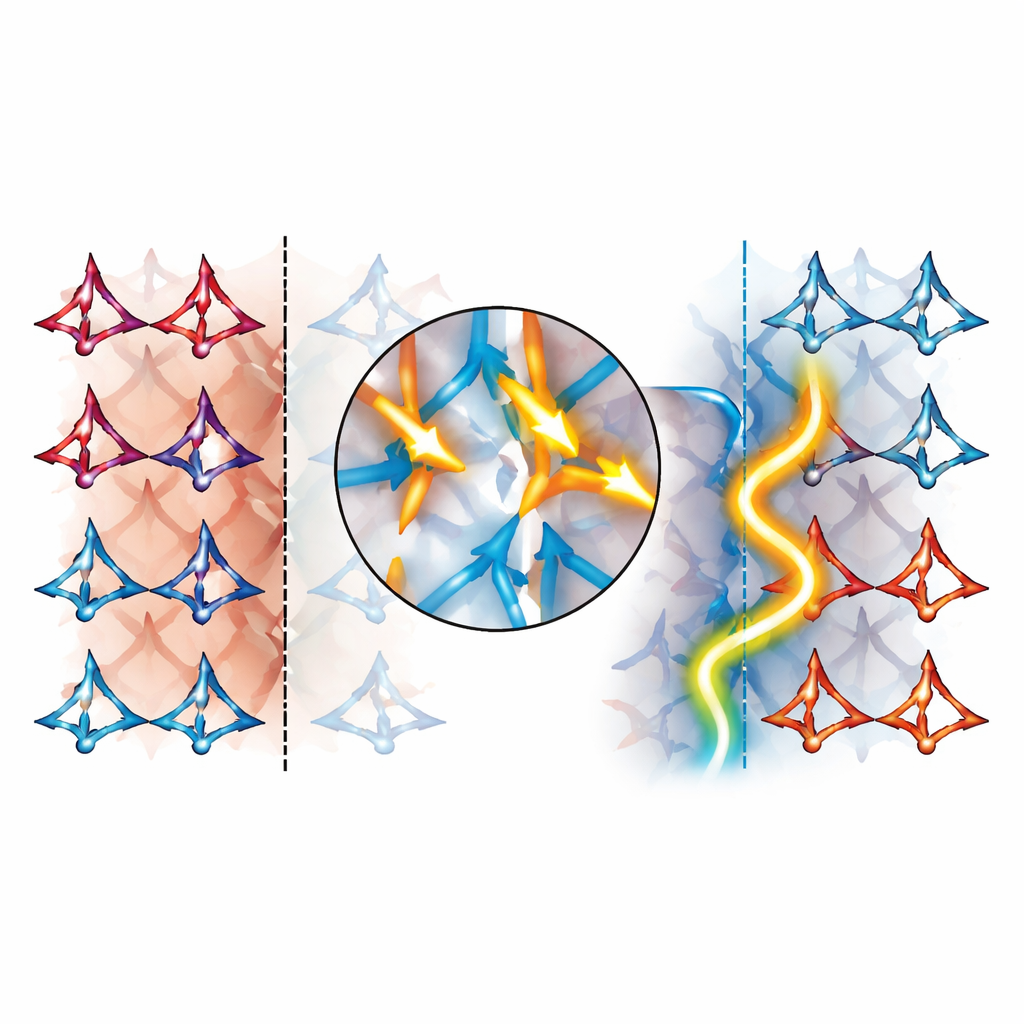
Below a characteristic temperature, the iridium sublattice tends to adopt the all-in–all-out pattern: on each tetrahedron, all four moments point either toward the center or away from it. Because the time-reversed version (all-out–all-in) has the same energy, crystals split into domains of each type separated by thin interfaces. At these domain walls, some spins are forced into three-in–one-out configurations, which mimic the magnetic charge of a monopole in spin-ice materials. The review argues that these interfacial regions host both “frozen” spins that give a tiny net ferromagnetic moment and more easily rotated spins that can be steered by small external fields. Transport measurements suggest that the domain interiors are strongly insulating, while the disturbed order at the walls can conduct much better, allowing electrical currents to trace out the invisible map of magnetic domains.
Two interlocking magnetic networks
The rare-earth ions on the A sites add a second, often larger, set of magnetic moments. Their behavior is shaped by the local crystal field and by exchange interactions that couple them to one another and to the iridium moments. In some compounds, such as Nd₂Ir₂O₇ and Tb₂Ir₂O₇, the ordered iridium network effectively drags the rare-earth spins into its all-in–all-out pattern. In others, like Dy₂Ir₂O₇ and Ho₂Ir₂O₇, the rare-earth moments show “fragmentation,” where part of the magnetic pattern forms an orderly lattice while the rest behaves like a fluid of emergent charges in a Coulomb phase. These rare-earth monopole-like excitations can couple back to the iridium domain walls, so that applying a magnetic field to the rare-earth sublattice indirectly reshapes the antiferromagnetic domains and their conductive interfaces. Across the series, delicate differences in local environment produce an entire catalogue of low-temperature behaviors, from spin-liquid-like metals to complex ordered states.
Toward electric control of magnetic charges
One of the most provocative ideas reviewed here is that each monopole-like excitation may carry not only a magnetic charge but also a tiny attached electric dipole. If so, electric fields or currents could in principle nudge these excitations and the domain walls that host them. Compared with more insulating spin-ice titanates, the iridates’ small charge gap and intrinsic 5d magnetism make them more amenable to such experiments, including current-driven studies and thin-film devices where strain further tunes their properties. For now, the evidence for magnetically charged, electrically active quasiparticles remains indirect, limited by the difficulty of growing large, clean single crystals and imaging microscopic domains. The review concludes that improving crystal growth, combining advanced scattering and imaging tools with transport and dielectric probes, and refining theoretical models will be crucial steps toward confirming whether rare-earth iridium pyrochlores truly harbour controllable magnetic monopole-like particles.
Citation: Klicpera, M. Frustrated magnetism in 227 rare-earth iridium pyrochlores. Commun Chem 9, 115 (2026). https://doi.org/10.1038/s42004-026-01918-7
Keywords: frustrated magnetism, spin ice, pyrochlore iridates, magnetic monopoles, spintronics