Clear Sky Science · en
Physics-informed deep learning enables fast ultrahigh-resolution nuclear magnetic resonance spectroscopy
Seeing Molecules More Clearly
Nuclear magnetic resonance (NMR) spectroscopy is one of chemistry’s most powerful microscopes for molecules, but its most detailed modes can be painfully slow. This paper introduces a way to use artificial intelligence to dramatically speed up an especially sharp form of NMR, called pure shift NMR, without sacrificing the fine detail scientists need. Faster, clearer spectra can help chemists follow complex reactions in real time, design better drugs and catalysts, and understand how molecules behave in crowded, real-world mixtures.
Why Regular NMR Sometimes Falls Short
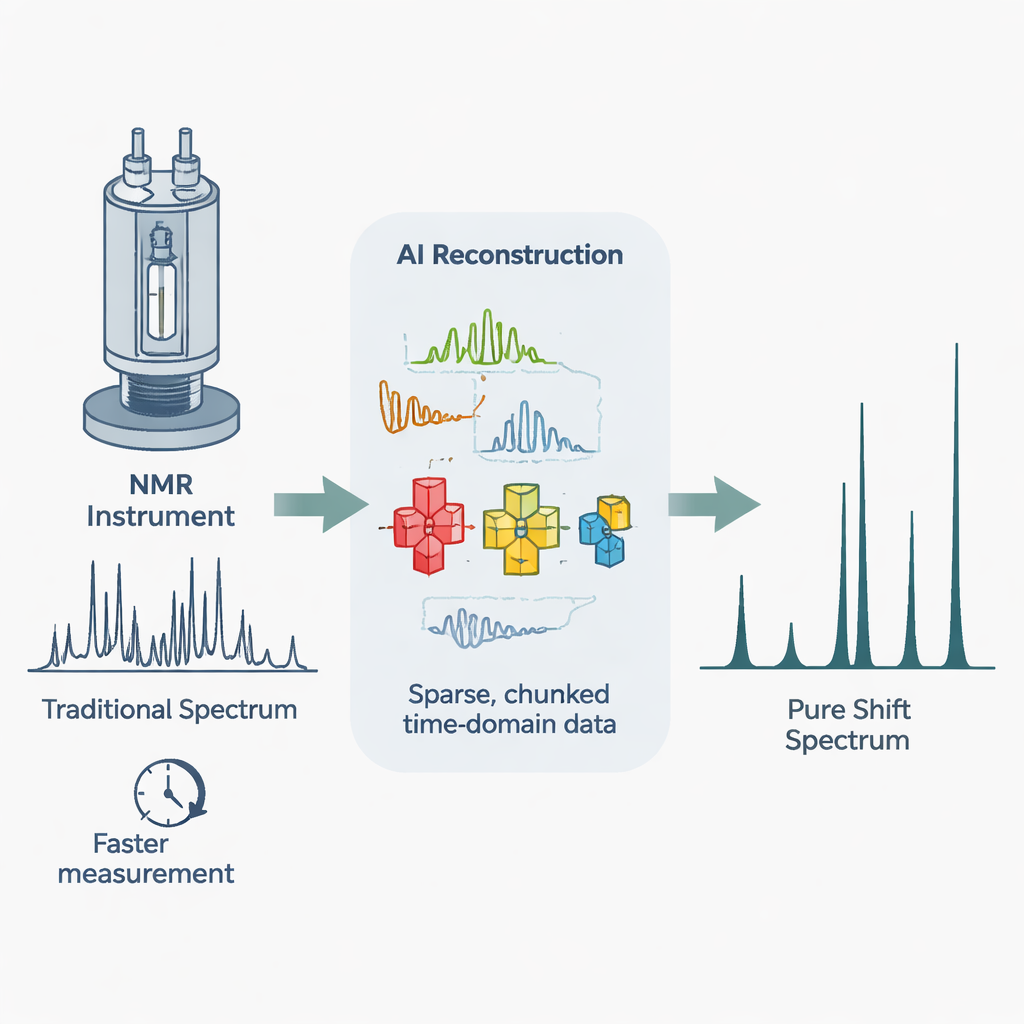
Conventional NMR turns subtle magnetic signals from atomic nuclei into graphs of peaks that reveal a molecule’s structure and environment. In crowded samples with many similar molecules, these peaks often overlap and split into intricate patterns, making them hard to interpret. Pure shift NMR simplifies this picture by collapsing those multi-peak patterns into single, sharp lines, giving “ultrahigh-resolution” views of crowded proton spectra. The catch is that pure shift methods require recording extra time points and stitching together many small data chunks. This can make experiments take ten times longer or more, especially for two- or three-dimensional techniques that already push instrument time to the limit.
Cutting Corners in Time, Not in Quality
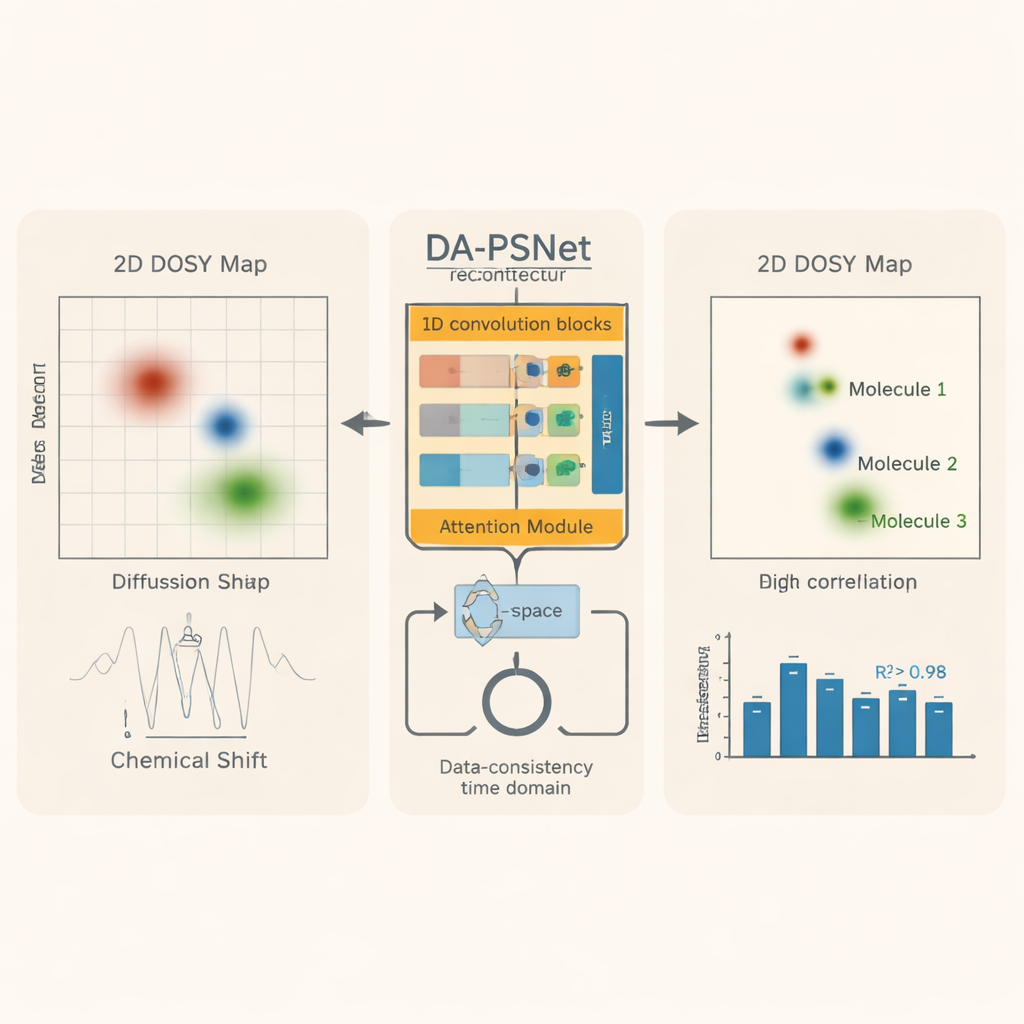
One way to shorten experiments is to record only a fraction of the data and try to reconstruct the missing pieces later. Earlier approaches borrowed ideas from compressed sensing, but they required careful tuning and often failed to recover weak signals or accurate peak heights. The authors present a new deep learning framework, called DA-PSNet, that learns directly from examples how to rebuild high-quality pure shift spectra from sparsely sampled measurements. The network is “physics-informed”: it works in both the frequency domain, where spectra are usually viewed, and the time domain, where it enforces consistency with the data that were actually measured. It also uses attention mechanisms to focus on subtle features like weak peaks buried near strong ones.
Sharper Spectra in One and Two Dimensions
The team first tests DA-PSNet on one-dimensional pure shift spectra of mixtures such as 1-butanol and butyric acid, in which key peaks strongly overlap in standard NMR. With only about 5% of the usual pure shift data, the raw sparse spectrum is badly distorted. Traditional reconstruction struggles to recover low-concentration signals and distorts peak intensities. In contrast, DA-PSNet restores closely spaced peaks, preserves their relative heights, and suppresses artificial features, while also running around a hundred times faster than the older method. At somewhat higher sampling levels, the reconstruction becomes accurate enough for demanding quantitative work, still delivering severalfold reductions in experiment time.
Following Reactions and Separating Complex Mixtures
Next, the authors show that the same trained model can accelerate more complex, multidimensional experiments without retraining. In two-dimensional pure shift DOSY measurements—which add information about how fast molecules diffuse in solution—DA-PSNet reconstructs high-resolution datasets for mixtures of three similar organic compounds from only 40% of the usual data. The resulting maps cleanly separate the components and closely match fully sampled reference spectra, with statistical agreement better than 98%. The method also proves its value in real-time electrochemical experiments: by combining pure shift NMR with DA-PSNet reconstruction, the researchers can clearly distinguish signals from a fuel molecule (1-butanol) and its oxidation product (butyric acid) as they evolve over time on different catalysts, revealing which catalyst converts the fuel more efficiently.
What This Means for Future Molecular Studies
Put simply, this work shows that a carefully designed, physics-aware neural network can “fill in” missing NMR data in a way that keeps weak peaks and accurate intensities while dramatically shrinking experiment times. There are still limits—if too little data are collected, even the best model cannot fully recover the spectrum, and training must reflect the range of samples and conditions of interest. But within realistic sampling levels, DA-PSNet turns previously slow, high-resolution pure shift methods into practical tools for routine and time-sensitive studies. For nonspecialists, the takeaway is that AI is helping NMR move from a slow, high-precision lab technique toward a faster, more flexible probe of structure and reactivity in complex chemical and biological systems.
Citation: Bao, J., Ni, Y., Hu, L. et al. Physics-informed deep learning enables fast ultrahigh-resolution nuclear magnetic resonance spectroscopy. Commun Chem 9, 103 (2026). https://doi.org/10.1038/s42004-026-01912-z
Keywords: nuclear magnetic resonance, pure shift NMR, deep learning, spectral reconstruction, reaction monitoring