Clear Sky Science · en
Ionic liquid-coated gold core polymeric nanoparticles for selective neutrophil hitchhiking towards endometriosis treatment
Rethinking Relief for a Common Hidden Illness
Endometriosis is a painful condition in which tissue similar to the uterine lining grows where it does not belong, often causing severe cramps, chronic pain, and fertility problems. Current treatments lean heavily on hormones or surgery, which can bring side effects, repeated procedures, and no guarantee of lasting relief. This study explores a very different idea: tiny light-activated particles that hitch a ride on the body’s own immune cells to seek out and gently destroy diseased tissue, potentially offering a future non-surgical option that could preserve fertility and reduce side effects.
Tiny Helpers Riding the Body’s First Responders
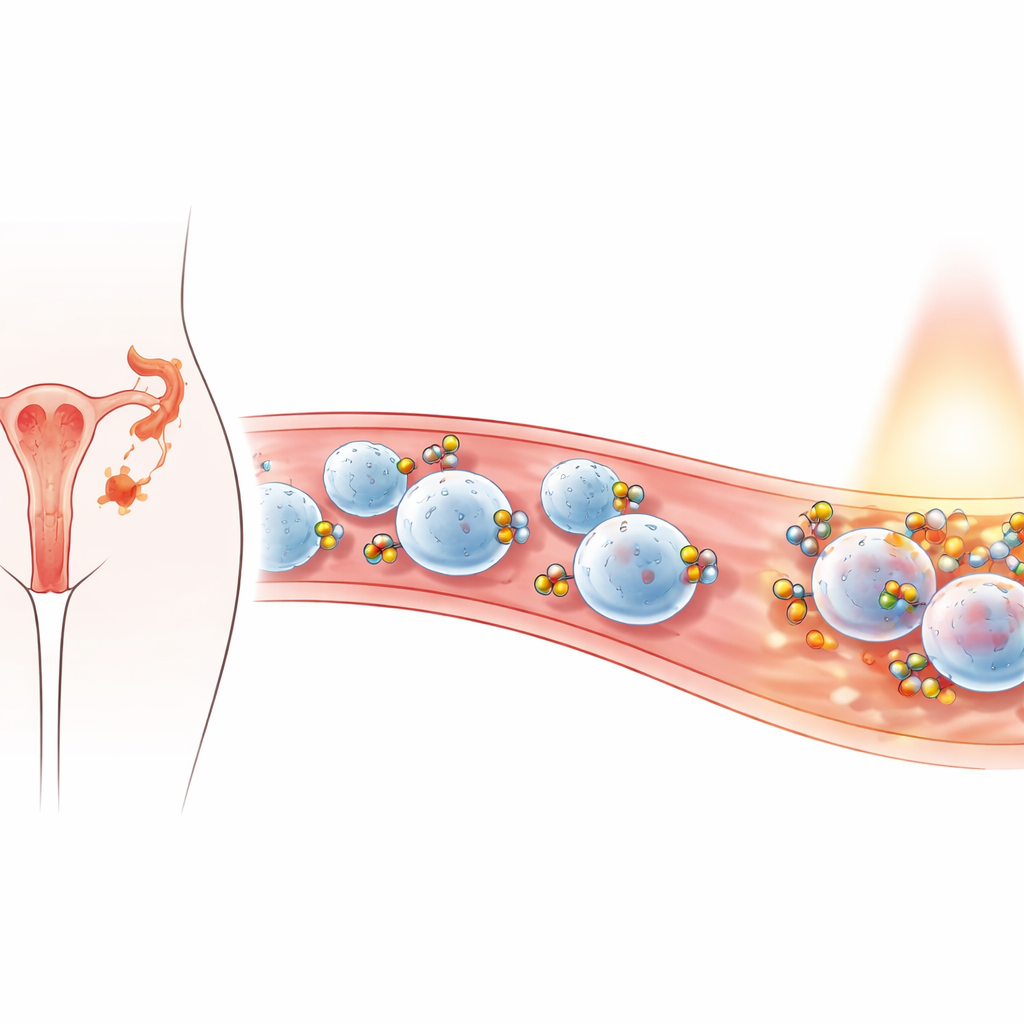
The researchers focused on neutrophils, a type of white blood cell that rushes to sites of inflammation, including endometriosis lesions. Their strategy is to "hitchhike" on these cells by coating nanoparticles so that neutrophils naturally pick them up or carry them on their surface. Once neutrophils travel to inflamed endometrial tissue, they bring the nanoparticles along, concentrating treatment where it is needed most while sparing healthy areas. Crucially, in healthy pelvic tissue neutrophil traffic is usually low for most of the menstrual cycle, which may help focus therapy on disease sites rather than normal tissue.
Building Smart, Light-Responsive Nanoparticles
To make this system work, the team built particles with three key components. At the core is gold, chosen because it can absorb near-infrared light and convert it to heat in a controlled way. Around the gold core they added a shell of a biodegradable plastic called PLGA, widely used in medical implants and drug delivery. Finally, they coated this shell with special "ionic liquids"—salty, oil-like molecules that stay liquid at relatively low temperatures. By carefully choosing the ionic liquids, they were able to tune how the particles interact with blood cells, particularly neutrophils. Microscopy and size measurements confirmed that the particles formed a neat core–shell structure, and optical tests showed that the coatings shifted the particles’ light absorption in a way that improved their heating performance.
Heating Diseased Cells Without Harsh Drugs
Once they had a stable particle design, the researchers tested how well these nanoscale heaters work on human endometrial cells in the lab. When solutions containing the particles were illuminated with near-infrared light—similar to what could be delivered by a medical laser—the temperature rose by only a few degrees overall, yet this was enough to damage nearby cells. Importantly, without light the particles were largely harmless: endometrial cells exposed to them remained more than 80% viable over a wide range of doses. Under light, however, the cells underwent mainly apoptosis, a tidy, programmed form of cell death, rather than necrosis, which can trigger inflammation. Additional tests showed little sign of DNA damage and no detectable release of inflammatory signaling molecules from the treated cells.
Proving Safety in Blood and Tracking the Ride
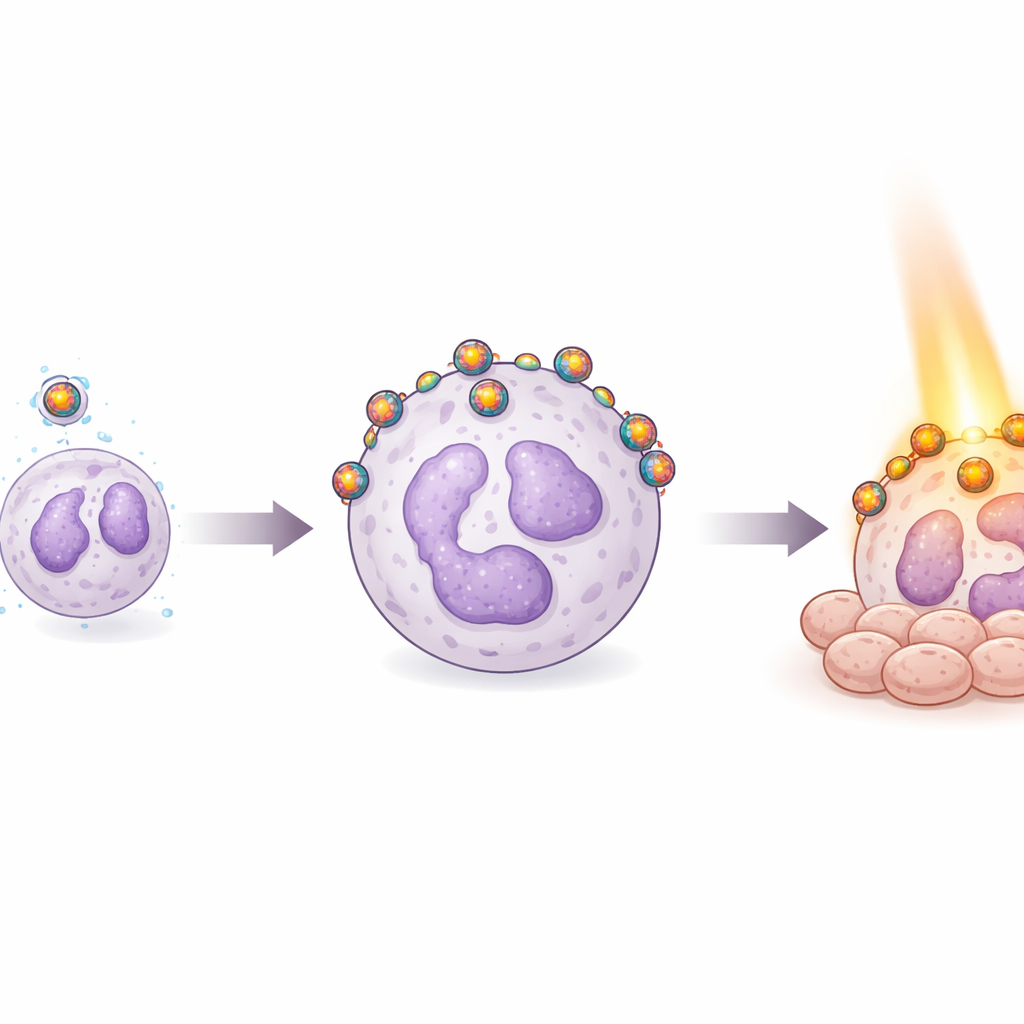
Safety in the bloodstream is essential for any intravenous treatment. The team exposed human red blood cells to the nanoparticles and found essentially no hemolysis—the destructive bursting of red cells that can cause serious complications—suggesting that the particles are gentle on blood. They then added a fluorescent dye to the particles and mixed them with samples of human blood to track which cells the particles preferred. Compared with uncoated particles, the ionic-liquid–coated versions showed much stronger association with neutrophils. Some coatings encouraged neutrophils to engulf the particles, while others caused the particles to stick to the cell surface like beads on the outside of a balloon. Both association patterns increased the amount of gold detected in neutrophils, confirming that the coatings successfully steer nanoparticles onto the body’s natural inflammatory couriers.
What This Could Mean for Future Treatment
Overall, the study introduces a new kind of "smart" nanoparticle that is designed to ride with neutrophils, safely circulate in blood, and, when triggered by gentle laser light, heat and kill endometrial cells mainly through controlled self-destruct pathways. While these experiments were done in cells and blood samples rather than in living patients, the results suggest a future in which endometriosis lesions could be treated from inside the body without major surgery or heavy hormone use. By combining targeted delivery with precise light-controlled heating, this approach could one day provide longer-lasting relief, fewer side effects, and better fertility preservation for people living with endometriosis.
Citation: Vashisth, P., Clerc, L.T.D., Hu, D. et al. Ionic liquid-coated gold core polymeric nanoparticles for selective neutrophil hitchhiking towards endometriosis treatment. Commun Chem 9, 119 (2026). https://doi.org/10.1038/s42004-026-01909-8
Keywords: endometriosis, nanoparticles, photothermal therapy, neutrophils, targeted drug delivery