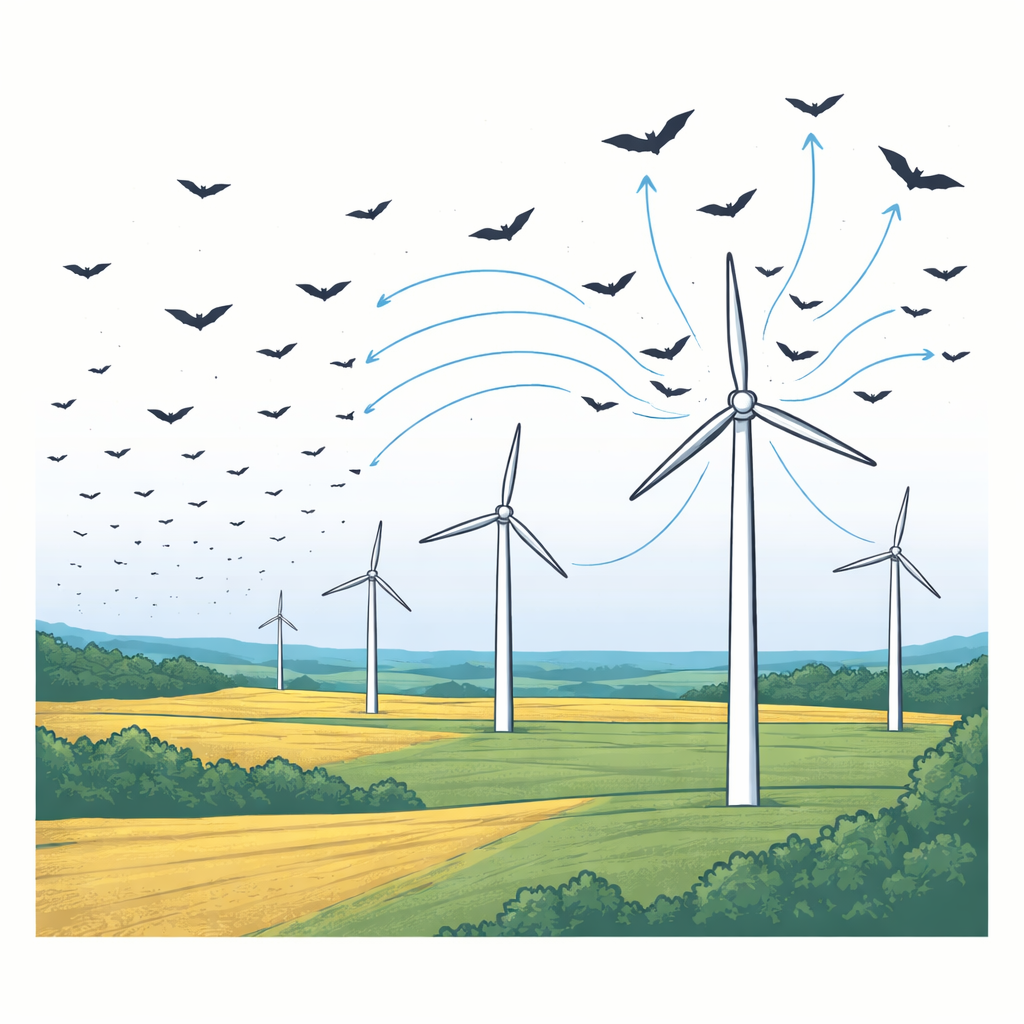
Wind power is essential for cutting greenhouse gas emissions, but spinning turbine blades are unintentionally killing large numbers of bats. This study from Germany asks a crucial question: are bats simply unlucky victims drifting into turbines, or are they actively drawn to these structures? By listening to bat sounds high up at turbine height and tracking their flights with thermal cameras, the researchers reveal that many bats are not just passing by—they are using turbines as places to hunt, socialize, and even court mates.
Bats and the hidden cost of clean energy
As wind farms spread worldwide, bat deaths at turbines have become a major conservation problem. Bats reproduce slowly and depend on long-lived adults to keep populations stable, so high adult mortality can quickly tip species into decline. Earlier work showed that most fatalities occur at low wind speeds in late summer and autumn, the time when many bats migrate and mate. Yet it remained unclear whether bats hit turbines by chance or because turbines offer something attractive, such as food, shelter, or social opportunities. Understanding this is key to designing smarter operating rules that protect bats while keeping energy production high.
Listening to bats at turbine height Figure 1.
The team analyzed over 83,000 audio recordings made at the level of the turbine nacelle—the hub where the blades attach—across 22 turbines at six sites in Germany. Sensitive microphones picked up both the rapid clicks bats use for echolocation and the more complex social sounds they use to communicate. In these recordings, the researchers identified more than 1,500 feeding buzzes, the rapid bursts of calls bats produce when closing in on insect prey, and over 4,000 social vocalizations. At least six species or species groups were heard feeding and ten were heard socializing, and these behaviors occurred at all studied turbines. Activity peaked from July to September, aligning with the known season of high bat fatalities.
Love songs in the rotor zone
Crucially, many of the social sounds were not just casual calls but full “songs” linked to courtship and territory defense. Seven species—including the two that make up almost two-thirds of known turbine deaths in Germany—were recorded singing while flying near turbines. These males produced structured song sequences from May through October, with a strong peak in late summer and autumn, the main mating period. By combining typical flight speeds from previous studies with the observed song durations, the authors estimate that many bats stayed in the rotor area long enough to circle the tower rather than just fly straight past. Calculations of how far these songs can travel suggest they act as acoustic beacons, broadcasting male presence over tens of meters and potentially drawing females toward the turbines.
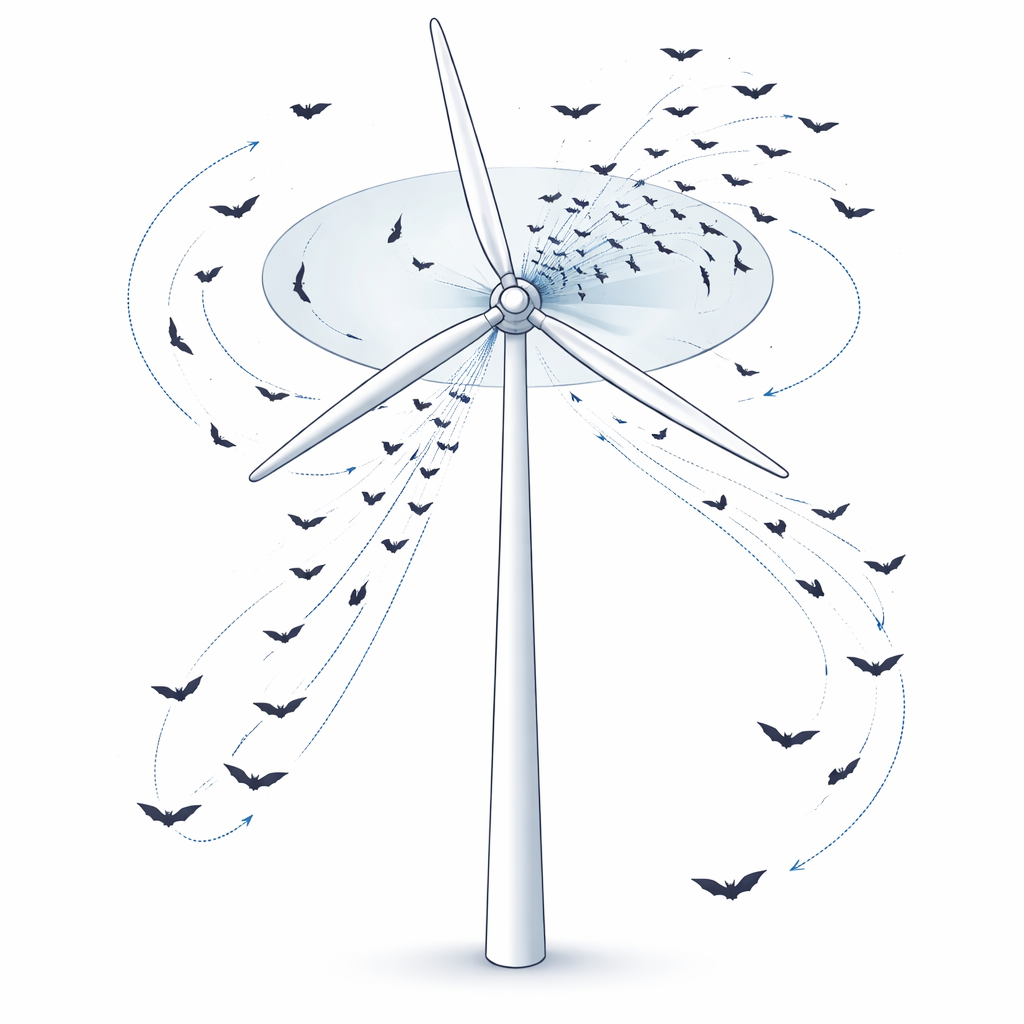
Thermal vision of bats crowding the blades Figure 2.
To see how bats move around turbines in three dimensions, the researchers used paired thermal cameras to reconstruct flight paths on six nights at four turbines. They then counted how many bat positions fell within concentric shells of space around the nacelle. Bat density dropped sharply with distance: it was highest inside the rotor-swept area and declined toward the surrounding free airspace. This pattern is hard to explain by random flight alone. Instead, it strongly indicates that bats actively approach turbine structures, concentrating where the blades pose the greatest danger. Combined with the acoustic evidence of feeding and mating behavior, the thermal data support the idea that turbines function as attractive hotspots for bats.
What this means for bats and wind power
For a layperson, the takeaway is stark: many bats are not just unfortunate bystanders at wind farms; they seem to treat turbines like tall trees or cliffs—places to hunt insects, stake out territories, and sing for mates. This attraction turns turbines into ecological traps: structures that appear beneficial but increase the risk of death. Because feeding and social activity closely track overall bat activity, the authors argue that curtailment—slowing or stopping turbines during high-risk periods—can still work, but it may need to be stricter during peak mating times. The study highlights that protecting bats at wind farms is not only about where turbines are placed or how fast the wind blows; it is also about understanding how bats use the night sky as social space, and ensuring that clean energy does not come at the cost of quietly disappearing bat populations.
Citation: Nagy, M., Hochradel, K., Haushalter, C. et al. Song flight and 3D thermal detection provide evidence for bat attraction to wind turbines in Central Europe.
Commun Biol9, 460 (2026). https://doi.org/10.1038/s42003-026-09882-7