Clear Sky Science · en
Antimicrobial resistance dissemination via horizontal gene transfer is constrained in stratified waters
Why Water Layers Matter for Germs and Medicine
Many of the antibiotics that protect us from infections are slowly losing their power as bacteria evolve ways to resist them. A major worry is that resistance genes could spread unchecked through rivers, lakes and oceans, turning these vast waters into highways for hard-to-treat germs. This study asks a simple but important question: do the natural layers that form in still or gently mixed waters act as invisible walls that slow the movement of resistance genes up and down the water column?
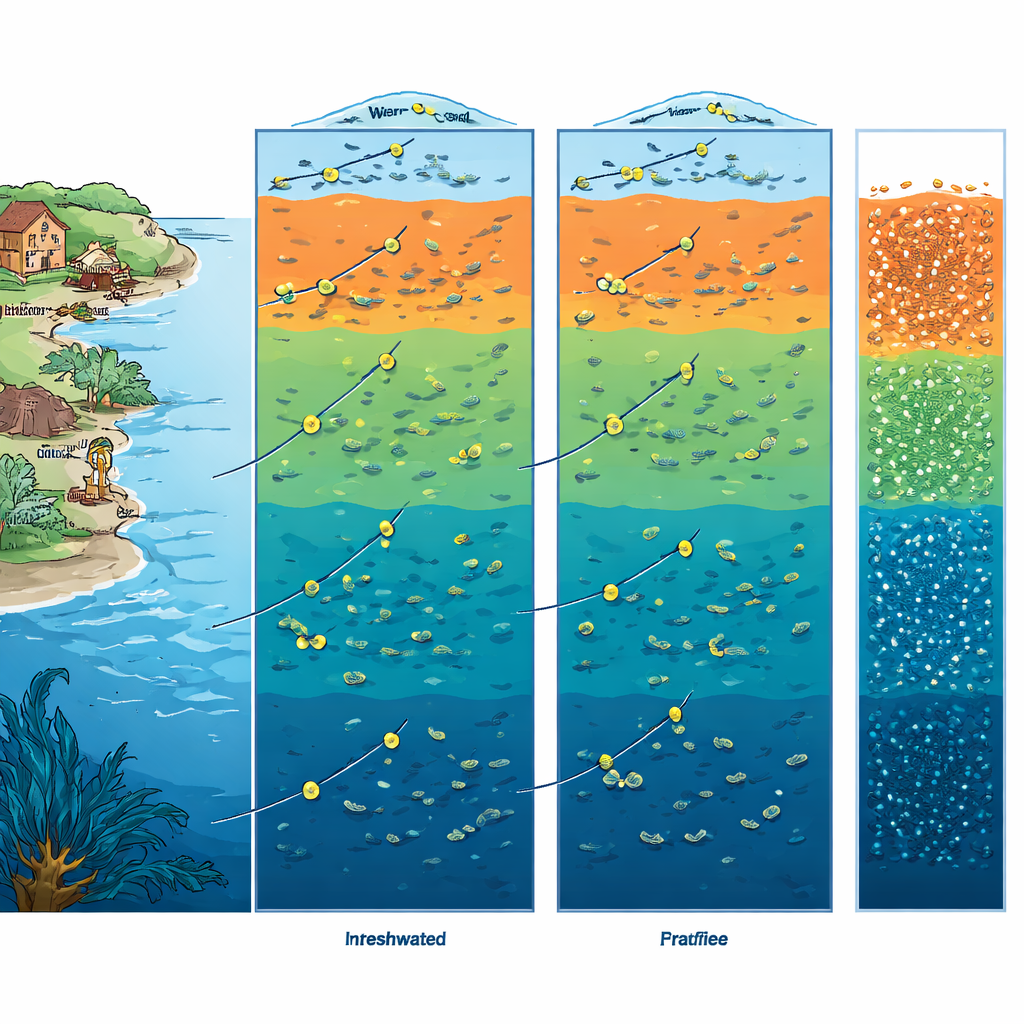
Hidden Layers in Lakes and Oceans
In both freshwater lakes and the open ocean, water often settles into stacked layers, divided by temperature or density. These layers can be stable for long periods, meaning microbes living a few meters apart may rarely mix. The researchers focused on antibiotic resistance genes, the DNA instructions that let bacteria survive drug treatment. They wanted to know whether these genes easily jump between bacteria living in different layers, or whether each layer tends to keep its own set of resistance tools.
Reading the DNA of Whole Microbial Communities
Instead of studying single species in the lab, the team reanalyzed large, publicly available DNA datasets from dozens of stratified lakes, ponds, reservoirs and marine sites. Using genome-resolved metagenomics, they reconstructed thousands of draft genomes from natural bacterial communities at multiple depths. They then used specialized software to detect horizontal gene transfer—instances where DNA appears to have recently jumped from one microbial lineage to another—across depths. At the same time, they searched these genomes for resistance genes using three complementary reference databases, capturing both well-known clinical resistance genes and more subtle or as-yet unobserved ones.
More Gene Swapping in Freshwater, But Not for Resistance
The analysis revealed that bacteria in freshwater systems swap genes more actively than those in the ocean, even after accounting for differences in sampling. Certain bacterial groups, especially within lakes and ponds, were frequent donors or recipients of transferred genes. Yet, when the authors looked specifically at antibiotic resistance genes, a striking pattern emerged: none of the identified resistance genes showed signs of having recently jumped between bacteria living at different depths. Although resistance genes were present—often more numerous in freshwater than in marine environments—they largely appeared to be inherited within lineages rather than shared across the layered water column.
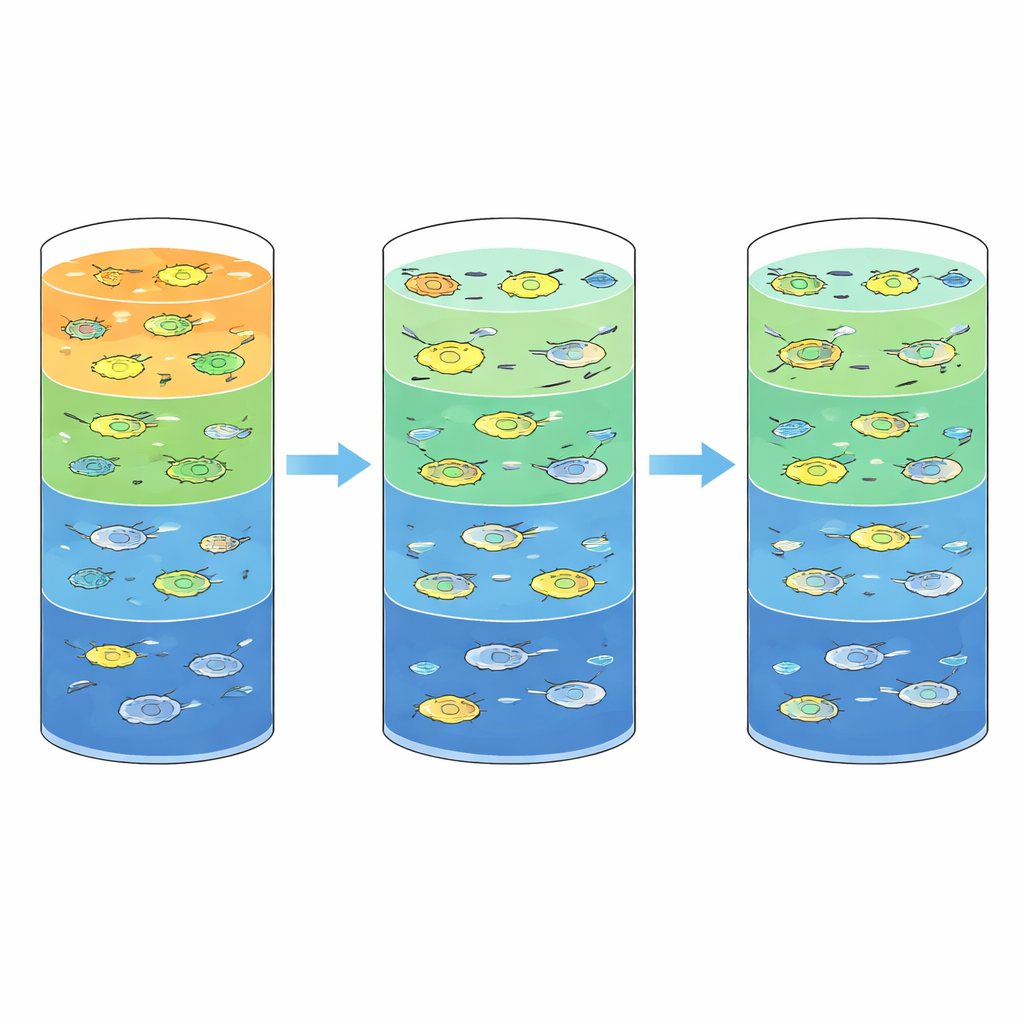
Mobile DNA and Viruses Play a Smaller Role Than Expected
The team also checked whether resistance genes were sitting on plasmids or viruses, the mobile pieces of DNA often blamed for rapid spread of antimicrobial resistance. Only a small fraction of resistance genes were found on such mobile genetic elements, and those that were mobile rarely appeared beyond one depth layer. In a few cases, viruses in a lake carried resistance genes that matched those in nearby bacteria, hinting at past or potential transfers. Still, most of these events were confined to the same depth, and any upward or downward movement was limited and sporadic rather than forming a clear pathway for vertical spread.
What This Means for the Future of Waterborne Resistance
Taken together, the findings suggest that the layers in stratified waters act more like vertical barriers than open conduits for antibiotic resistance genes. Resistance tends to accumulate and persist within individual layers rather than flowing freely between them. As climate change is expected to intensify and prolong water column stratification in many regions, this could further reduce vertical mixing of resistance genes. While aquatic ecosystems remain important reservoirs of resistance, this study indicates they may be less effective at moving clinically relevant resistance genes between bacterial hosts across depths than previously feared, even though undiscovered genes and uncultured microbes may still hold surprises.
Citation: Vass, M., Abramova, A. & Bengtsson-Palme, J. Antimicrobial resistance dissemination via horizontal gene transfer is constrained in stratified waters. Commun Biol 9, 435 (2026). https://doi.org/10.1038/s42003-026-09857-8
Keywords: antibiotic resistance, aquatic microbiome, horizontal gene transfer, water stratification, mobile genetic elements