Clear Sky Science · en
Population coding for visual and auditory quantity in human numerotopic maps
How Our Brains Sense “How Many” Without Counting
Humans and many animals can instantly tell whether there are one, three, or five things in front of them, or how many beeps they just heard, without carefully counting. This quick sense of “how many” is crucial for everyday decisions, from judging how many people are in a room to estimating the number of cars approaching a crosswalk. The study described here asks a deceptively simple question: does the brain use the same basic code to judge quantity from both sight and sound, and if so, how is that code laid out across the brain’s surface?
Seeing and Hearing Numbers
To explore this question, the researchers scanned the brains of twelve adults with an ultra‑powerful 7‑Tesla MRI scanner. Inside the scanner, people either looked at brief displays of black dots or listened to short sequences of beeps. In both cases, the number of items ranged from one to five. The dots all had the same total area on the screen, and the beeps varied randomly in pitch, so that simple visual brightness or sound frequency could not explain any brain differences. Participants just had to press a button when the dots changed color or when an odd‑pitched beep appeared, ensuring they stayed alert without explicitly counting. 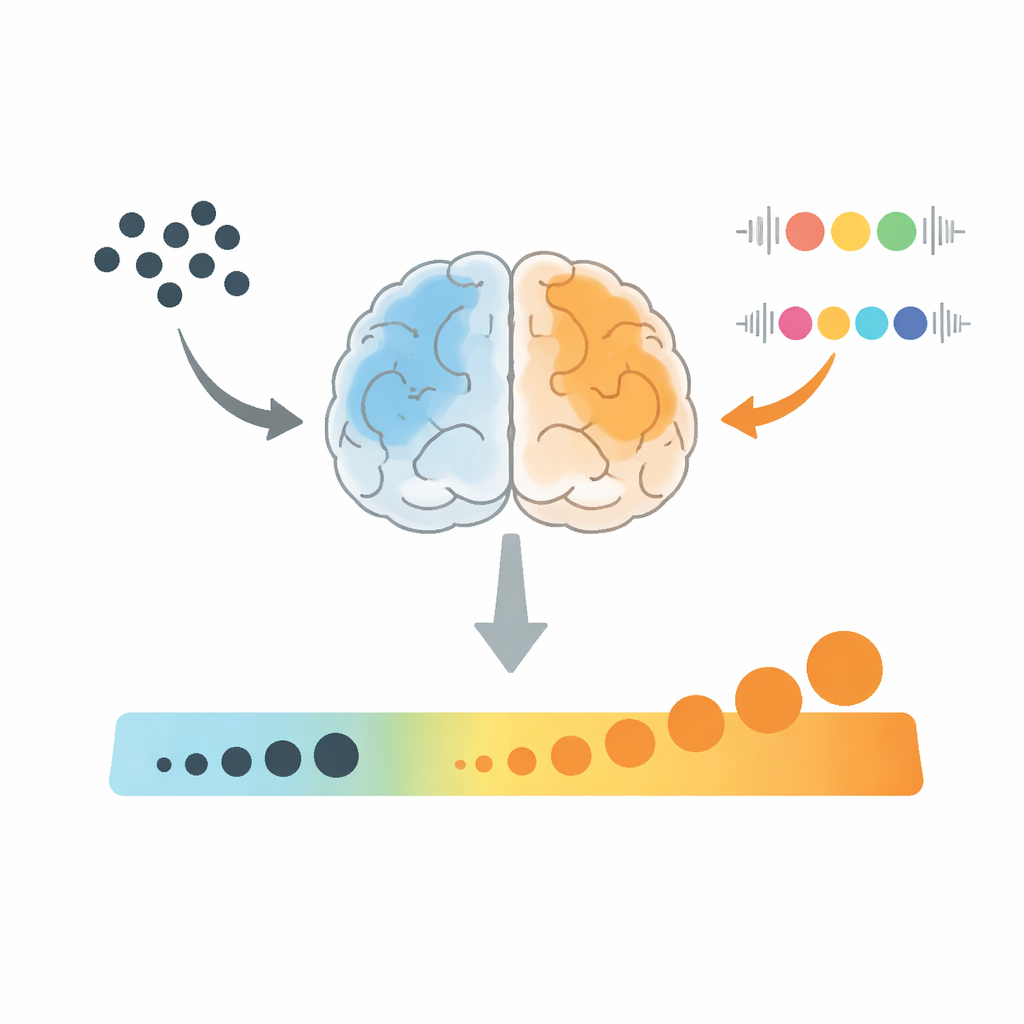
Hidden Maps of Quantity
The team modeled the brain activity with a mathematical tool that describes how strongly each tiny patch of cortex prefers particular numbers. For each patch, they estimated a “favorite” quantity and how broadly it responds to nearby quantities. They found that responses followed a smooth, bell‑shaped curve when numbers were laid out on a logarithmic scale, meaning that differences between small numbers (like one vs. two) are treated as larger than the same step at higher numbers (like four vs. five). In both visual and auditory tasks, neighboring patches of cortex preferred neighboring quantities, forming orderly “numerotopic” maps—much like maps for vision and touch—where the sense of number is laid out across the brain’s surface.
Different Spots for Sight and Sound
Although the code for quantity was similar across senses, the brain areas involved were distinct. Visual quantities were represented in several regions across the back and top of the brain, including occipital, parietal, and frontal areas. Auditory quantities, by contrast, appeared in fewer and much smaller maps, mainly in parts of the temporal lobe involved in hearing and in premotor regions toward the front of the brain. No single region responded strongly to both visual and auditory quantity within the tested range, suggesting that the brain keeps sensory input streams separate while still using a shared coding strategy. The researchers also found that more cortical surface was devoted to smaller quantities than to larger ones, and that patches preferring larger numbers responded more broadly, blurring over a wider range of nearby quantities. 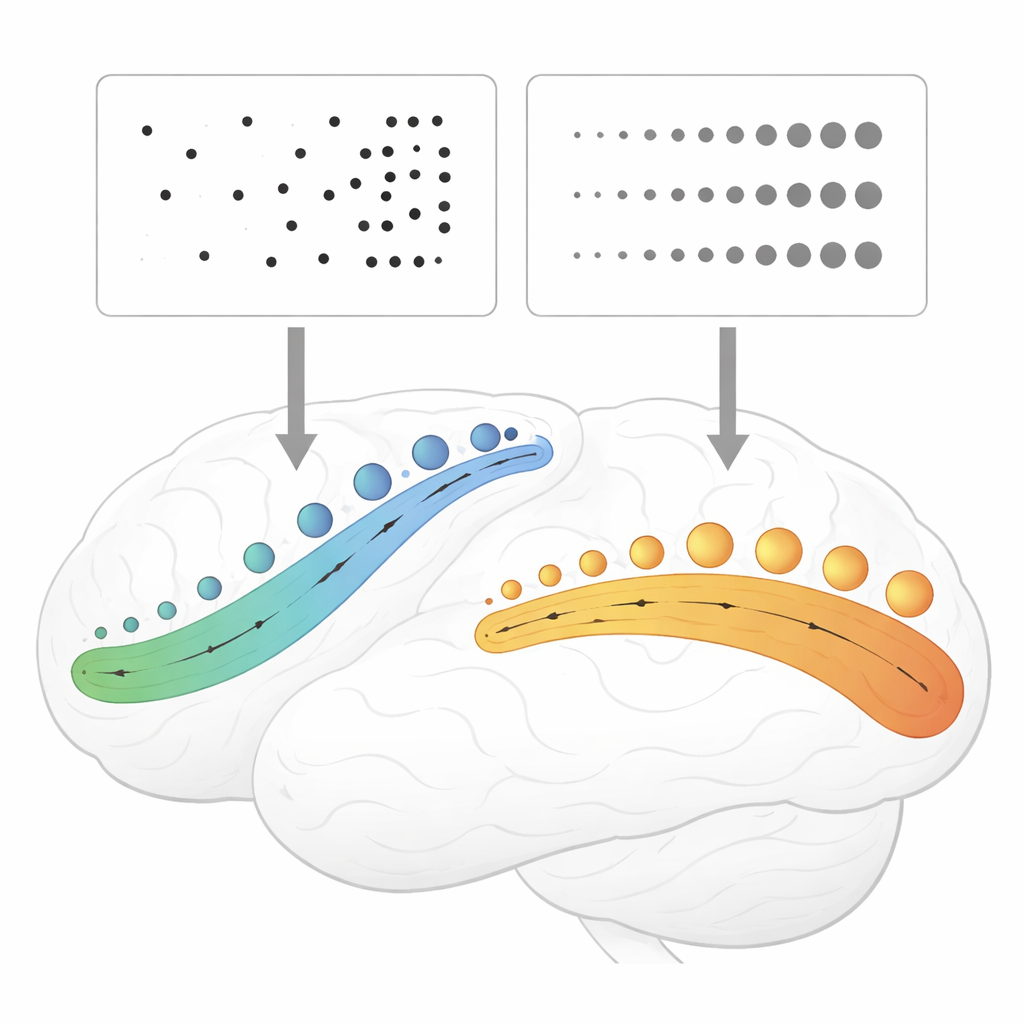
Why Some Quantities Are Sharper Than Others
The differences between visual and auditory maps may reflect how easily we can grasp number in each sense. Small numbers of dots can be recognized nearly at a glance, a process called “subitizing,” whereas it is much harder to do the same for short sound sequences. Visual maps were larger, showed stronger signal changes, and had narrower tuning, consistent with a sharper, more precise representation. Auditory maps were smaller, with weaker and broader responses, perhaps because sounds unfold over time, can be masked by background scanner noise, and must be briefly held in memory. Across both senses, the left hemisphere tended to devote more space to quantity with somewhat sharper tuning than the right, extending earlier findings about visual number maps to hearing.
What This Means for Our Sense of Number
Overall, this work shows that the human brain uses a common population‑based code to represent “how many” across sight and sound, but implements this code in separate, modality‑specific maps rather than in a single, fully shared hub. Each map is organized so that nearby brain tissue represents nearby quantities, with smaller numbers occupying more space and being encoded more precisely than larger ones. For a layperson, the takeaway is that our effortless sense of number is supported by finely structured, sensory‑specific layouts in the brain that follow the same underlying rules. These findings set the stage for future research on how these maps develop in children, how they differ between individuals, and how the brain might combine visual and auditory quantity information in everyday life.
Citation: Jeong, G., Soch, J., Trampel, R. et al. Population coding for visual and auditory quantity in human numerotopic maps. Commun Biol 9, 383 (2026). https://doi.org/10.1038/s42003-026-09752-2
Keywords: numerosity, multisensory perception, brain mapping, population coding, numerical cognition