Clear Sky Science · en
Simulated microgravity alters sperm navigation, fertilization and embryo development in mammals
Why Space Babies Are Harder Than They Look
As plans for Moon bases and trips to Mars move from science fiction to concrete timelines, a simple question becomes urgent: can mammals, including humans, actually conceive and develop healthy offspring away from Earth’s gravity? This study explores what happens to sperm and early embryos when they experience microgravity-like conditions, offering early clues about whether long-term life in space could ever support thriving families and food animals.
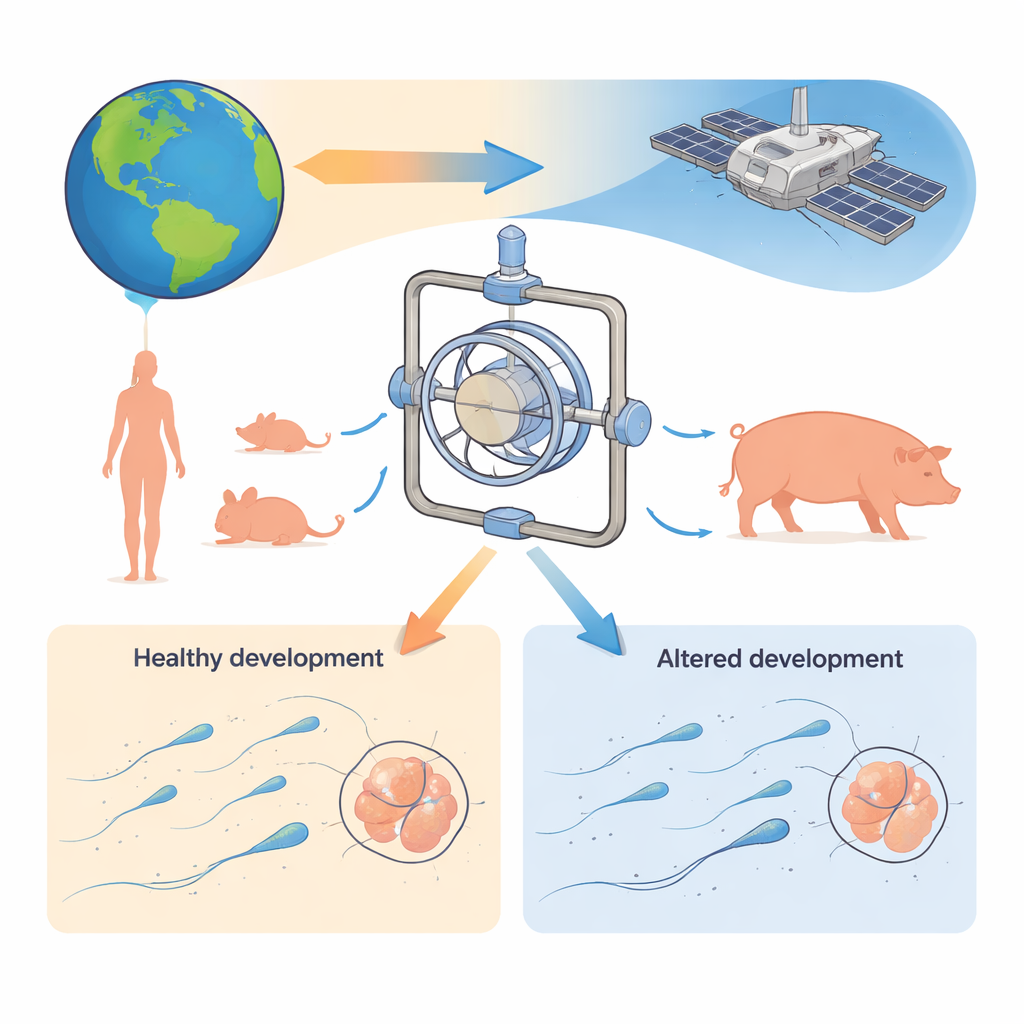
Testing Reproduction Without Earth’s Pull
The researchers focused on the very first steps of life: how sperm swim to an egg, how fertilization happens, and how the resulting embryo develops over the first few days. Because sending large numbers of samples into orbit is impractical, they used a dual-axis rotating device called a 3D clinostat to simulate microgravity on Earth by constantly changing the direction of the gravity pull. They combined this with micro-sized channels and culture systems that closely mimic current human fertility clinics and the female reproductive tract. Crucially, they worked with three mammalian species—human, mouse, and pig—to see which effects might be broadly shared and which might be species-specific.
When Sperm Lose Their Sense of Direction
Human sperm exposed to simulated microgravity could still move and beat their tails normally, but they were significantly worse at finding their way through narrow channels designed to imitate the path through the female body. In other words, their “compass” failed even though their “engines” were fine. Adding a high dose of the natural hormone progesterone—normally released around the egg—partly rescued this lost navigational ability, suggesting that chemical cues can help compensate when gravity-based guidance disappears. Intriguingly, the sperm that did make it through under microgravity were better at binding to a natural sugar coating related to egg quality, hinting that these conditions may weed out weaker sperm and favor hardier ones.
Mouse and Pig Embryos Under Strain
In mice, sperm also struggled to navigate under microgravity, and fewer eggs were fertilized after a short exposure. Yet the embryos that formed were not obviously behind schedule and, in some cases, had more cells in the inner group destined to become the fetus (the epiblast), a sign often linked to strong developmental potential. However, when sperm, eggs, and the earliest embryo were kept in simulated microgravity for a full day, the story changed. Fertilization rates caught up, but embryo development slowed and final embryos contained fewer cells overall, suggesting that prolonged early exposure can quietly erode quality even when fertilization succeeds. In pigs, which are closer to humans in many reproductive aspects, microgravity again reduced fertilization and also cut the number of embryos that reached advanced stages. For those that did, the inner cluster of fetal-forming cells was larger, while the outer layer that will form the placenta was relatively smaller, indicating a shifted balance in cell types.
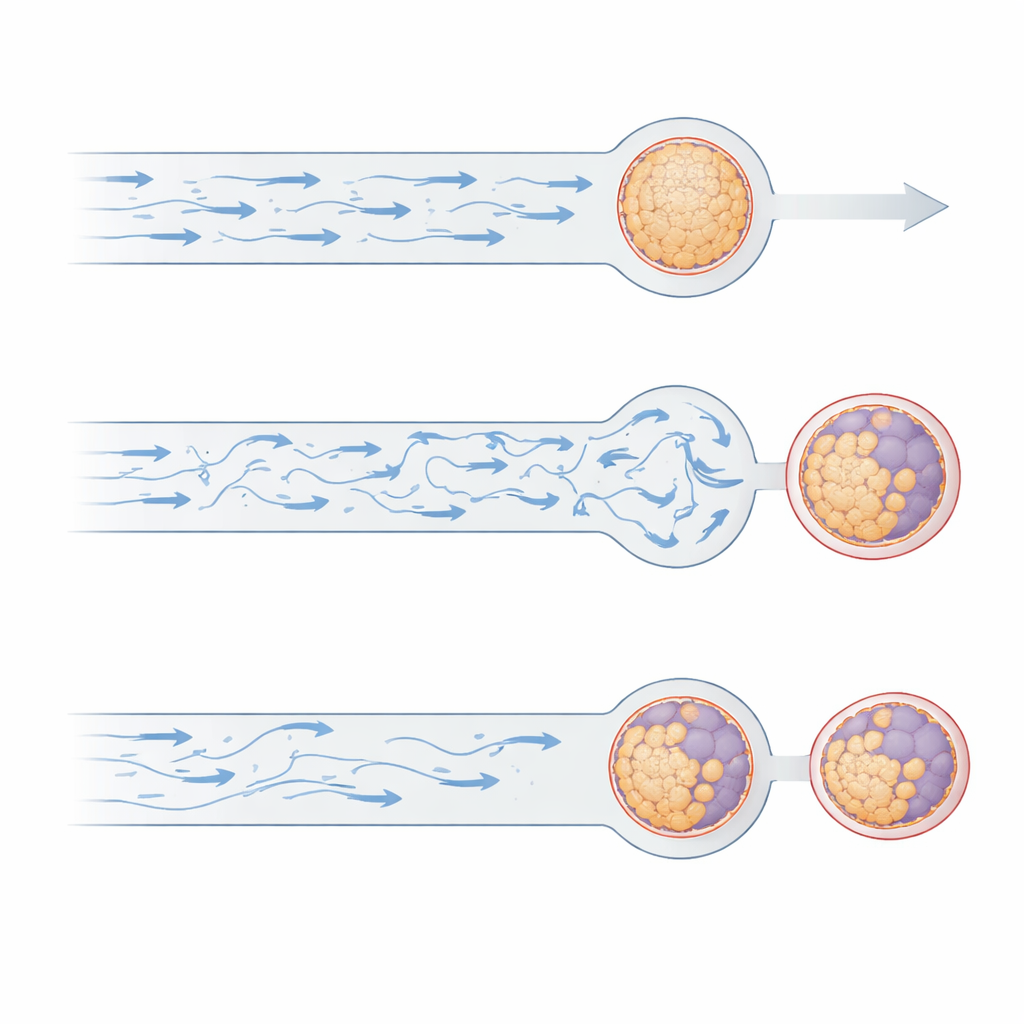
Resilient Beginnings, Hidden Vulnerabilities
Taken together, the experiments paint a nuanced picture. Mammalian sperm and embryos are surprisingly resilient: fertilization and early development can still occur under conditions mimicking weightlessness. At the same time, gravity clearly matters. It helps sperm stay oriented, likely through subtle mechanical sensing, and its absence can reduce fertilization efficiency and subtly reshape how early embryos allocate their cells. Short bursts of microgravity may act like a filter that favors the most robust sperm, while longer exposure during the first day after fertilization can quietly chip away at embryo quality. For future spacefarers and for livestock that might one day accompany them, these findings underscore that successful reproduction beyond Earth will probably demand carefully engineered environments—especially during the delicate hours around conception and the first cell divisions.
Citation: Lyons, H.E., Nikitaras, V., Arman, B.M. et al. Simulated microgravity alters sperm navigation, fertilization and embryo development in mammals. Commun Biol 9, 401 (2026). https://doi.org/10.1038/s42003-026-09734-4
Keywords: space reproduction, microgravity, sperm navigation, early embryo development, human spaceflight