Clear Sky Science · en
Dendritic heterosynaptic plasticity arises from calcium-based input learning
How Neighboring Synapses “Talk” to Each Other
Learning and memory rely on tiny connections between nerve cells called synapses. For decades, scientists have mostly treated these sites as independent switches that strengthen or weaken on their own. This paper shows that synapses along the same branch of a neuron can influence each other through the spread of calcium ions, revealing a hidden layer of communication that helps the brain learn complex patterns without needing full-blown nerve cell spikes.

Signals on a Branch, Not Just at a Point
Traditional models of brain function often treat neurons as simple points that add up incoming signals. Real neurons, however, have branching extensions called dendrites covered with tiny protrusions known as spines, where most excitatory synapses live. When a spine is directly activated, its synapse changes strength; this is called homosynaptic plasticity. Yet experiments have repeatedly hinted that nearby, unstimulated spines can also change, a phenomenon called heterosynaptic plasticity. Until now, it has been unclear how these neighboring synapses influence one another or why different experiments sometimes appeared to contradict each other.
Calcium as a Neighborhood Messenger
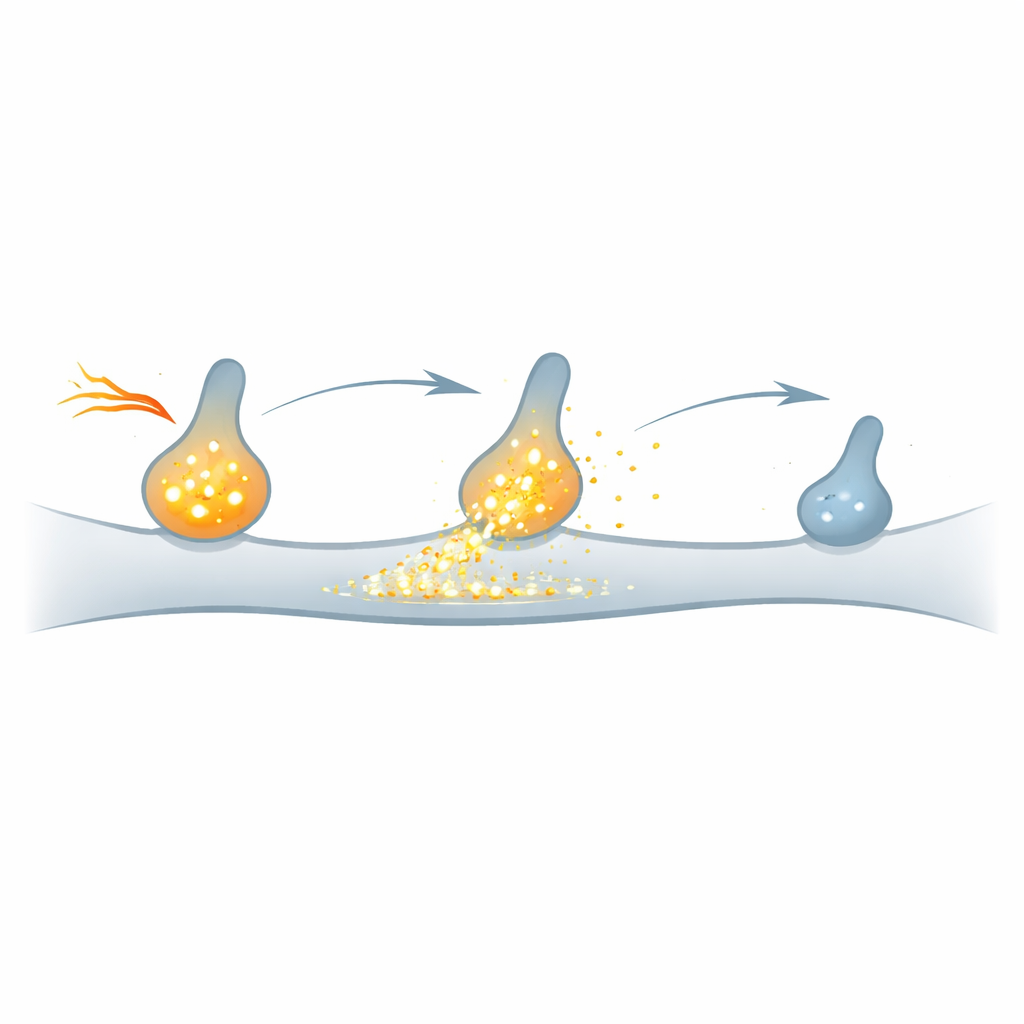
A leading idea in neuroscience holds that the size and direction of synaptic change depend on how much calcium flows into a spine: high levels strengthen a synapse, moderate levels weaken it, and low levels leave it unchanged. The authors extend this idea from single spines to small neighborhoods of spines along a dendrite. They build a mathematical model of how calcium diffuses within a dendritic branch and into and out of spines, and how this diffusion shapes changes in synaptic strength. In their model, a strong input at one spine creates a surge of calcium that not only affects that spine, but also seeps through the dendritic shaft to its neighbors, nudging them toward strengthening or weakening depending on how much calcium they receive and when.
Competition, Cooperation, and Timing
Using computer simulations of just two spines connected by a short stretch of dendrite, the researchers show that a single, brief input can strengthen the stimulated synapse while slightly weakening its neighbor, a form of synaptic competition. When they increase the input frequency, calcium builds up and spreads more strongly, so both the stimulated and adjacent unstimulated spines can strengthen together, displaying cooperation. The precise timing between inputs to two nearby spines turns out to be crucial: by varying delays on the order of milliseconds, the model produces rich “windows” of time in which different combinations of strengthening and weakening emerge, all without requiring any outgoing spike from the neuron itself.
From Single Branches to Real Experiments
The team then scales up the model to a longer dendritic segment carrying many spines, some stimulated and some left silent, mimicking three different experimental studies that used distinct stimulation frequencies. By tuning only the calcium diffusion properties, the model reproduces the diverse patterns seen in these experiments: in some cases only stimulated synapses weaken, in others near neighbors weaken while far ones stay unchanged, and in yet others both stimulated and close neighbors grow while distant ones shrink. Crucially, the best match to the data occurs when calcium is allowed to diffuse with a realistic speed, supporting the idea that calcium spread is a key physical mechanism behind heterosynaptic plasticity.
Learning the Order of Events
Finally, the authors connect their dendritic model to a simplified cell body, or soma, and test whether this local calcium-based learning can teach the neuron to recognize the order in which inputs arrive along the branch. After training with repeated “inward” or “outward” sequences—signals arriving from one end of the branch to the other—the cell learns to respond most strongly to the trained sequence. This shows that purely local, subthreshold calcium signaling within a dendrite can endow a neuron with a kind of sequence memory, without needing global feedback from full action potentials.
What This Means for Our Understanding of Learning
In everyday language, this work suggests that synapses are not isolated volume knobs but parts of a small neighborhood that listens to shared chemical whispers. A strong input at one location can quietly reshape its surroundings by sending out diffusing calcium signals, creating patterns of competition and cooperation that help stabilize networks and encode the timing and order of events. By explaining a range of puzzling experimental findings with a unified calcium-based mechanism, the study points to dendritic branches as powerful local learning units and hints that future artificial intelligence systems might benefit from similar neighborhood-style learning rules.
Citation: Shafiee, S., Schmitt, S. & Tetzlaff, C. Dendritic heterosynaptic plasticity arises from calcium-based input learning. Commun Biol 9, 382 (2026). https://doi.org/10.1038/s42003-026-09719-3
Keywords: synaptic plasticity, dendrites, calcium signaling, heterosynaptic learning, neuronal computation