Clear Sky Science · en
Hippocampal and cortical oscillatory dynamics support semantic processing and performance
How the Brain Finds Meaning in Everyday Words
Every time you read a sign, listen to a friend, or scroll through headlines, your brain rapidly decides which words belong together and which do not. This ability to link words to ideas—knowing that “dog” and “leash” go together, but “dog” and “lamp” probably do not—is called semantic processing. The study summarized here asks a deceptively simple question: what does the living human brain actually do, millisecond by millisecond, when it makes these meaning judgments, and how do different brain rhythms help us succeed at this task?
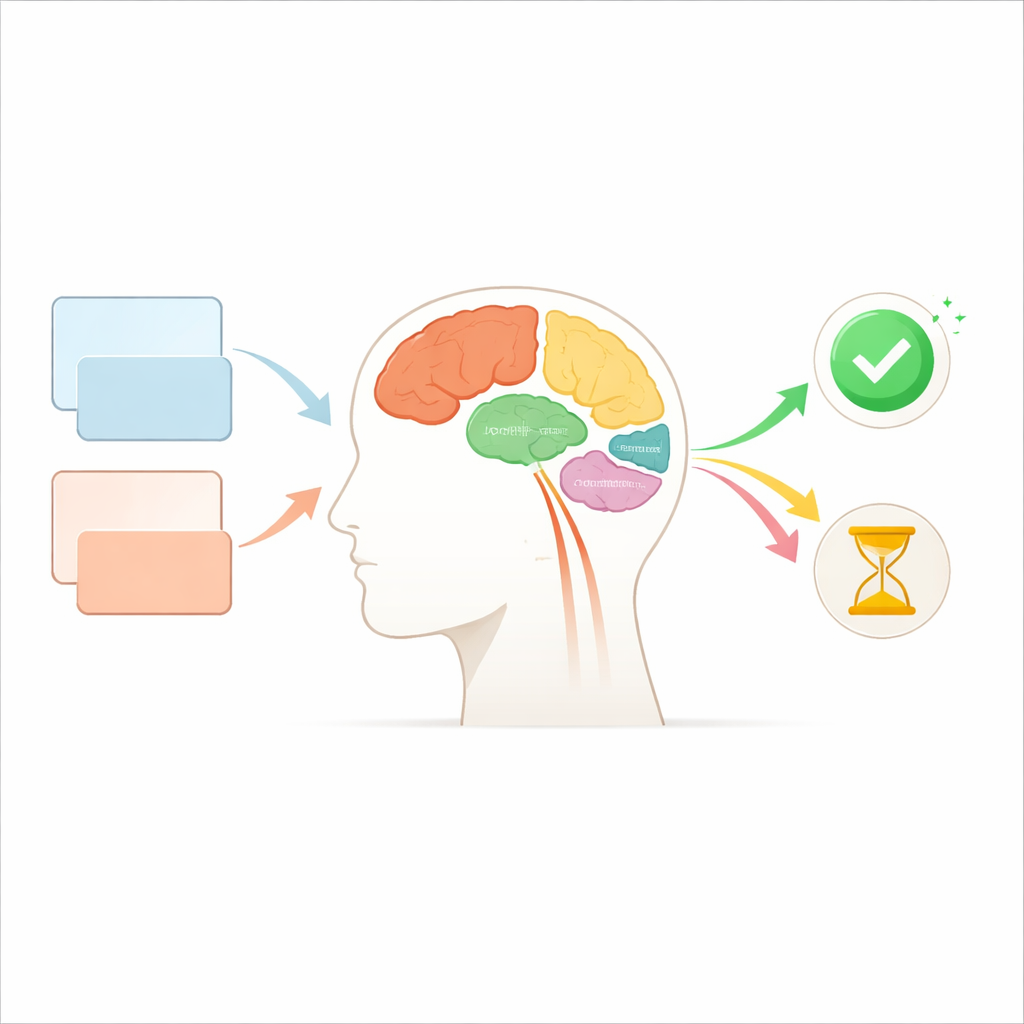
A Simple Game of Word Connections
To probe these questions, researchers recruited 150 healthy adults spanning a wide range of ages. While sitting in a highly shielded room, participants played a word game inside a magnetoencephalography (MEG) scanner, a device that measures tiny magnetic fields from brain activity with millisecond precision. On each trial, they saw a first word (the “prime”), followed shortly by a second word (the “target”). They had to quickly decide whether the two words were related in meaning, unrelated, or whether the second item was a made-up letter string. Only the related and unrelated pairs were analyzed, allowing the scientists to focus on how the brain distinguishes meaningful connections from mismatches.
Fast Responses, Slow Responses, and Hidden Effort
Behaviorally, the task looked straightforward. Participants were very accurate overall, correctly responding on about 96 percent of trials. Still, their reaction times told an important story: people responded more quickly when the two words were related than when they were unrelated. In other words, when the brain could easily link the second word to the first, decisions came faster; when no obvious link existed, decisions slowed down. This pattern suggests that unrelated pairs demand a deeper mental search through stored knowledge, even though people can still answer correctly most of the time.
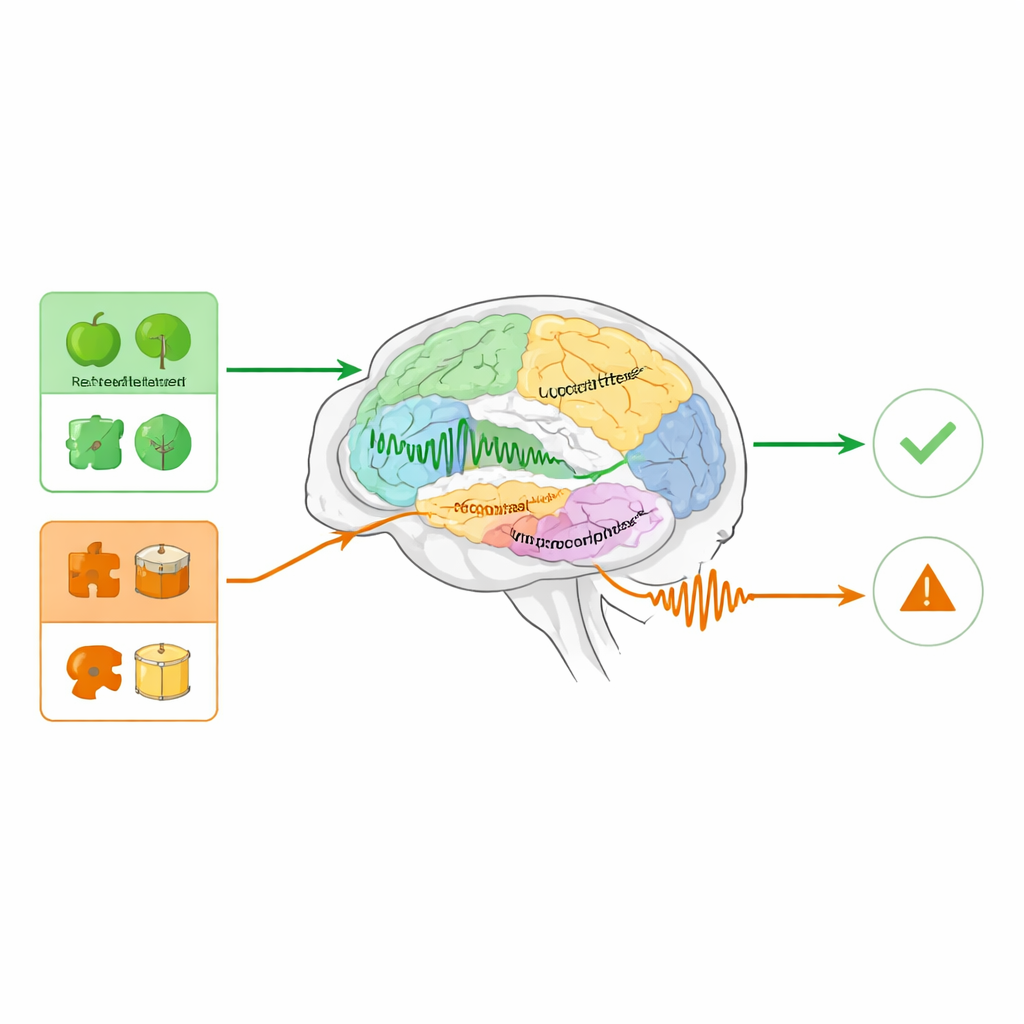
Brain Rhythms that Track Meaning
The MEG recordings revealed that this extra mental effort shows up as distinct patterns of brain rhythms. The researchers focused on two frequency bands: slower “theta” rhythms (about 3–6 cycles per second) and faster “gamma” rhythms (about 60–80 cycles per second). Shortly after the second word appeared, theta power ramped up and stayed elevated for roughly half a second, while gamma activity showed a briefer burst. Using advanced imaging analyses, the team pinpointed where in the brain these rhythms were strongest. Theta activity surged in several regions known to support control over meaning, including both sides of the inferior frontal cortex, parietal areas, and notably the hippocampus, a deep structure best known for memory and navigation. Gamma activity, in contrast, was strongest in frontal regions, visual areas at the back of the brain, the cerebellum, and again the hippocampus.
When Words Match, When They Clash
A striking pattern emerged when the team compared related versus unrelated word pairs. Theta rhythms were consistently stronger when the words were unrelated, especially in the inferior frontal regions, parietal cortices, and hippocampi. This fits the idea that theta supports laborious “semantic search” and error checking: when no easy match is found, the brain ramps up these slower oscillations to sift through possibilities and resolve conflict. In one patch of the left parietal lobe, however, the opposite was true—theta was stronger for related pairs, hinting at a role in focused attention when the link is clear. Gamma rhythms showed the reverse overall pattern. In frontal areas, visual cortex, the left hippocampus, and the cerebellum, gamma power was greater for related word pairs than for unrelated ones. This suggests that faster gamma oscillations may help cement and integrate meanings when the brain’s predictions are confirmed and the connection between words falls smoothly into place.
Why These Findings Matter for Everyday Understanding
Taken together, the study paints a dynamic picture of how the brain negotiates meaning. When words easily fit together, fast gamma rhythms help bind their meanings across a network including frontal, parietal, visual, and memory-related regions, supporting quick and efficient decisions. When words clash, slower theta rhythms surge, particularly in frontal and hippocampal areas, signaling more demanding search and control processes as the brain checks and reshapes its expectations. For a lay reader, the key message is that understanding language is not a single, static operation, but a finely timed dance of brain rhythms in multiple regions. These coordinated oscillations allow us to rapidly sift through our mental dictionary, spot mismatches, and settle on the right interpretation, moment by moment, in everyday conversation and reading.
Citation: Hall, M.C., Rempe, M.P., John, J.A. et al. Hippocampal and cortical oscillatory dynamics support semantic processing and performance. Commun Biol 9, 444 (2026). https://doi.org/10.1038/s42003-026-09718-4
Keywords: language meaning, brain rhythms, semantic memory, word recognition, hippocampus