Clear Sky Science · en
Deep-time preservation of amino acids in mammalian fossil tooth enamel
Ancient Clues Hidden in Our Teeth
When animals die, most of their soft tissues vanish, erasing direct chemical traces of how they lived and ate. Yet their teeth, especially the hard outer enamel, can survive for tens of millions of years. This study explores whether tiny building blocks of proteins—amino acids—can persist inside that enamel over deep time, and what that means for reconstructing ancient ecosystems long after DNA has decayed.
The Hardest Tissue as a Time Capsule
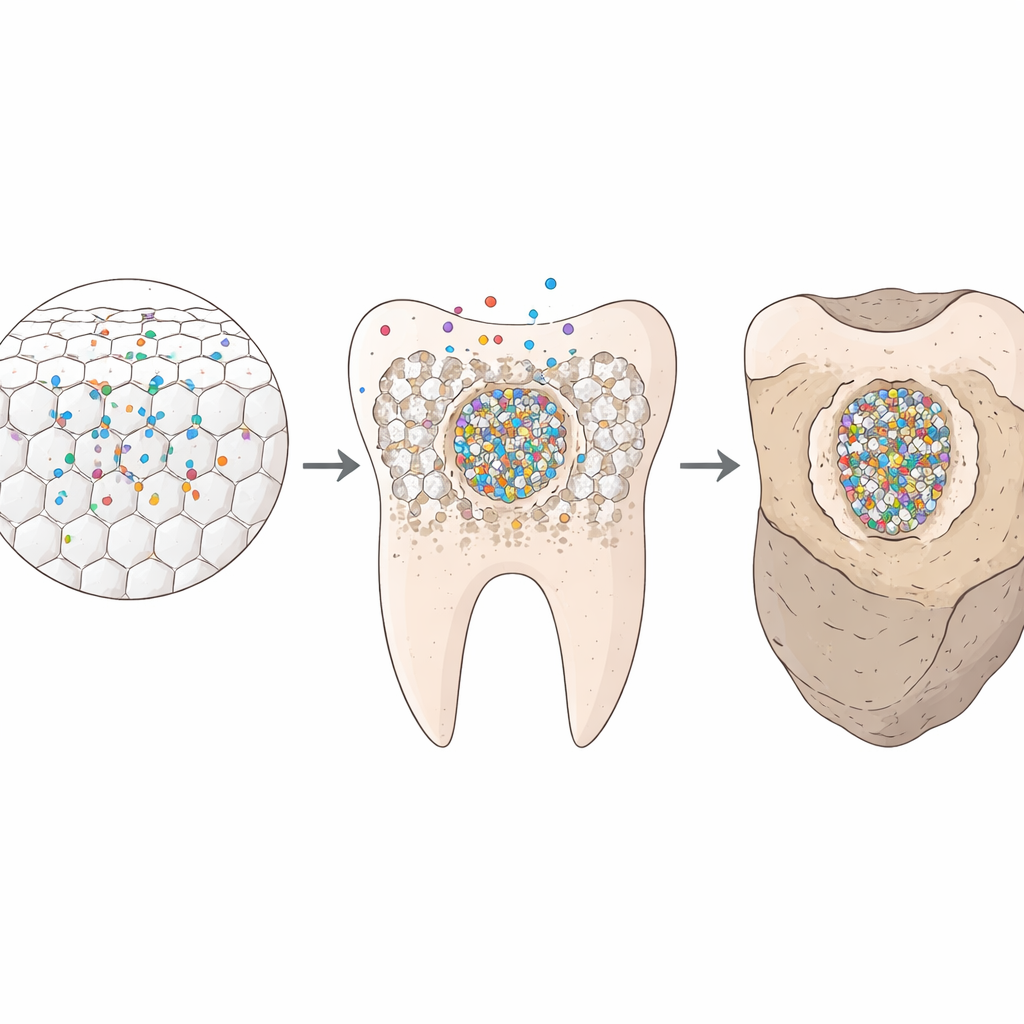
Tooth enamel is the hardest tissue in the mammal body. It is made almost entirely of tightly packed mineral crystals, with only about one percent organic material, mostly proteins or their breakdown products. As enamel forms, some of this organic matter becomes locked inside the mineral crystals rather than remaining in the tiny spaces between them. Those trapped molecules are effectively sealed off from water, microbes, and other agents of decay, turning enamel into a miniature vault that may protect organic traces for millions of years—much better than more porous tissues like bone or dentine.
Testing Teeth Through Millions of Years
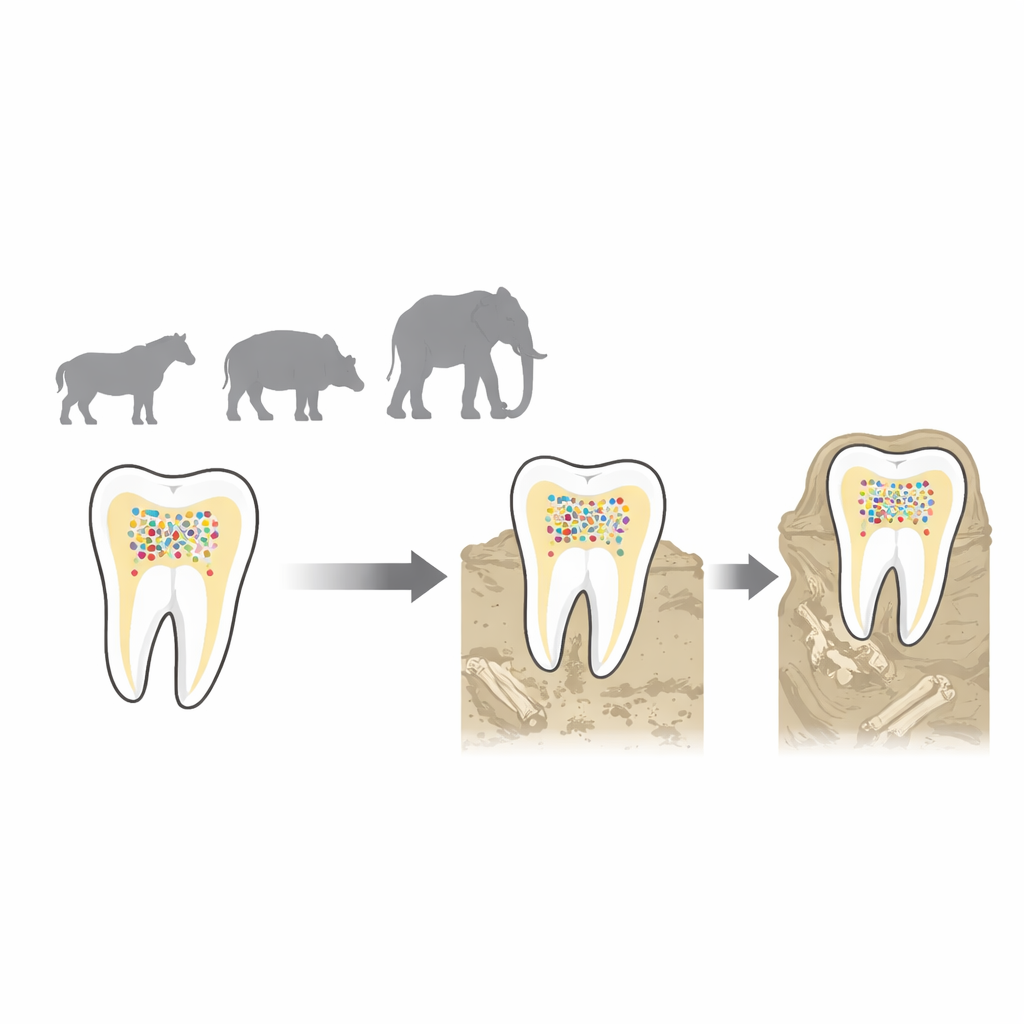
The researchers examined enamel from 72 fossil teeth and 12 modern teeth of large herbivorous mammals—horses and their relatives (Equidae), rhinos (Rhinocerotidae), and elephants and their kin (Proboscidea). The fossils came from many kinds of burial environments across central Europe, from river and lake deposits to peat bogs, coal seams, and karst fissures, spanning ages from about forty thousand years to forty‑eight million years. For each specimen they measured the total amount and relative mix of eleven amino acids, capturing both free amino acids and those still bound in protein fragments.
A Fast Early Loss, Then Long-Term Stability
The team found a clear pattern in how amino acids change with time. Compared with modern teeth, fossil enamel loses a large portion of its amino acids very early in the fossilization process—within roughly the first hundred thousand years. During that interval, total amino acid levels can drop by more than half and in some cases by over ninety percent. After this rapid early decline, however, the remaining amino acids stabilize and persist with surprisingly little further loss, even in teeth dating back to the Eocene, about forty‑eight million years ago. This suggests that a more exposed organic fraction is stripped away first, while a better-protected fraction remains securely locked inside the enamel crystals.
Age Matters More Than Burial Conditions
Because the fossils came from many types of sediments, the authors could ask whether burial setting or animal type strongly affects amino acid survival. Overall, age turned out to be more important than taphonomic context: older samples consistently held fewer amino acids than younger ones, almost regardless of where they had been buried. The relative proportions of different amino acids were also remarkably similar between modern and fossil enamel, once a few particularly unstable types were set aside. Advanced statistical models showed that changes in certain amino acids—such as phenylalanine, tyrosine, arginine, and isoleucine—track geological age well enough to offer a potential chemical clock, while others contribute little to age prediction.
Different Teeth, Subtle Differences
Although the general pattern was shared, the three mammal groups were not identical. Modern elephant relatives showed higher variability in amino acid content than horses and rhinos, probably reflecting their more complex tooth structure and enamel formation. Fossil horse teeth, especially those from the famous Messel site in Germany, often showed amino acid levels close to modern horses, hinting at especially favorable combinations of enamel structure and burial conditions. Even so, the study found no major influence of evolutionary relationships on the basic amino acid makeup of enamel: different large mammals start from broadly similar compositions before diagenesis takes its toll.
What These Tiny Molecules Can Tell Us
For a non-specialist, the key message is that mammal tooth enamel acts as a robust natural safe for tiny organic clues, preserving amino acids for at least forty‑eight million years. Much of the fragile material is lost early, but the fraction entombed within the mineral crystals can endure through vast spans of time. This opens the door to using enamel not just to study ancient proteins themselves, but also to measure the isotopic signatures of individual amino acids, which can reveal diet, food chains, and ecological change long after DNA is gone. In practical terms, the method requires only a milligram of enamel, making it a gentle way to screen valuable fossils before more targeted protein or isotope analyses, and turning fossil teeth into powerful recorders of ancient life and environments.
Citation: Gatti, L., Lugli, F., Rubach, F. et al. Deep-time preservation of amino acids in mammalian fossil tooth enamel. Commun Biol 9, 381 (2026). https://doi.org/10.1038/s42003-026-09716-6
Keywords: tooth enamel, amino acids, fossil preservation, paleoproteomics, ancient ecology