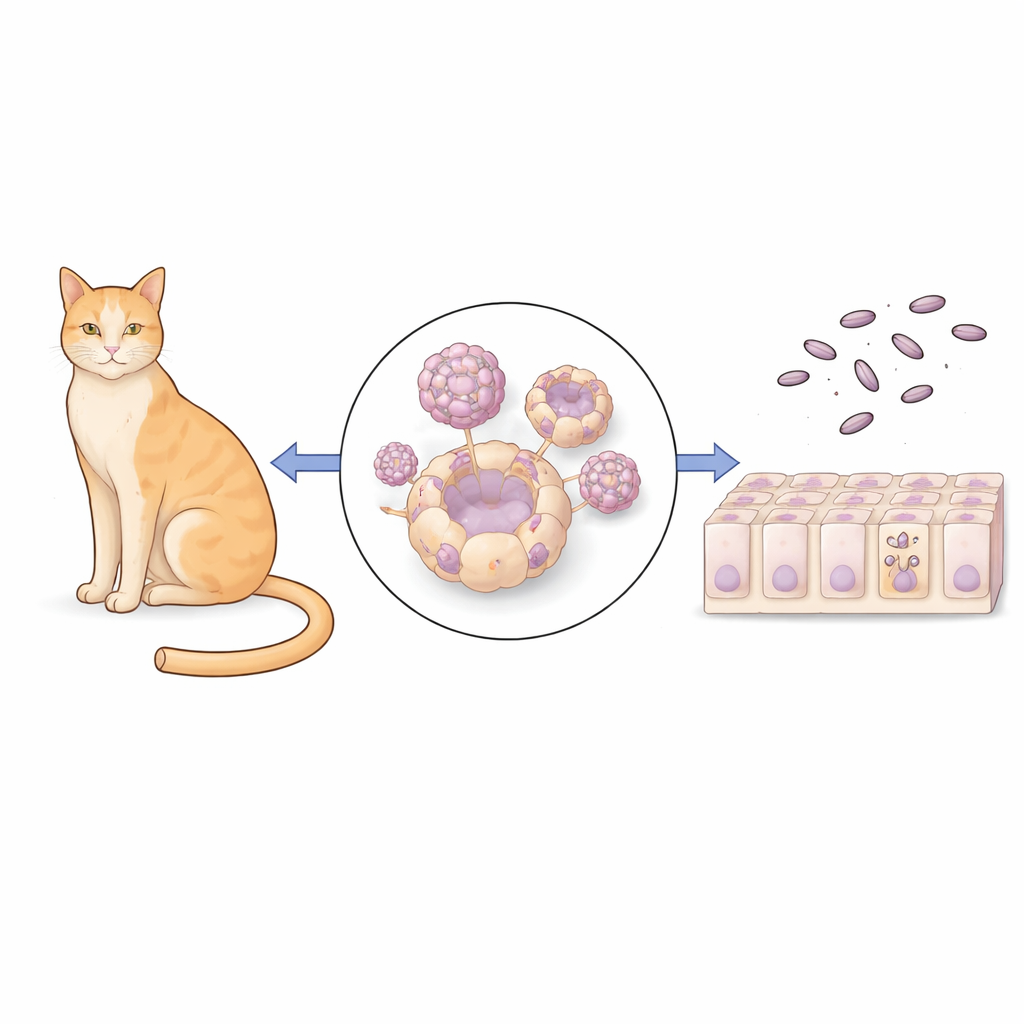
Toxoplasma gondii is a microscopic parasite that can infect almost all warm-blooded animals, including people. Most human infections are mild or unnoticed, but the parasite can seriously harm unborn babies and people with weak immune systems. A crucial part of its life cycle, however, unfolds only in the intestines of cats, where it reproduces sexually and forms hardy oocysts that spread in the environment. Because experimenting on live cats is difficult and ethically sensitive, scientists are searching for lab-grown cat gut tissues that can stand in for the real thing. This study reports a major step in that direction and tests whether such tissues can coax Toxoplasma toward its sexual stages.
Building a cat gut in a dish
The researchers began by isolating stem cells from the small intestines of domestic cats and growing them into three-dimensional “organoids” — tiny hollow spheres that mimic key features of the gut lining. Earlier attempts from other groups often stalled after a short time, but here the team optimized temperature and growth signals to keep these mini-intestines alive and dividing for many months without the help of supporting “feeder” cells. The organoids could also be switched from a growth mode to a more mature, gut-like state, showing structural changes and shifts in gene activity that match different intestinal cell types.
Flattening organoids into infection-ready layers Figure 1.
To better control infection experiments, the scientists turned the 3D organoids into flat sheets called organoid-derived monolayers. They broke organoids into single cells, spread them on porous membranes, and let them re-form a continuous layer resembling intestinal lining. Microscopy and electrical measurements showed that these layers were tightly sealed, polarized (with a clear top and bottom), and structurally similar to cat duodenum tissue. Although the range of cell types was limited and skewed toward less mature cells, the setup provided a reproducible, feline-specific surface that parasites could reach from the “gut” side, much like in a real intestine.
Challenging the parasite to change
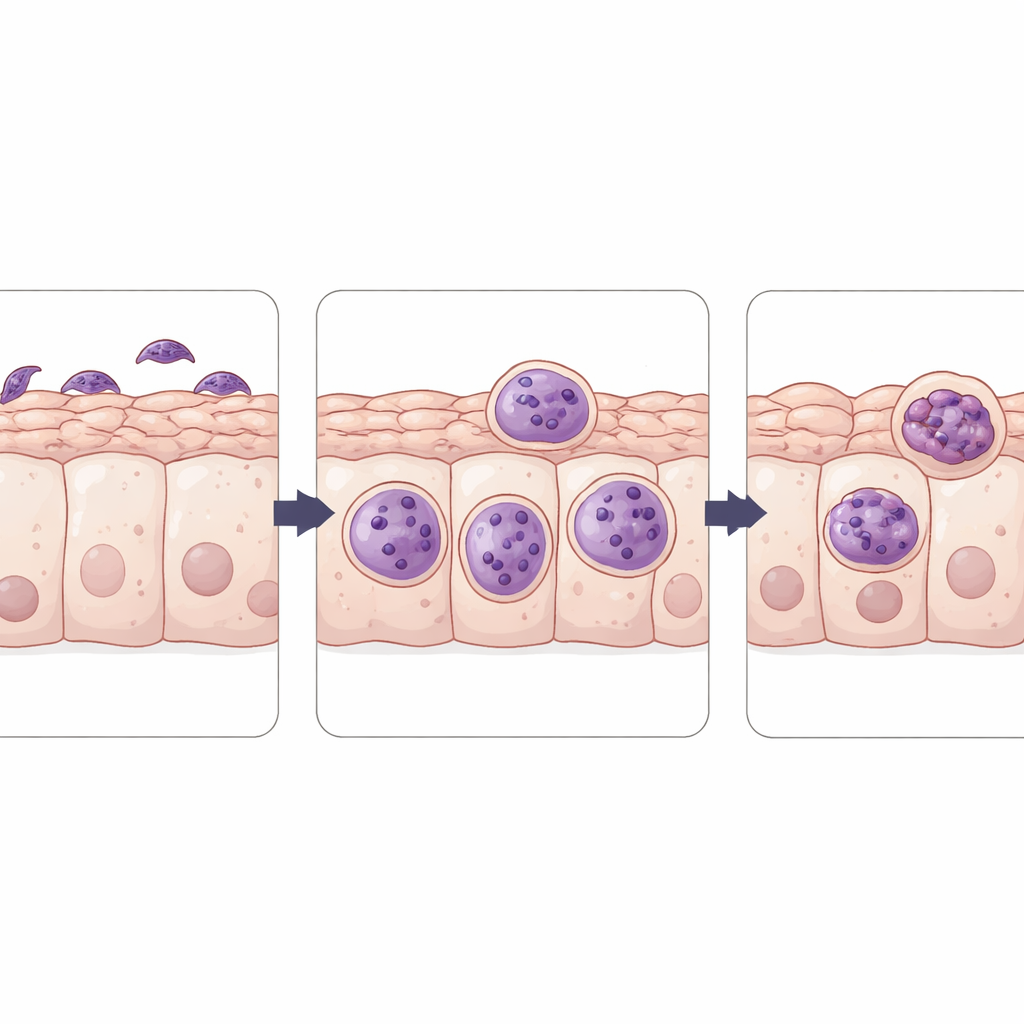
With this platform in place, the team asked whether the feline environment could push Toxoplasma toward its elusive sexual stages. They used a genetically engineered parasite line in which two regulatory proteins, AP2XII-1 and AP2XI-2, can be chemically removed. Earlier work in human cells had shown that taking away both factors nudges the parasite from its common fast-growing form (tachyzoites) toward a pre-sexual stage called merozoites, but the transition stopped there. In the cat cell layers, removing these regulators again drove parasites toward merozoite-like forms. Ultrastructural imaging revealed dividing forms consistent with this shift, while standard tachyzoites diminished.
Hints of sex, but no full transformation Figure 2.
To look for true sexual development, the researchers tracked parasite genes that normally turn on in male and female sex cells and in oocyst walls. In the feline monolayers, these sexual-stage markers rose more clearly after AP2 removal than they did in conventional human cell cultures, suggesting that cat cells provide some of the right cues. However, detailed electron microscopy failed to reveal fully formed gametes or oocysts, even when the culture medium was spiked with nutrients and fatty acids thought to be important in cats, such as linoleic acid, taurine, and a cat-specific compound called felinine. A second, naturally oocyst-competent parasite strain also remained stuck in its asexual state, underscoring that the right signal mix is still missing.
What this means for understanding and controlling toxoplasmosis
This work delivers a robust, long-lived model of cat small intestine in the lab and shows that it can partially push Toxoplasma down the path toward sexual reproduction. For non-specialists, the key message is that scientists now have a powerful cat-specific tissue system that avoids using live animals yet captures many features of the natural host. While the parasites in this study did not complete their sexual cycle, the rise in sex-related gene activity is a strong hint that the model is close to the real thing. By systematically tweaking nutrients, oxygen levels, and parasite genetics in these organoids, future research can pinpoint the exact “cat-only” cues that allow Toxoplasma to make infectious oocysts. That knowledge could eventually inform new strategies to block environmental contamination and reduce human and animal exposure worldwide.
Citation: Warschkau, D., Hoffmann, T., Laue, M. et al. Long-term feeder cell-free cat intestinal organoid cultures to study Toxoplasma gondii’s sexual development.
Commun Biol9, 379 (2026). https://doi.org/10.1038/s42003-026-09710-y
Keywords: Toxoplasma gondii, intestinal organoids, cat gut model, parasite life cycle, host–parasite interaction