Clear Sky Science · en
Med13 is involved in the radial migration and contralateral projection of cortical neurons via PlxnA4
How a Single Gene Helps Build the Thinking Brain
Brains do not simply grow; they are built, cell by cell, in precisely organized layers and wiring patterns. This study explores how one gene, called Med13, helps young brain cells in the cortex move to the right place and connect across the two hemispheres. Because subtle mistakes in this construction process are increasingly linked to conditions like autism and intellectual disability, understanding Med13 offers a window into how early brain development can go awry.
Building the Brain’s Six-Layer Neighborhood
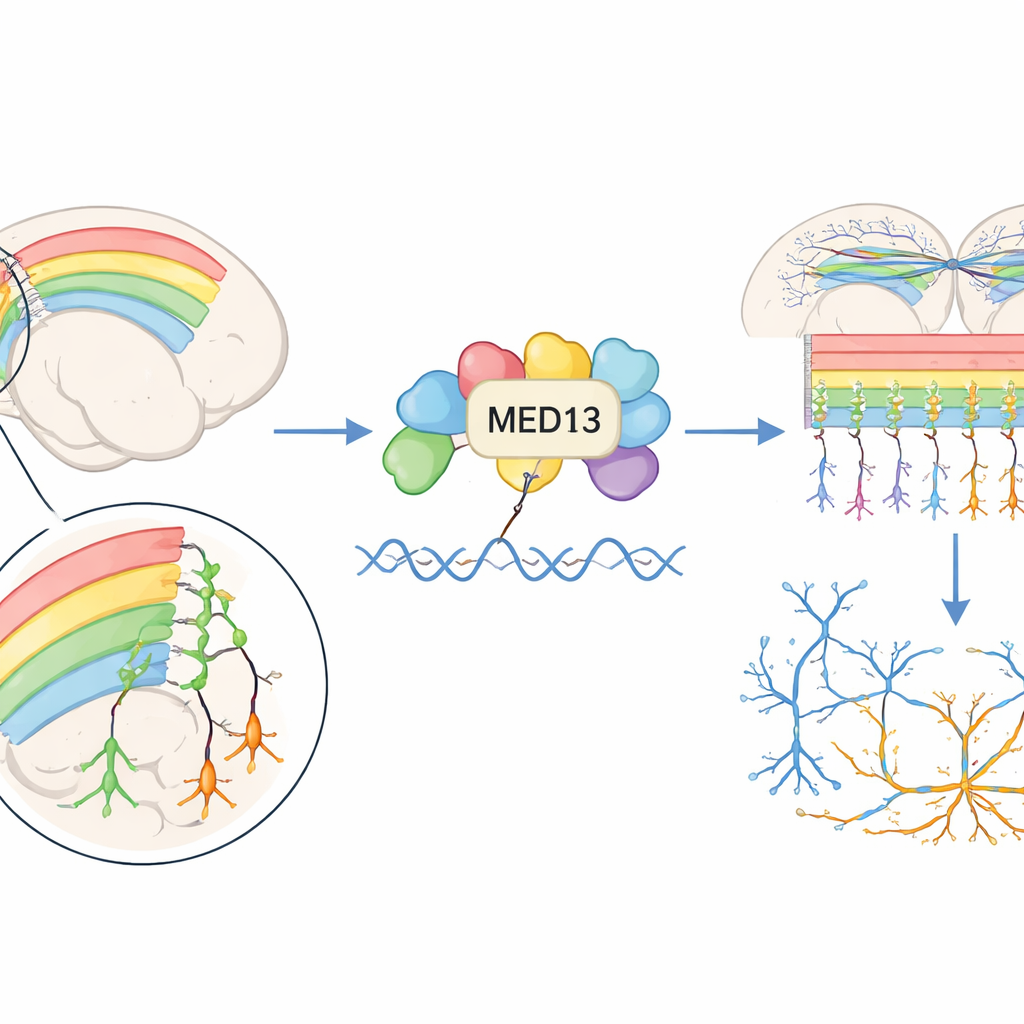
The cerebral cortex, the wrinkled outer sheet of the brain, is organized into six layers of nerve cells that form during embryonic life. Newborn neurons are born deep inside the brain and then migrate outward in an “inside-out” sequence to form these layers. The authors first asked where and when Med13 is active during this process. In mouse embryos, Med13 was found at high levels in regions where neural stem cells divide and where young neurons are on the move, especially around a key mid-gestation time point when many cortical neurons are generated. Med13 was present both in dividing precursor cells and in maturing neurons, suggesting it participates broadly in shaping the cortex.
When Neurons Lose Their Way
To test what Med13 actually does, the team selectively reduced its levels in developing mouse cortical neurons using a technique that introduces designer DNA into the fetal brain. Labeled neurons lacking Med13 were tracked over time. Compared with control neurons, many Med13-deficient cells stalled partway along their journey instead of reaching the upper cortical layers where they belong. Even days after birth, a large fraction remained scattered in the deeper tissue or in the white matter below the cortex. These misplaced cells also showed signs of incomplete maturation: some failed to express markers typical of fully developed upper-layer neurons, yet they did not turn into other cell types such as lower-layer neurons or glia. This indicates that Med13 is needed not only for neurons to reach their destination but also to fully adopt their correct identity.
Broken Bridges Between Brain Hemispheres
Proper brain function depends on long-range connections between neurons, including fibers that cross the midline through the corpus callosum to link the left and right hemispheres. The researchers found that neurons lacking Med13 had much poorer projections to the opposite side of the brain. Fewer axons penetrated the appropriate region of the contralateral cortex, and this deficit became more pronounced as development proceeded. At the same time, the dendritic “trees” that receive incoming signals were noticeably simpler: Med13-deficient neurons had fewer branches and shorter total dendritic length. Together, these changes point to Med13 as a key organizer of both where neurons end up and how richly they connect with their partners.
From Gene Control to Guidance Signals
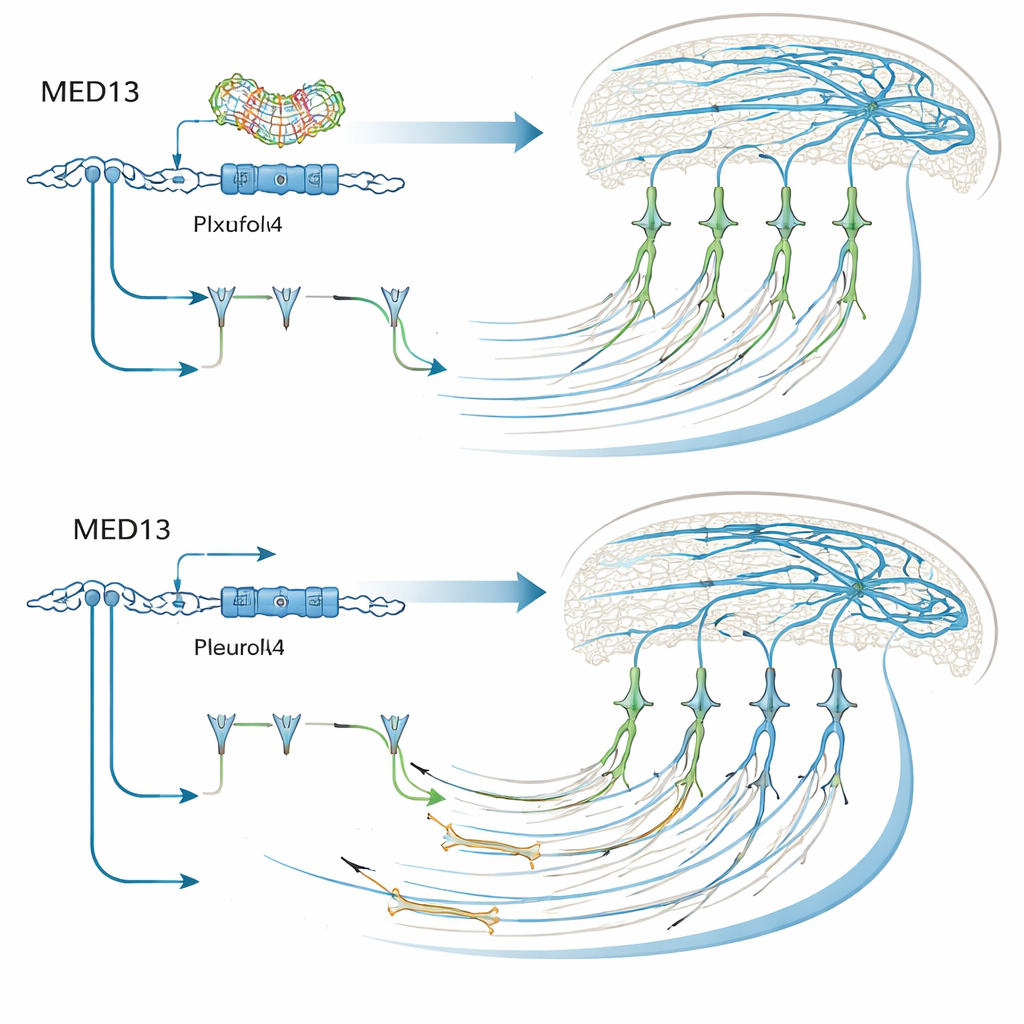
Med13 is part of a large protein assembly that controls how many other genes are switched on or off, so the authors next looked for downstream players that might explain its effects. Using human nerve-like cells engineered to lack MED13, they cataloged thousands of proteins and found over a hundred whose levels changed. Many were involved in neuron shape, movement, and cortical development, and several overlapped with known risk genes for neurodevelopmental disorders. One stood out: PlxnA4, a receptor that helps neurons respond to guidance cues as they migrate and extend axons. PlxnA4 levels dropped when MED13 was missing, both in cultured human cells and in mouse neurons with reduced Med13. Remarkably, forcing neurons to make extra PlxnA4 could largely rescue their migration problems and restore much of their callosal projection, even when Med13 was silenced. However, this did not fix the simplified dendritic architecture, implying that Med13 also acts through other targets to shape neuronal branches.
What This Means for Brain Disorders
Together, these findings show that Med13 helps young cortical neurons move into the correct layers and form long-distance connections, in part by sustaining the guidance molecule PlxnA4. When Med13 is disrupted, neurons misplace themselves, under-develop their branches, and send fewer fibers across the corpus callosum—all changes that echo brain alterations seen in some neurodevelopmental disorders. While many additional genes and signals are clearly involved, positioning Med13 as a central regulator offers a clearer picture of how early genetic changes can ripple outward to alter brain wiring and, ultimately, behavior.
Citation: Li, ZX., Tu, SX., Li, YW. et al. Med13 is involved in the radial migration and contralateral projection of cortical neurons via PlxnA4. Commun Biol 9, 394 (2026). https://doi.org/10.1038/s42003-026-09704-w
Keywords: cortical development, neuronal migration, corpus callosum, neurodevelopmental disorders, gene regulation