Clear Sky Science · en
Interactions between sensory-biased and supramodal working memory networks in the human cerebral cortex
How the Brain Keeps Track of What Just Happened
Remembering whether a picture or sound matches one you encountered a moment ago is something your brain does constantly, from following a conversation to driving in traffic. This short-term storage system, called working memory, relies on many brain areas talking to each other. This paper asks a deceptively simple question with big implications: do the brain’s visual and auditory memory systems plug into a shared “control hub” in the same way, and what happens when they do not?
Different Paths for Seeing and Hearing
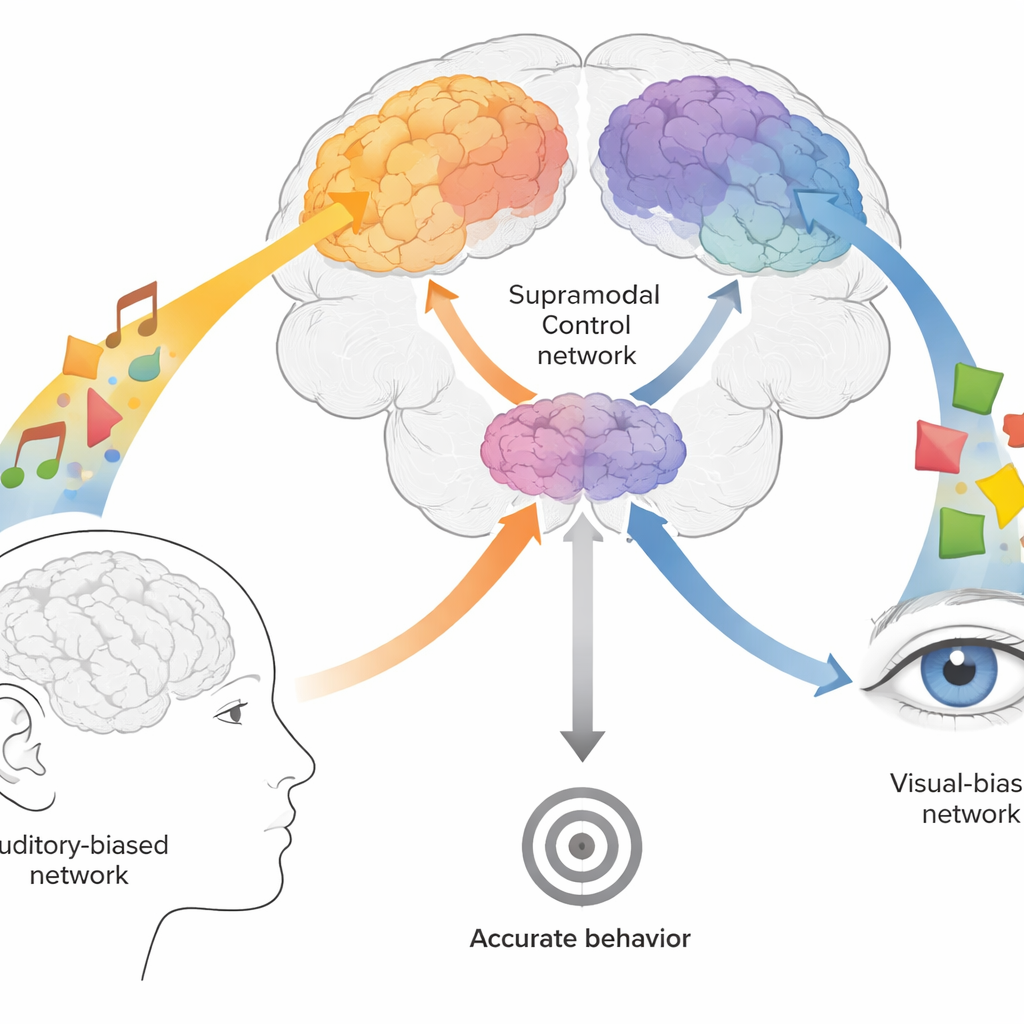
Working memory comes in flavors: holding an image in mind is not exactly the same as holding a sound in mind. Earlier research showed that visual information mainly relies on regions at the back of the brain, while sounds lean more on areas along the sides. Both, however, also tap into regions in the frontal lobes that seem to handle general problem-solving regardless of whether the input is seen or heard. The authors call these content-specific visual and auditory networks, plus a “supramodal” (cross-sense) network that works across types of information. They wanted to know how these networks are wired together when the brain is idle and how that wiring shifts when people actively use visual or auditory working memory.
Measuring Brain Conversations at Rest and During Tasks
Twenty-one adults lay in an MRI scanner while their brain activity was recorded. In one task, they watched patterned images and decided whether each one matched the image shown two steps earlier. In another, they listened to “warbling” tones and judged whether each tone’s rhythm matched the one from two steps before. The difficulty of both tasks was carefully tuned for each person so that seeing and hearing were equally challenging. The same volunteers were also scanned at rest, simply staring at a dot. By tracking how activity in dozens of precisely mapped brain spots rose and fell together, the researchers could infer how strongly each network was connected to the others.
Vision’s Head Start at Rest
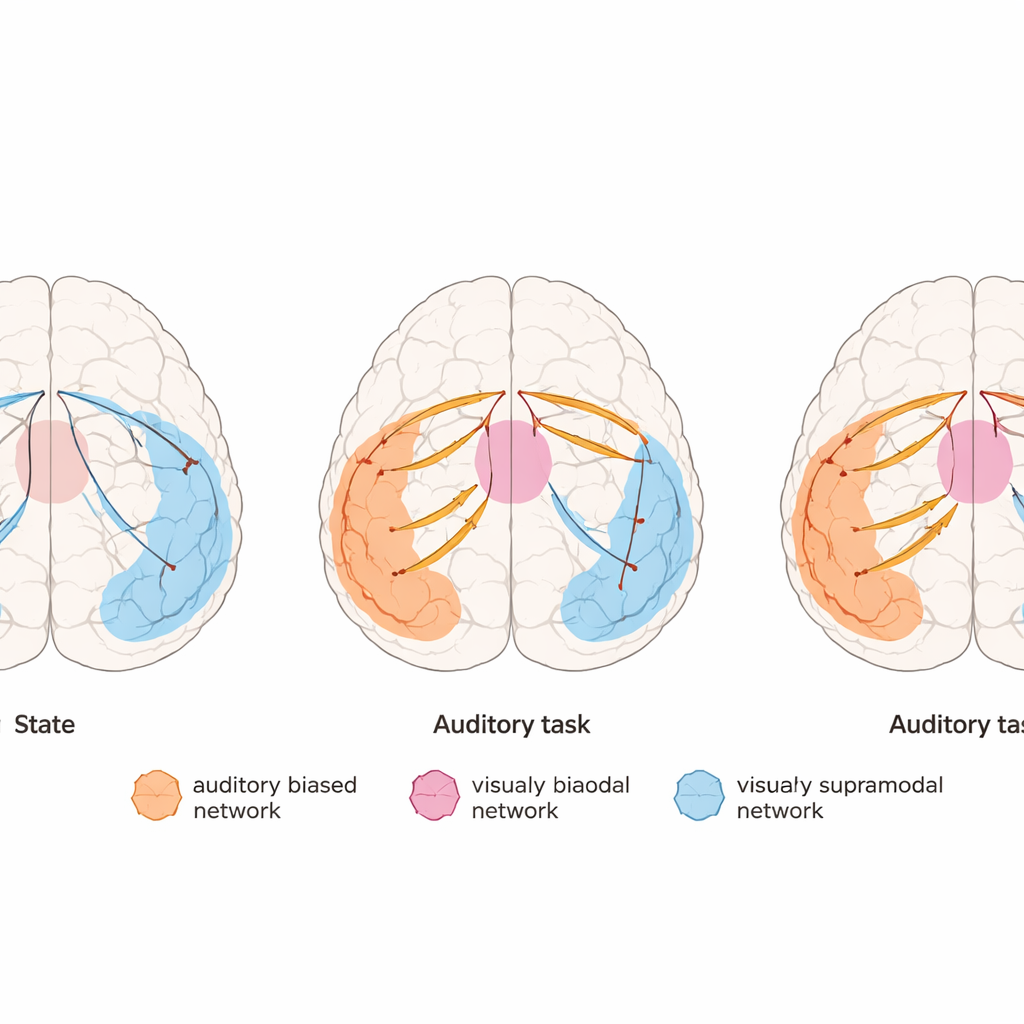
When participants were resting, the brain’s wiring was far from random. Regions tuned to visual information formed one tightly linked stream, auditory regions formed another, and the supramodal control areas sat between them. Crucially, the supramodal network was more strongly linked to the visual stream than to the auditory one. Visual-related frontal regions showed robust “resting friendships” with the supramodal hub, whereas auditory regions were more separate. Direct links between visual and auditory streams were relatively weak, even though these areas were interwoven physically in the frontal lobes. This pattern suggests that, by default, the brain’s general-purpose control system is more closely allied with vision than with hearing.
Hearing Catches Up by Rewiring on the Fly
During the memory tasks, the picture changed. Performing the auditory working memory task triggered widespread reshaping of connections. Links from auditory regions to both the supramodal network and visually biased frontal regions grew stronger. At the same time, some connections from back-of-the-brain visual regions to supramodal and frontal visual areas weakened, reducing competition from vision. Connections within the auditory network itself also tightened. In contrast, the visual memory task produced relatively modest changes, and the already strong bond between visual and supramodal regions barely shifted. Across individuals, those whose auditory networks showed larger task-driven boosts in connectivity tended to hold sounds in mind more precisely. No such brain–behavior link emerged for the visual task.
Why This Asymmetry Matters
For a non-specialist, the key message is that the brain is not “fair” to all senses by default. Its control hubs seem to favor vision when we are at rest, which fits with everyday experiences where sight often dominates what we notice. Yet this study shows that the auditory system can compensate when needed by temporarily strengthening its lines of communication and dialing back visual influence. People who do this dynamic rewiring more effectively perform better on demanding listening memory tasks. In other words, strong hearing-based working memory is not just about how good your auditory areas are, but also about how flexibly the whole network can reconfigure to support them.
Citation: Possidente, T., Tripathi, V., McGuire, J.T. et al. Interactions between sensory-biased and supramodal working memory networks in the human cerebral cortex. Commun Biol 9, 389 (2026). https://doi.org/10.1038/s42003-026-09688-7
Keywords: working memory, functional connectivity, visual attention, auditory processing, brain networks