Clear Sky Science · en
Simple mechanistic traits outperform complex syndromes in predicting avian dispersal distances
Why bird movement matters to us
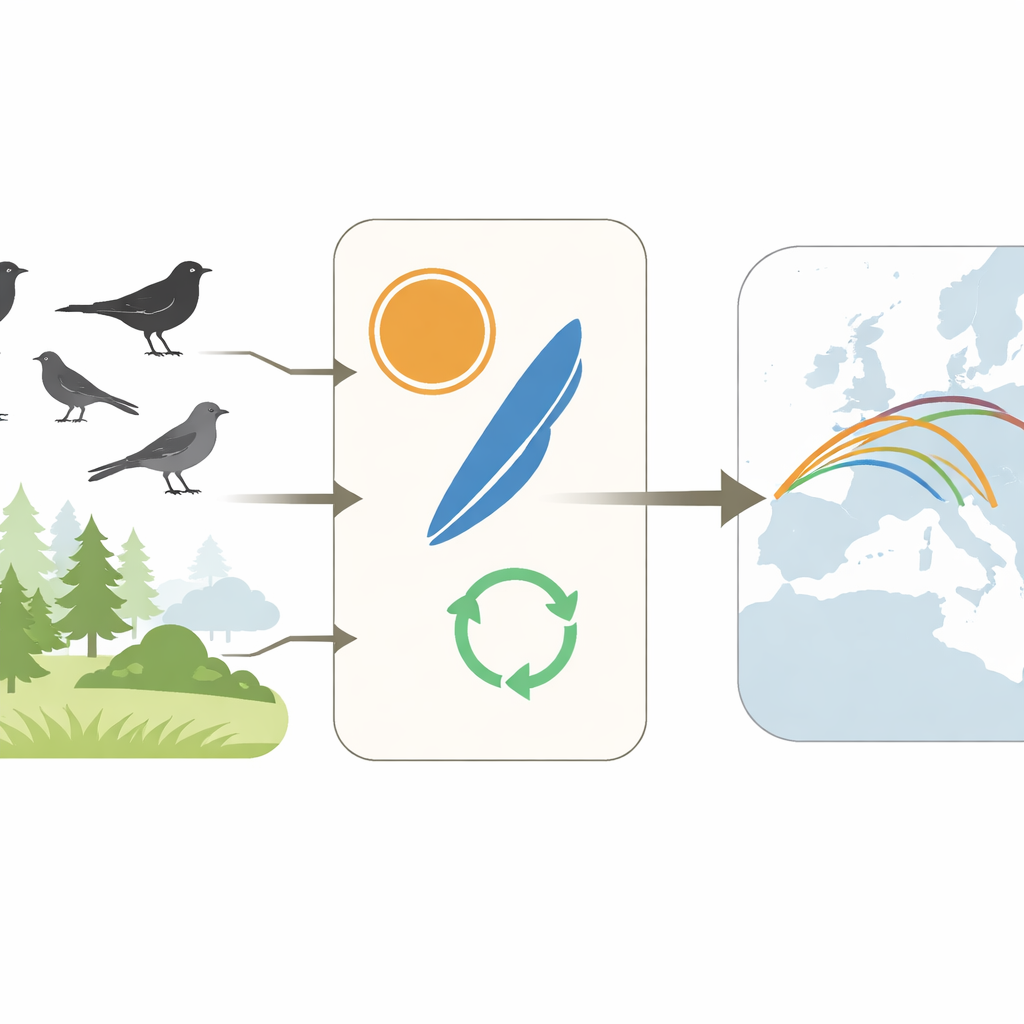
When birds move from one place to another to breed, they carry seeds, spread genes, and help species keep up with a warming and rapidly changing world. Knowing how far different birds tend to travel is vital for forecasting where they will live in the future and how well they can survive shrinking habitats and shifting climates. Yet measuring these journeys for every species is nearly impossible, so scientists urgently need shortcuts that can reliably predict how far birds go, even when no direct tracking data exist.
Simple clues from bird bodies and lifestyles
This study asked whether a handful of straightforward bird traits can reveal how far birds usually move between breeding sites, or whether researchers must rely on more complex “dispersal syndromes” that combine many traits at once. Using one of the largest ringing and recapture data sets for European birds, the authors worked with detailed “dispersal kernels,” which describe the full spread of movement distances for each species. They then compared these kernels with traits that are relatively easy to measure or find in existing databases, such as body mass, wing shape, typical habitat, diet, and whether a species matures and reproduces quickly or slowly over its lifetime.
What best explains typical and rare long journeys
The results revealed that different aspects of bird movement are governed by different trait combinations. For the median, or typical, dispersal distance, a small set of traits explained much of the variation among species. Larger birds tended to move farther between breeding sites, and species with faster life histories—those that mature early and reproduce more—also showed greater movement. Birds breeding at higher latitudes generally traveled shorter distances, perhaps reflecting the tight seasonal schedule in harsh northern environments. In contrast, rare long-distance movements, which can be crucial for colonizing new areas, were most strongly linked to how efficiently a bird flies, captured by a measure of wing shape called the Hand Wing Index, with diet playing a supporting role.
Life stages tell different movement stories
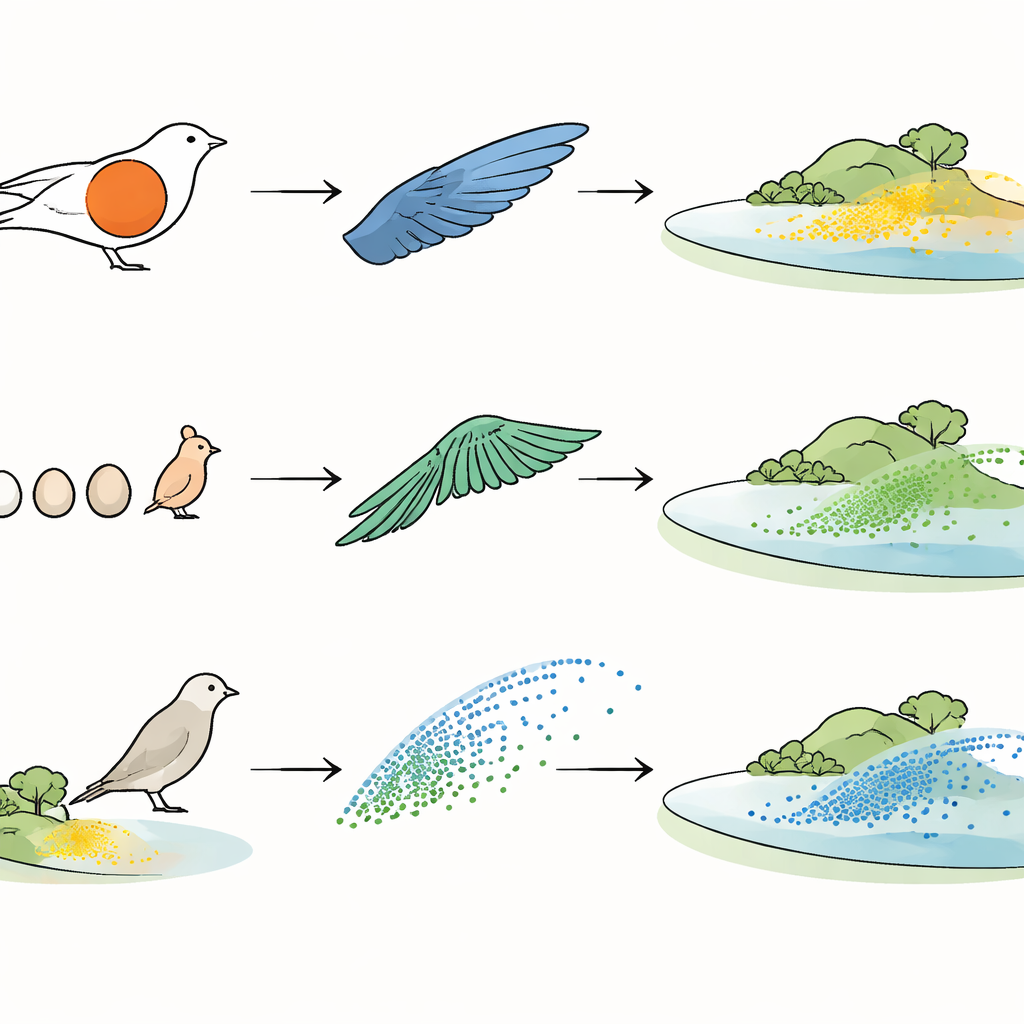
By separating movements of young birds leaving their birth sites from those of adults shifting between breeding attempts, the study uncovered further nuance. Body mass remained the single most powerful predictor for both natal and breeding dispersal: heavier species of chicks and adults alike tended to travel farther. However, diet mattered mainly for young birds, with carnivorous species, such as many birds of prey, showing especially high dispersal distances—likely reflecting strong territorial competition that pushes youngsters to move away. Adult birds, once settled in a good territory, appeared less influenced by diet and more inclined to stay put unless other pressures intervened.
Testing predictions across the bird family tree
To see how well trait-based models might work for species with no movement data, the authors tested their models’ predictive power by repeatedly hiding some species from the analysis and then trying to predict their dispersal distances. They compared simple one-trait models, multi-trait “syndrome” models, and models that relied only on relatedness along the bird family tree. Surprisingly, models using just one clear mechanistic trait—most notably body mass, followed by life-history pace and, to a lesser extent, wing shape—outperformed the more complex multi-trait syndromes. This pattern held both within individual bird orders and, though more weakly, across distantly related groups, suggesting that extra model complexity can actually hurt prediction when species differ widely.
What this means for birds in a changing world
For non-specialists, the key message is that simple, tangible features of birds—how big they are, how quickly they live their lives, and how their wings are shaped—go a long way toward predicting how far they can spread across the landscape. Intricate combinations of many traits help scientists describe the full complexity of movement, but they do not necessarily improve our ability to forecast where species will go next. This study shows that straightforward, mechanistic traits can serve as powerful tools for estimating bird movements when direct data are scarce, improving models that project how species will track shifting climates and habitats and helping conservation planners design networks of protected areas that birds can actually reach.
Citation: Fandos, G., Robinson, R.A. & Zurell, D. Simple mechanistic traits outperform complex syndromes in predicting avian dispersal distances. Commun Biol 9, 376 (2026). https://doi.org/10.1038/s42003-026-09676-x
Keywords: bird dispersal, body size, flight efficiency, life history, species movement