Clear Sky Science · en
Out of the tropics and adaptation in the Asian subtropics of Dendrobium section Dendrobium (Orchidaceae)
Orchids on the Move
Many of the world’s orchids began their story in warm, stable tropical forests. This study follows one such group, Asian Dendrobium orchids, to ask a simple but important question: what happens when tropical plants move into cooler, more seasonal subtropical regions? By combining genetics, climate data and plant measurements, the authors show how these showy epiphytes (plants that grow on trees) left the tropics multiple times, adapted their bodies to new conditions, and what this means for their future under climate change.
From Tropical Cradle to New Homes
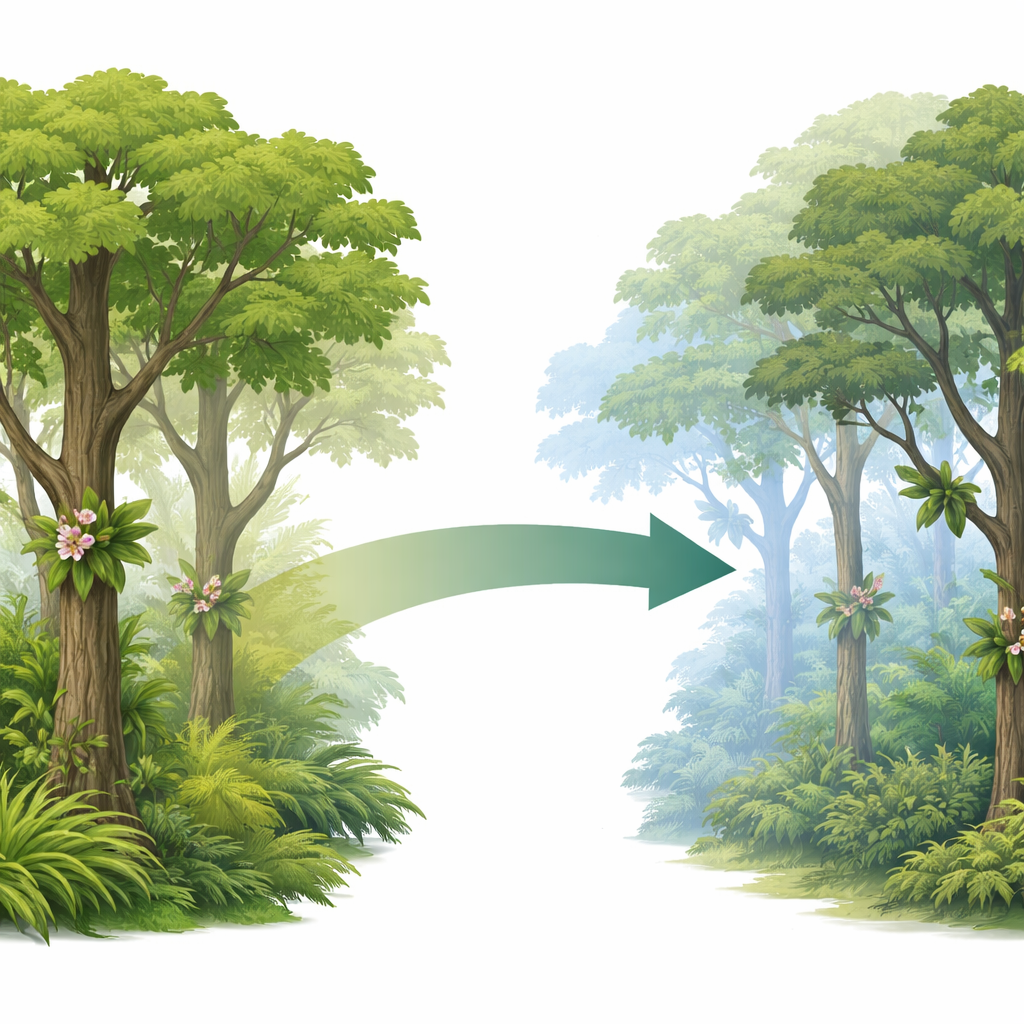
The researchers focused on Dendrobium section Dendrobium, a group of about 88 orchid species, many valued in traditional medicine and horticulture. Today these orchids are concentrated in the Asian tropics and nearby subtropics, especially from the eastern Himalayas across northern Indochina to southern China. Using complete chloroplast genomes and nuclear DNA, the team reconstructed a detailed family tree and dated key branching points. They found that this orchid group originated in the Asian tropics about 14–18 million years ago, then remained there for several million years before sending offshoots into the subtropics at least four times during the last 5 million years.
Changing Climate, Changing Diversity
Next the authors asked how orchid diversity changed through time. Statistical models applied to the dated family tree showed that overall, the rate at which new Dendrobium species formed has slowly declined since the middle Miocene, while extinction stayed low. This slowdown tracks a long-term cooling of global temperatures. In other words, the Asian tropics acted both as a “cradle,” where new species first arose, and a “museum,” where many lineages persisted for millions of years even as the climate cooled. Yet within this general slowdown, a striking contrast emerged: tropical lineages gradually diversified less, while subtropical lineages that recently left the tropics began diversifying faster.
Smaller Bodies for Harsher Seasons
Why would subtropical lineages diversify more quickly? The authors turned to plant form. They measured four simple traits—stem length and thickness, and leaf length and width—across dozens of species and mapped these traits onto the evolutionary tree. Ancestral reconstructions and statistical tests converged on the same pattern: species living in the subtropics consistently have shorter, thinner stems and smaller leaves than their tropical relatives. These changes evolved repeatedly and do not just reflect shared ancestry, suggesting that they arose as independent responses to similar environmental pressures.
Seasons as a Sculptor
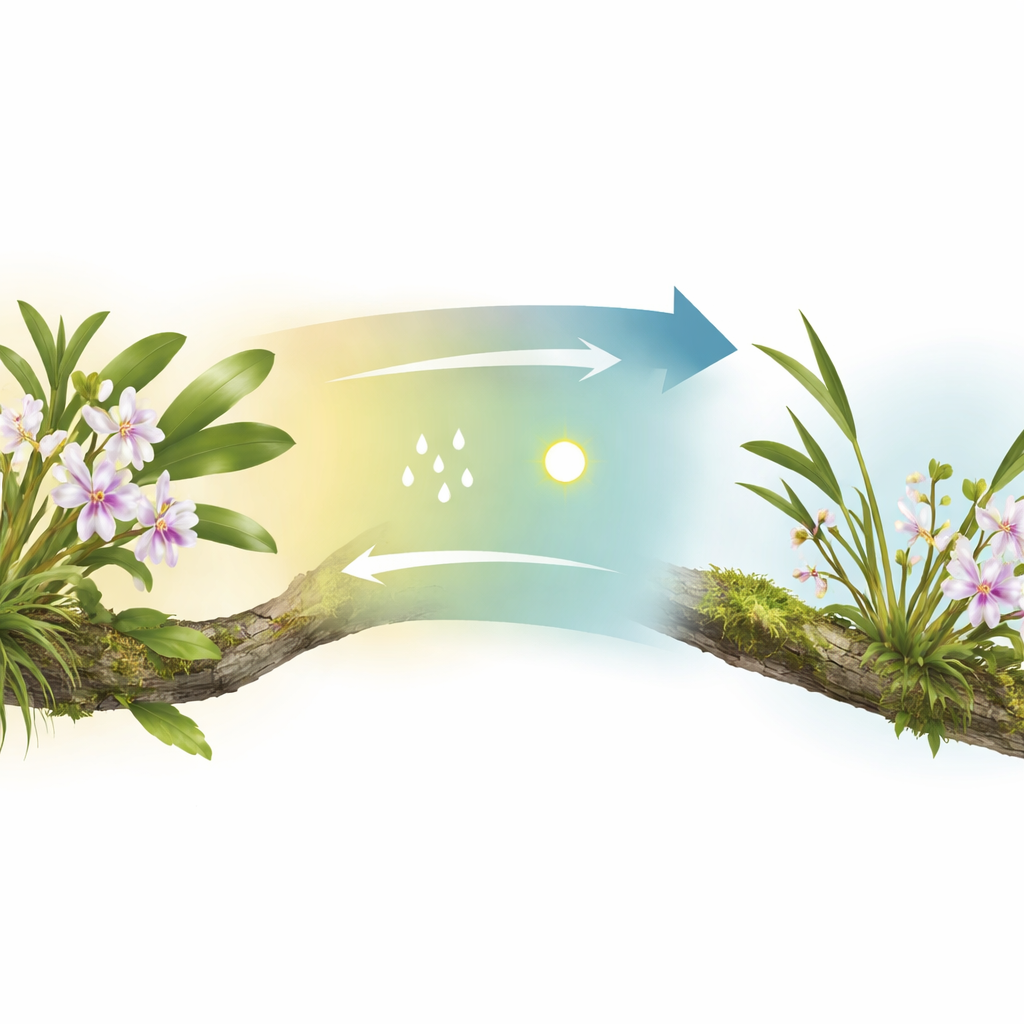
To pinpoint those pressures, the team overlaid plant traits with modern climate data on a 100 km grid across the region. They found that the single strongest predictor of stem and leaf size was temperature seasonality—how much temperatures swing over the year. Higher seasonality was linked to smaller stems and leaves, while high rainfall in the warmest part of the year tended to favor larger structures. Asian subtropical evergreen broad-leaved forests are defined by a monsoon climate with pronounced seasons, making them very different from the year-round warmth and moisture of tropical rainforests. In this setting, compact stems and leaves may help epiphytic orchids cope with periodic stress, such as cooler, drier winters, and these adaptive shifts appear to be tied to higher diversification in subtropical lineages.
Past Range Shifts and Future Risks
Finally, the authors used species distribution models to reconstruct where suitable habitats for these orchids likely existed in the past and how they may change by 2090 under a moderate climate scenario. Since the Pliocene, potential ranges for Dendrobium and for four dominant tree families of Asian subtropical evergreen forests have gradually contracted as precipitation declined. The northern limit of the orchids has closely tracked the belt of these evergreen forests in the past and is projected to remain within it in the future. Because all species in this group grow on trees—and many endangered species rely on particular host forests—the fate of the orchids is tightly bound to the health of subtropical evergreen broad-leaved forests.
What This Means for Orchids and Forests
In plain terms, this study shows how a tropical orchid lineage repeatedly ventured into cooler, more seasonal subtropical forests, shrank its stems and leaves to fit the new climate, and in doing so spun off new species more rapidly. The Asian tropics provided the original diversity and long-term refuge, but the subtropics offered fresh ecological opportunities that rewarded adaptable body plans. As climate change alters rainfall and temperature patterns, conserving the subtropical evergreen forests that host these orchids—and the trees they grow on—will be crucial for preserving both their evolutionary legacy and their medicinal and horticultural value.
Citation: Zhou, P., Lei, WS., Zhang, PY. et al. Out of the tropics and adaptation in the Asian subtropics of Dendrobium section Dendrobium (Orchidaceae). Commun Biol 9, 391 (2026). https://doi.org/10.1038/s42003-026-09670-3
Keywords: tropical orchids, subtropical forests, plant adaptation, climate history, biodiversity evolution